

In NSW, eligible households may receive an upfront discount when replacing an existing electric or gas water heater with an […]

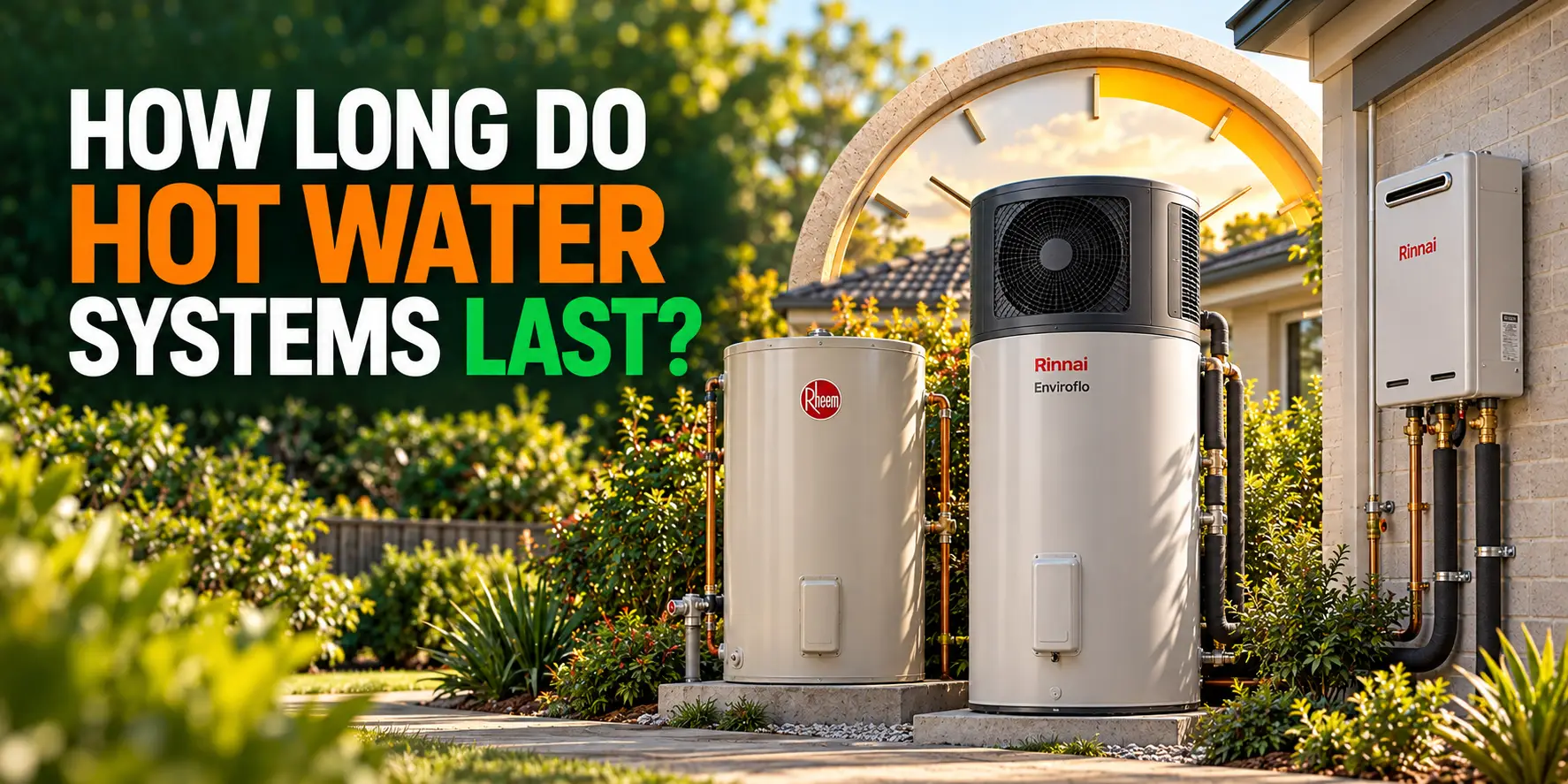
Most Australian households can use 10 to 15 years as a planning window for a hot water system, but it is not an expiry date. A system may need a repair sooner or keep working longer. Its condition depends on the model, installation, water quality, demand and maintenance. For gas storage, the Australian Government gives a typical life of 12 to 15 years. Before replacing any system solely because of age, have its condition and repair options assessed.
Source: Victorian Government hot water buyers guide
Source: Australian Government guide to electrification
The important distinction is between the tank, the parts that heat the water and the warranty. A ten-year cylinder warranty does not mean every component is covered for ten years, and a warranty is not a prediction of when a heater will fail.
These are practical planning estimates, not independently measured averages for every product. The 10 to 15 year baseline follows Victorian Government buying guidance; individual models and components vary. Check the warranty and service instructions for your exact model.
| System type | Planning window | Likely trouble spots | Maintenance focus |
| Electric storage | About 10 to 15 years | Tank corrosion, element or valve faults | Check anode where fitted; service valves as instructed |
| Gas storage | About 12 to 15 years | Tank corrosion, burner or control faults | Check anode where fitted; qualified gas servicing |
| Gas continuous flow | Assess around 10 to 15 years; model dependent | Heat exchanger, ignition and controls | Follow model-specific service interval |
| Electric continuous flow | No robust universal range; assess by model | Heating elements and electrical controls | Follow manufacturer instructions |
| Heat pump storage | Assess around 10 to 15 years; parts vary | Tank, compressor, fan and controls | Keep airflow clear; service to manual |
| Solar hot water | Assess tank around 10 to 15 years; collectors vary | Tank, booster, collector and pump | Check tank and solar components separately |
The longer quoted ranges sometimes seen for continuous flow or solar collectors should not be applied to every installed unit. A solar collector, storage tank and booster can reach the end of service at different times.
Storage heaters keep a volume of hot water ready for use. The tank may eventually corrode or leak; valves, heating elements, burners and controls can fail independently. Replacing a serviceable element or valve is a different decision from replacing a leaking cylinder. Do not assume that one fault means the entire system has reached end of life.
Glass-lined steel tanks commonly use a sacrificial anode to help protect the tank. A qualified technician should inspect or replace it at the interval specified for the model and local water conditions. Stainless steel tanks have different corrosion behaviour and water-quality limits. Choose between them using the manufacturer’s water-quality requirements, rather than a blanket claim that one material always lasts longer.
Source: Australian Government YourHome hot water guide
Source: Rheem electric storage owner guide and installation instructions
Continuous-flow systems heat water as it passes through the unit, so there is no storage cylinder to corrode. That does not make them maintenance-free: heat exchangers, ignition, or electrical controls can still require attention. Water quality and the specific appliance design matter. Rinnai recommends servicing its gas continuous-flow appliances at least every two years; use the interval for your own model rather than applying that instruction to every brand.
Source: Rinnai gas continuous flow warranty and service booklet
A heat pump combines a storage cylinder with refrigeration components such as a compressor, fan and controls. The tank can remain sound while a mechanical part needs repair, or the tank can fail while the heat pump assembly still operates. Check the cylinder and other components separately when comparing warranties. Keep the required airflow around the unit clear and follow its installation and service manual.
Source: Australian Government YourHome hot water guide
Solar hot water systems have more than one lifespan to consider: collector, tank, pump where fitted, and backup heater. A loss of solar contribution does not necessarily mean the tank is unusable; the backup may still be heating water at a higher running cost. Have each part diagnosed before deciding whether a component repair or full replacement makes sense.
Source: Australian Government YourHome hot water guide
Water quality is one reason. Scale may accumulate in heaters or heat exchangers, while water outside a manufacturer’s specified limits can affect tank warranties and corrosion risk. Coastal exposure, restricted heat-pump airflow, pressure problems and a system poorly matched to household demand may also affect performance. None of these factors proves a precise number of years will be lost; they are reasons to check the installation and manufacturer instructions.
Maintenance should be model specific. Record the installation date, keep the manual, check for visible leaks and changes in performance, and arrange professional checks at the maker’s recommended interval. Do not open electrical covers, work on gas fittings or adjust a relief valve beyond the instructions supplied with your appliance.
A service assessment is more useful than a simple age cutoff. Use these questions to prepare for the conversation:
Some discharge from a storage system’s pressure relief valve during heating can be normal. Persistent or unusual leaking still warrants professional assessment. Do not use the amount of sediment in a tank or a change in bills alone as a universal replacement rule.
Source: Australian Government YourHome guidance on pressure relief valves
Lowering the temperature of stored hot water simply to reduce wear can create a hygiene risk. Australian Government YourHome guidance says residential storage hot water must reach at least 60°C at least once every seven days to control bacteria such as Legionella. Appropriate tempering or mixing at outlets helps protect users from scalding. Ask a licensed professional about the settings for your particular heater rather than changing them to extend its life.
Source: Australian Government YourHome hot water safety guidance
Compare the installed cost, expected running cost, hot water capacity, site constraints, product warranty and service requirements. A heat pump may be attractive when replacing an old electric storage unit, particularly if you can make use of rooftop solar generation. The right choice still depends on your household, site and electricity arrangement. Arrange an assessment before the old unit fails if it is ageing or repeatedly causing problems; that leaves time to compare suitable options.
Rules also vary by state. In Victoria, from 1 March 2027, an existing household gas hot water appliance that breaks and cannot be repaired must generally be replaced with an electric alternative, subject to the applicable rules and exemptions. That is a Victorian requirement, not a Sydney rule.
Source: Victorian Government electrification and efficiency standards
Ask the technician to identify the exact component at fault, the condition of the cylinder where it can be assessed, the repair cost, the applicable parts warranty, and any manufacturer-required maintenance. If replacement is recommended, ask which finding makes repair unsuitable. E-Green Electrical can assess the site and provide options for a suitable hot water upgrade in Sydney.
In NSW, eligible households may receive an upfront discount when replacing an existing electric or gas water heater with an […]
For most people, buying a hot water system is only a priority when building a new home, moving in, or […]
Quick Answer After thousands of hot water system installations, we confidently recommend a properly sized commercial heat pump for many […]
Hot water usage refers to all the energy consumed to heat water for domestic purposes. While this is often overlooked, […]






Our energy efficiency experts are here to answer all your questions and guide you through the products, rebates, and installation process.

Upgrade now and pay later with the Home Energy Saver Program!