Home batteries are becoming an increasingly common part of Australian households. When paired with solar, they help you store excess […]
Electricity prices across NSW have been rising, with some households seeing bill increases of up to 9.7%. Most people feel this most during long summers and cold winter nights, when air conditioners and heaters run for hours at a time.
In fact, heating and cooling alone account for roughly 40–50% of a home’s total energy use. This places pressure not only on household power bills but also on the electricity grid during peak demand periods.
To address this, the NSW Government has focused on improving home energy efficiency, particularly by encouraging the use of high-efficiency electric air conditioners through the NSW Energy Savings Scheme (ESS).
This is where rebates come in. However, the term is often misunderstood. What many people call a rebate isn’t money sent back after you buy. In NSW, these are cost savings applied upfront when purchasing or installing an eligible air conditioner.
These upfront discounts are provided by an Accredited Certificate Provider (ACP) under the NSW Energy Savings Scheme (ESS). The goal is to reduce overall energy consumption, lower emissions, and help households save on running costs over time.
If you’re unsure what these rebates are or how they work, keep reading. We’ll break it all down and show you exactly how to claim them.
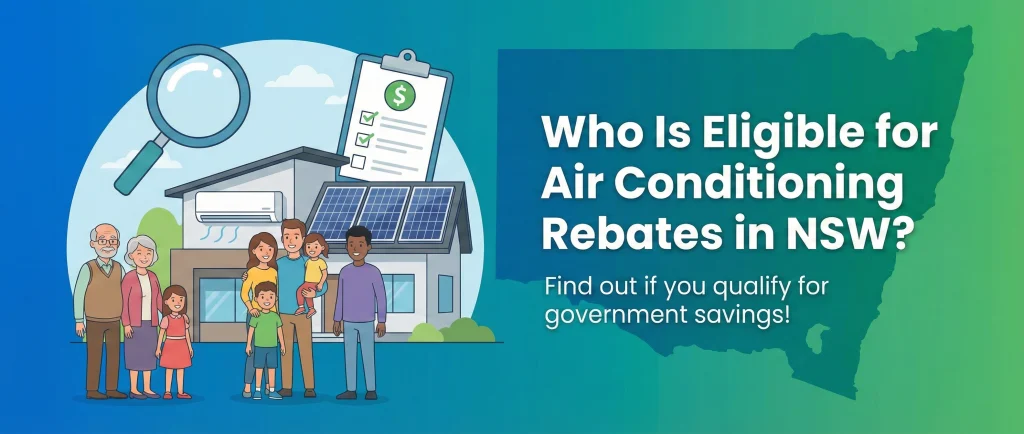
Eligibility is largely based on the following factors:
If the air conditioner is an inverter type with good star ratings and is replacing an old or inefficient air conditioner, then it is likely to be eligible.
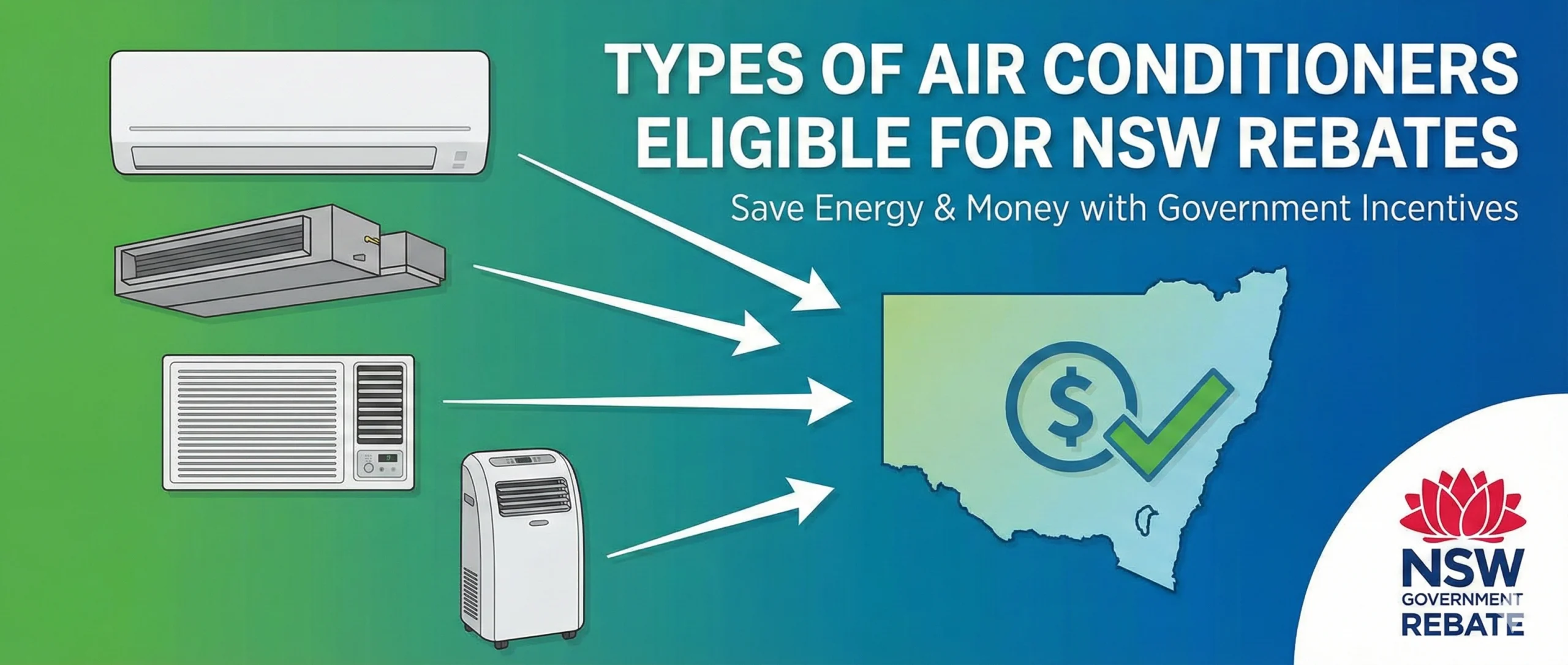
So which air conditioners actually qualify? Let’s break it down.
Split systems are popular in Australia for good reasons. They’re made up of a wall-mounted indoor unit connected to an outdoor compressor.
They have a simple setup, a clean look and offer reliable performance. These systems are suitable for single rooms or small zones like bedrooms, living rooms, or home offices.
Modern split systems qualify because they are efficient by design. Most use inverter compressors that adjust output instead of switching fully on and off. This can actually help cut energy use by 30–40% compared to older fixed-speed units.
Many current models sit at 6 to 7 stars, well above the minimum threshold.
Key features
Popular models
Brands like Daikin, Rinnai, Mitsubishi Electric, Fujitsu, and Panasonic dominate this space. Their inverter-based systems are commonly approved by ACPs for certificate discounts.
Rebate estimate
For eligible split systems, households often see A$400 to A$800 taken off the upfront price. Larger or higher-star units tend to land at the upper end of that range.
Ducted systems are built for scale. One central unit pushes the air through ducts into multiple rooms that are controlled by zones and a thermostat.
They cost more, yes. But when properly sized and zoned, they can be efficient.
A zoned ducted air conditioning system qualifies since it ensures that energy is not wasted on empty rooms. It can reduce energy consumption by 20-30% compared to an old ducted air conditioning system, where the entire house is conditioned at once.
To qualify, the systems must meet MEPS standards, which require high star ratings for cooling and/or heating systems.
Key features
Popular models
Eligible systems must be listed on the GEMS Register and meet high-efficiency standards such as Daikin, Mitsubishi Electric, Panasonic, ActronAir, and Fujitsu.
Rebate estimate
For larger ducted systems, incentives often start around A$1,000 and can increase based on system size and efficiency scores.
Reverse-cycle systems are the backbone of NSW rebate programs; whether split or ducted, most eligible systems fall into this category.
They are cool in summer and warm in winter, using heat pump technology.
They qualify because they are far more efficient than traditional electric heaters. For every unit of electricity used, a modern heat pump can deliver 3 to 5 units of heating energy.
That efficiency is why governments push them so hard.
Key features
Popular models
Daikin Cora Series, Mitsubishi Electric MSZ-AP Series, and Fujitsu General Lifestyle Range
Rebate estimate
Reverse-cycle units with 7-star ratings or higher tend to unlock the strongest incentives, especially when replacing older heaters or air conditioners. Depending on the model’s efficiency, unit size, and installer, typical savings range from A$200 to over A$1,000.
Some air conditioners miss out on NSW rebates because they don’t line up with where energy policy is headed.
Gas systems are the clearest example.
They don’t run on electricity, they don’t carry Energy Star ratings in the same way, and they don’t support the state’s shift toward electric heat pump technology. NSW rebate programs are built around cutting grid emissions.
This is why electric systems are favoured, and gas heating is left out.
Low-efficiency air conditioners also fall short. Systems with poor star ratings, older models without inverter technology and basic window or portable systems usually fail to meet MEPS requirements.
These systems draw more power than they should, cycle on and off too often and end up costing more to run over time.
Oversizing is another common issue. A bigger unit might sound better. However, if it’s too powerful for the space, it wastes energy and performs worse.
Many older systems were installed this way, and this is why they’re often excluded from rebate programs.
Here is the step-by-step guide:
🟩 Find an ACP: Go to the official NSW energy saving website (like energy.nsw.gov.au) and find a list of approved providers.
🟩 Get Three Quotes: Prices and rebates can vary between installers. Getting a few quotes helps you get the fairest deal.
🟩 Check the Model: Ensure the model number is on the approved list. This is crucial. One digit off could mean zero rebate.
🟩 The Paperwork: You’ll sign a form (often digital) that assigns the “energy savings certificates” to the provider in exchange for the discount.
If you’re upgrading your air conditioning, the smartest move is sticking with high-efficiency split systems, well-zoned ducted units, or modern reverse-cycle systems. These are the models that qualify for NSW rebates and actually reduce power bills over time. With upfront discounts often covering 20–30% of installation costs, the savings start immediately and continue every time the system runs.
Energy‑efficient air conditioners that meet NSW energy performance standards, especially reverse‑cycle models.
Yes, modern energy‑efficient split systems with high star ratings typically qualify.
Yes, ducted systems that meet efficiency requirements and MEPS standards are also eligible.
Usually no. Rebates focus on fixed, efficient systems like split or ducted units installed by accredited professionals.
Yes, reverse‑cycle units that cool in summer and heat in winter qualify because of their higher efficiency.
No, older or low‑efficiency units generally are not eligible. You must install a compliant, energy‑efficient model.
Not directly. Any brand can qualify if the unit meets energy efficiency standards and installer requirements.
Home batteries are becoming an increasingly common part of Australian households. When paired with solar, they help you store excess […]
Air conditioning rebates in New South Wales are often misunderstood. Many people assume they work like traditional government grants: apply, […]
Managing the heat in New South Wales can be a struggle, especially when power bills start to rise. Air conditioning […]
Electricity bills continue to rise, and more Australians are looking for ways to save. One of the biggest opportunities right […]

Our energy efficiency experts are here to answer all your questions and guide you through the products, rebates, and installation process.

Upgrade now, pay later with