
For many Australians, air conditioners are a fundamental necessity rather than a luxury, as the nation continues to face record-breaking […]
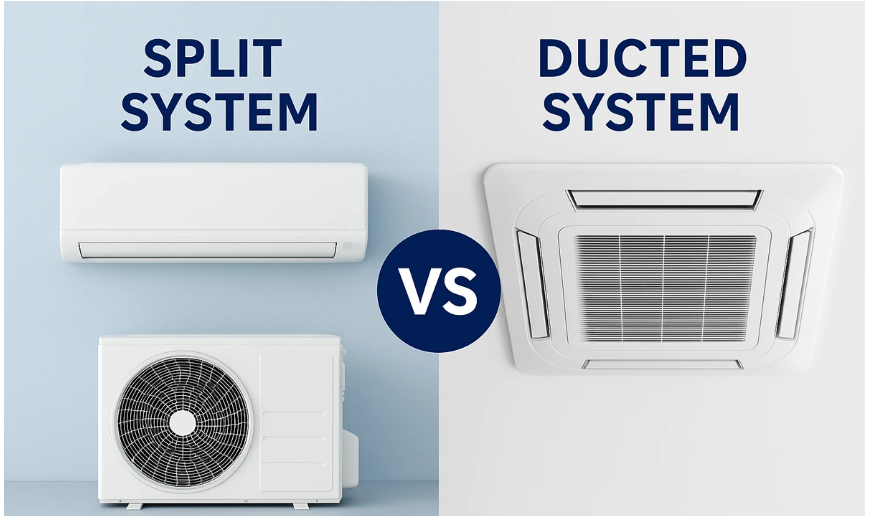
When it comes to keeping your home comfortable, the air conditioning choice is a big one.
The main reason is that you’re deciding on a whole system that affects your comfort, your power bills and your home’s appearance for the next decade.
Most Aussies often get stuck when choosing between the two main types: ducted AC and split systems.
However, the basic difference is simple.
A split system cools one specific room using an indoor unit mounted on the wall.
Meanwhile, a ducted system cools your entire house from a central unit, sending the air through a network of hidden pipes.
In this guide, we’ll cover the following:
These will help you know exactly which system makes sense for your specific home and lifestyle.
Let’s get started!
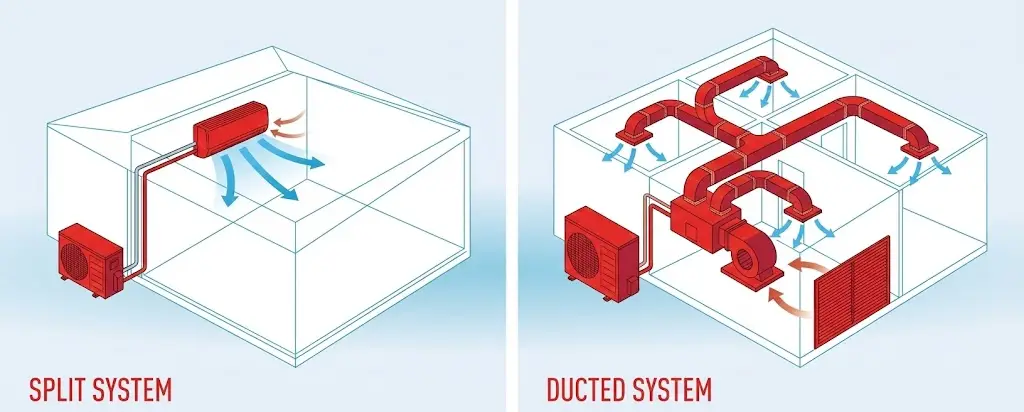
In ducted air conditioning, the main work is done by one central outdoor unit and one large indoor unit (often tucked away in the roof space or under the floor).
The main unit pushes conditioned air through a network of ductwork—flexible or rigid tubes that run throughout your ceiling or floor cavity.
The air comes out through discrete vents (or grilles) in each room.
A key feature here is zoning. Modern ducted systems let you divide your home into separate areas.
You can choose to cool only Zone 1 (the living area) during the day and Zone 2 (the bedrooms) at night, and this gives you control and saves energy.
On the other hand, the split AC system has two main parts: an outdoor unit (the condenser) and one or more indoor head units mounted high on a wall.
The two are connected by a small refrigerant line that runs through the wall.
This system is essentially room-based.
A single split cools just one area.
A multi-split system allows one powerful outdoor unit to connect to two, three, or up to six individual indoor head units in different rooms.
Each indoor unit can be controlled separately for temperature, which is a major bonus.
This is often the biggest factor, and the costs break down into two categories:
✅ What you pay to install it
✅ What you pay to run it.
Ducted AC requires a significant investment up front because of the extensive labour involved. You have to buy the central unit, all the ductwork, the ceiling vents, and pay for the complex installation and zoning control system.
Ducted AC Installation Range: Expect to pay between AUD11,000 and AUD1,000 for a system size of 10kW to 15.5 kW/ or 3–5 bedroom home. This price increases if your home needs renovation or extensive electrical work.
Split Systems are far cheaper and easier to install. Price ranges between AUD1,650 to AUD4,200. You’re just connecting two units through a small hole in the wall.
Split System Installation Range: A single and high-quality 2.5kW split system for a bedroom might cost between AUD1,500 and AUD3,000 fully installed. A multi-split setup for three rooms would likely cost between AUD5,500 and AUD8,000.
The takeaway here: For the same number of rooms, the ducted system almost always costs at least 2.5 to 3 times more to install than the equivalent split system coverage.
Whole-Home Cooling (Ducted): If you run your ducted AC and cool your entire house, it will use significantly more power than a single split system running in one room. A large 12kW ducted unit running at full tilt might consume over 40% more energy than a 5kW split system.
Targeted Cooling (Split): If you only use air conditioning in one room (say, your main bedroom at night), the single split system is dramatically cheaper to run.
It’s only cooling 10–20% of your home’s volume. However, if you buy a ducted system with effective zoning, and you only run 2 out of 5 zones, your consumption drops.
It often becomes comparable to running two separate modern split units.
Ducted systems have more components, which means more potential costs over time.
Ducted: Needs regular duct cleaning every 3 to 5 years to prevent dust and mould build-up, which costs around AUD300 to AUD500.
Repairs to ductwork or the central unit can be complex and expensive.
Split: Maintenance is simple, and the service cost is around AUD200. Mostly, it is just cleaning the filters every few months.
Repairs are usually localised to one unit. If one split system breaks down, your other units still work.
Ducted systems win on comfort, hands down.
They deliver air gently through multiple outlets, leading to extremely even temperatures across the room and between rooms.
You don’t get that blast of cold air aimed at you. Studies show people perceive even temperature distribution as a higher quality of comfort.
Split systems are great, but they are localised.
They often struggle to cool adjoining spaces, and you’ll notice a clear temperature difference the moment you step out of the cooled room.
A ducted system with zoning allows you to cool exactly 15% of your home (the kitchen/living area) and then switch that off and cool the 10% which is the master bedroom.
This is incredibly efficient for large homes where people spend time in different areas.
With split systems, you achieve “zoning” by simply turning off the units in rooms you aren’t using.
Ducted: The noise from the central unit is usually outside, away from living areas. The airflow from the ceiling vents is near silent. It is by far the most discreet and quiet option.
Split: The indoor unit can sometimes be audible, especially in older models running at full power.
More importantly, the units are big wall fixtures. This is a big aesthetic sacrifice for many homeowners.
Airflow and Dust: Ducted systems require well-maintained ductwork.
If the ducts aren’t sealed properly, they can suck in dust and allergens from the ceiling cavity.
Also, up to 30% of conditioned air can be lost through leaky ducts, wasting energy.
Humidity: In tropical or very humid environments, ducted systems sometimes struggle to manage humidity without specialised controls.
This leads to a clammy feeling. Split systems are often better at dedicated dehumidification on a room-by-room basis.
| Feature | Ducted AC Pros | Ducted AC Cons | Split AC Pros | Split AC Cons |
| Coverage | Whole-home and zoning control | High ductwork needs | Single-room efficiency | Multiple units for whole home |
| Installation | Hidden vents, aesthetic | Complex | Quick | Visible indoor units |
| Running costs | Efficient with zoning | Higher if full-home use | Lowest for 1-2 rooms | Scalable but uneven temps |
| Noise/maintenance | Quiet operation | Harder repairs | Easy service | Louder indoors |
| Energy efficient | Good for large spaces | Potential duct losses | Inverter models top-rated | Limited zoning |

The “better” system is the one that matches your circumstances.
Here are tailored recommendations for different types of buyers and homes.
Split systems are ideal because they are low-cost, easy to install, and provide powerful and targeted cooling for the 1 or 2 main rooms you use.
For a two-bedroom apartment, a multi-split setup often provides perfect coverage at a fraction of the cost of ducted.
Ducted with zoning is typically best.
Why?
The superior and uniform comfort of ducted AC across a large footprint outweighs the higher upfront cost.
With 4 or more bedrooms, installing 4 separate split systems starts to look messy and becomes very expensive anyway.
If you have 5 zones and you’re only cooling 2 zones at a time, your operating costs will be lower than running 5 separate units all day.
Choose split systems for staged installation. You can buy one split unit this year for the main living area, another next year for the bedroom, and so on.
You can spread the cost over several years instead of needing AUD10,000+ all at once.
If you rarely cool the whole home, split systems are cheaper to run. You only pay for the room you cool.
If you frequently cool large portions of the home, ducted systems with good zoning can be more efficient.
Ultimately, there is no single best answer. The best option depends on your home. Ducted AC is better for whole-home comfort, aesthetics, and large modern houses.
It provides superior and smooth climate control that makes a big house feel luxurious and uniformly comfortable.
Meanwhile, split AC is better for the budget, small homes, targeted cooling, and energy savings when you only need to cool one or two rooms. It offers flexibility and a significantly lower entry price.
If you have a large family and are building a new house, ducted is worth the extra investment.
If you live in a two-bedroom apartment and only need to escape the summer heat in the evening, a quality split system is the clear winner.
For many Australians, air conditioners are a fundamental necessity rather than a luxury, as the nation continues to face record-breaking […]

Mitsubishi Electric Mitsubishi Heavy Industries Mitsubishi Split System: Key Takeaways After reviewing the top 7 Mitsubishi air conditioner models for […]

Designing a home climate system is an exercise in precision. When we talk about installing a new air conditioner, we […]

Normal Range: $1,850 – $30,000 Air conditioning and climate control service costs in Australia depend heavily on your specific project, […]








Our energy efficiency experts are here to answer all your questions and guide you through the products, rebates, and installation process.

Upgrade now, pay later with