
Are Heat Pump Hot Water Systems Worth It? If you’ve ever opened your electricity bill and felt that sting of […]
Hot water might seem like a small part of your household budget, but in Australia, it accounts for up to 30% of total energy consumption.
That’s huge.
For an average home, switching to an Emerald heat pump could save you around AUD 913 every year.
That’s almost a thousand dollars you could spend elsewhere. With energy prices constantly rising, investing in a reliable and efficient hot water system makes more sense than ever.
Emerald promises to save you up to 80% on hot water costs, plus smart technology, quiet operation and eco-friendly refrigerants.
In this guide, we’ll look at how the Emerald heat pump works and what makes it stand out. We will also review the available Emerald models so you can choose the one that suits you best.
Emerald is an Australian-owned company that has been around since 2006. They are committed to offering innovative solutions and developing technology that costs you and the environment less.
What makes them interesting is their “ecosystem” approach.
They don’t just sell you a tank; they sell you a smart system that talks to your phone.
In a market flooded with generic imports, having an Australian brand with a local support network is a massive plus when something—inevitably—needs a service five years down the road.
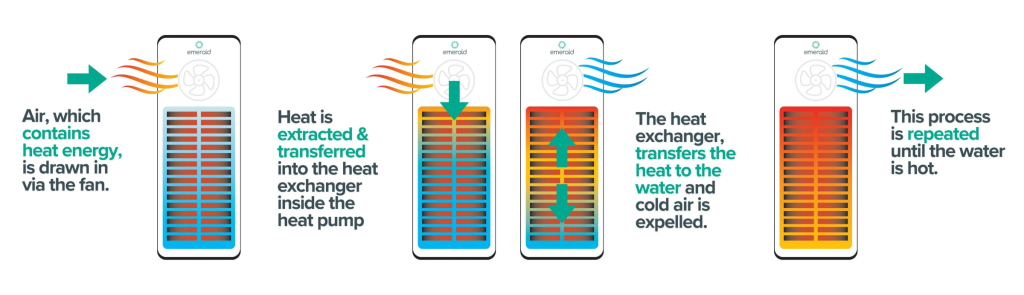
When you try to think about how an Emerald heat pump works to heat your water, it may seem confusing at first.
Fortunately, Emerald explains it very clearly by comparing it to the way a reversing refrigerator works. This is how it goes:
✅ Cuts hot water energy use by up to 70%: Hot water can take up close to 30% of household energy use in Australia. Thankfully, Emerald heat pumps help slash that by pulling heat from the air instead of generating it with electricity.
✅ Real savings you actually feel: Based on typical household usage, switching to an Emerald heat pump can help save around AUD 913 per year on energy bills.
✅ High efficiency with strong COP figures: Emerald systems reach COP levels up to 4.7. This simply means they deliver more than four times the heat energy for every unit of electricity used.
✅ Uses R290 natural refrigerant: R290 has a very low global warming impact compared to older refrigerants. It’s efficient, environmentally responsible and aligned with future regulations.
✅ Quiet operation: With sound levels around 40 dB, Emerald units run quietly in the background. No loud compressors and no constant hum near bedrooms or outdoor areas.
✅ Works in real Australian conditions: Some models operate reliably between -15°C and 46°C. This makes them suitable for cold regions as well as hot climates.
✅ Smart control through the Emerald app: It has an app that monitors usage, adjusts temperatures and manages boost mode remotely. This helps households fine-tune energy use and avoid waste.
✅ Flexible system options: All-in-one and split systems are available with tank sizes ranging from 200L to 320L. This helps cover both small households and large families.
✅ Strong warranties across the range: Depending on the model, Emerald offers up to 7 years on tanks and 5 years on parts and labour.
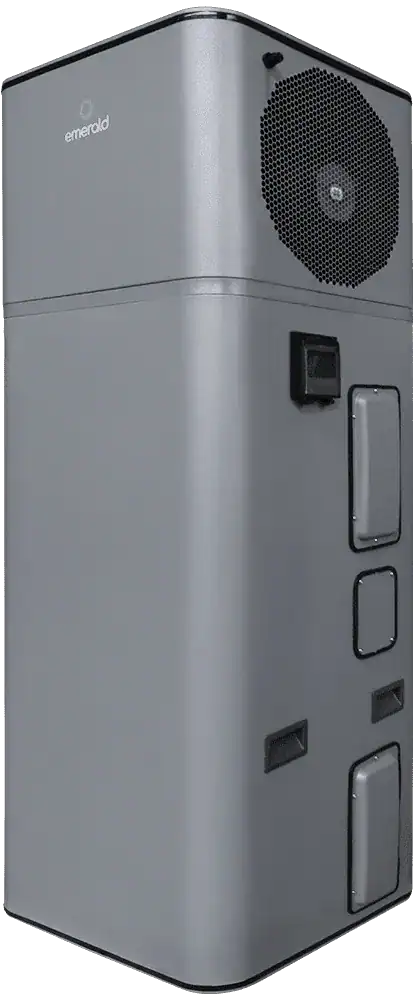
“Select“ is the company’s basic workhorse that is supposed to deliver high levels of efficiency without requiring complex installation processes.
Available in 220L, 270L and 320L capacity variants, it’s definitely good enough for smaller homes.
This model incorporates a non-inverter rotary compressor that is known to be quite reliable while keeping installation costs low.
Even in being their basic offering, it has modern technology: it comes equipped with Wi-Fi connectivity to control heating functions using the Emerald app.
This unit employs R290 refrigerant, which is more environmentally friendly than others because it has a very low GWP (Global Warming Potential).
One of the most important features of Emerald’s Select is that it comes in the “E-Heater” variant – these variants come equipped with an additional 1kW heating element that will allow hot water delivery regardless of temperatures falling as low as -15°C outside.
Even without the additional heating element, it is capable of handling temperatures as low as -7°C which covers most areas of the Australian coast.
Specifications
What we like
What could be improved
Best for: Budget-conscious families or those upgrading their old electric tank.
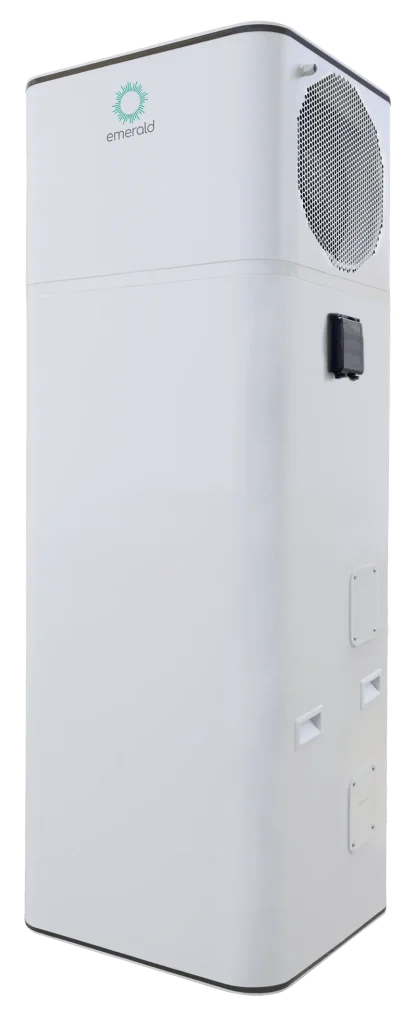
The “Pro” series is the high-performance upgrade, primarily distinguished by its superior DC Inverter technology. Unlike standard models that click on and off, the Pro’s compressor and fan adjust their speed to match the exact heating demand.
This results in a higher Coefficient of Performance (COP) of up to 5.2, meaning it’s significantly cheaper to run over the long term.
It’s available in 220L, 270L, and 320L capacities, with the largest unit easily handling a 6-person home.
It also runs quieter than the Select and produces less than 40dB at a three-meter distance—roughly the sound of light rain.
The warranty is where this model really shines.
It offers 7 years on the tank and 5 years for both parts and labour.
For those with solar panels, the Pro is “Solar Soaker” ready, allowing the app to automatically trigger heating cycles during peak solar production hours to maximise your savings.
Specifications
What we like
What could be improved
Best for: Families or households needing reliable performance with minimal maintenance.
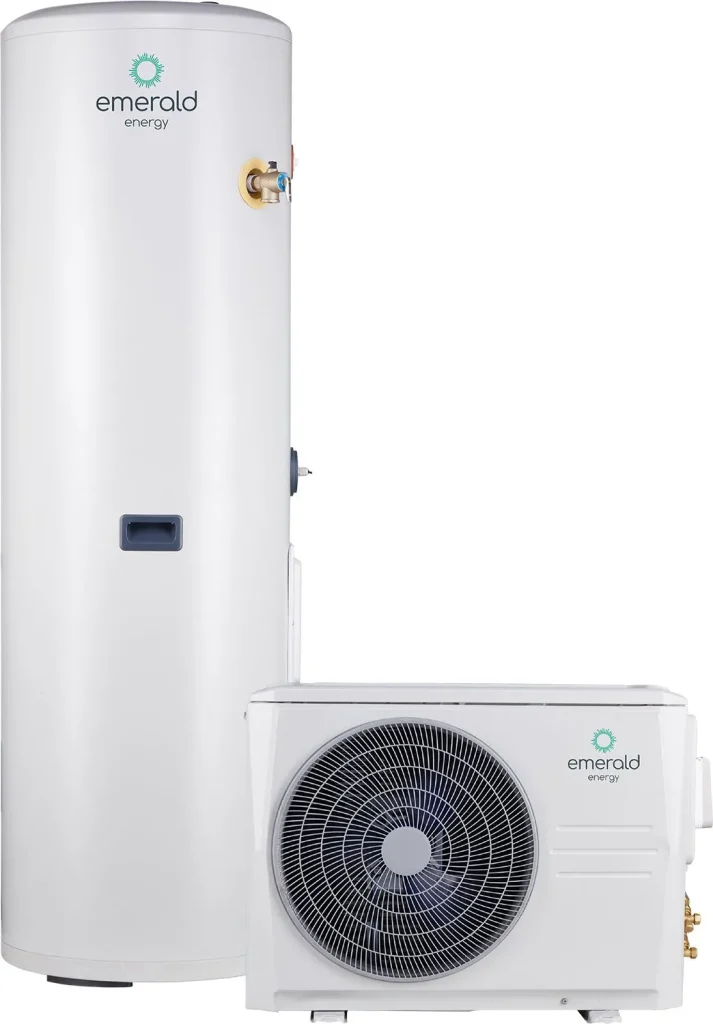
The Split System is the solution for homes that lack space or have a complicated setup. Unlike other models, such as the All-In-One, this system splits the storage tank and the compressor unit.
In this regard, it allows the positioning of the storage tank out of sight in the laundry or side passage, and at the same time, it places the fan unit elsewhere where it can take in the maximum flow of air.
It is available in either 200 or 300 litres and comes along with an extremely powerful 4.2kW electric backup heater.
Indeed, it is a powerful system that works perfectly even during low temperatures, ranging from -15°C to 46°C.
Moreover, since it splits the compressor, it comes along with an extremely modern four-way automatic valve, which allows it to automatically defrost, especially during the presence of heavy frosting in alpine areas.
Specifications
What we like
What could be improved
Best for: Homes with limited outdoor space or those in extremely cold climates
Here is a brief of the smart features of the Emerald Heat Pump.
Emerald’s heat pumps come with app-based monitoring that gives you real-time insights into your hot water system’s performance.
Instead of wondering whether your hot water system is working properly, you can monitor water temperatures and performance right on your smartphone.
It matters because hot water is one of the largest consumers of energy within your home.
When you are able to view how your hot water system performs, you are able to cut down on wasted heating without having to work too hard at it.
Life doesn’t always follow a perfect schedule.
Extra guests. Back-to-back showers. Laundry days that get out of hand. Emerald’s boost mode is there for those moments.
When it is activated, the system temporarily increases heating output to recover hot water faster. It’s not something you’ll need every day, but when you do, it prevents cold showers without permanently increasing energy use.
Once demand drops, the system returns to its normal and efficient operation.
Emerald heat pumps don’t just run at one fixed level.
Their DC inverter technology allows the system to adjust output based on conditions like air temperature and water demand. On warmer days, the unit works less.
On colder days, it adapts to maintain performance without unnecessary energy draw.
This kind of responsive operation is a big reason Emerald systems maintain strong efficiency figures across different climates, including colder regions where traditional electric systems struggle.
Another underrated benefit of Emerald’s smart setup is remote system monitoring.
If performance drops or something isn’t operating as expected, issues can often be identified early. This actually reduces downtime and helps avoid larger problems later on.
For homeowners, it means fewer surprises and more confidence that the system is running as it should every day.
If you’re considering making the switch, the financial side usually comes down to two things: the money you stop sending to your energy provider every month and the government cash available to help you buy the unit in the first place.
In Australia, a typical electric hot water tank is practically a huge energy drain.
An average four-member household that requires a conventionally powered hot water system would be spending approximately AUD1,103 each year just to keep the water hot.
That cost, when replaced by an Emerald Heat Pump, is merely an exchange for a new tank when you consider what you’re getting in return.
These units are capable of being five times as efficient as an electric heater, so it is possible to save up to AUD913 per year.
If you have solar panels, the cost savings could easily reach over 80%.
Utilising the Emerald app to turn on the heating cycle during the daytime means you’re effectively heating your water for free using the energy that you’ve generated.
For a ten-year span, the figures accumulate to over AUD9,000 in avoided costs.
That’s far from “pocket change”. In fact, it could easily pay for a few family vacations or make a significant impact on the mortgage payments.
The sticker price of a heat pump can be intimidating, but almost nobody in Australia pays full price. There is a stack of incentives designed to make these units affordable.
Federal STCs (Small-scale Technology Certificates): This is the baseline “rebate” available Australia-wide. Every Emerald unit is assigned a certain number of certificates based on how much carbon it saves.
For a typical installation, this usually works out to an upfront discount of AUD800 to AUD1,200. Your installer usually handles this for you and applies it as a point-of-sale discount.
The Victoria “Double Dip“: If you’re in Victoria, the deal gets even better.
Through the Solar Victoria Hot Water Rebate, you can claim an additional AUD1,000.
Starting July 1, 2025, there is also a “Locally Made” incentive that can push this rebate up to AUD1,400 if the product meets local content requirements.
State Energy Schemes (NSW & Others): In NSW, the Energy Savings Scheme (ESS) provides Energy Saving Certificates (ESCs) which act similarly to STCs.
Depending on what you are replacing (swapping gas for a heat pump is often highly incentivised), you could see another EAUD300 to AUD600 shaved off the bill.
When buying a heat pump, you want to know if it’ll actually do the job when it’s 2°C outside and if it’s going to be a nightmare to manage.
Recovery rate is where the Emerald series shines. If you have a house full of teens, you understand the cold shower lottery.
A typical Emerald model delivers an average recovery rate of 58 litres an hour at an ambient temperature of 20°C. If you’re in a hurry, switching on “Boost Mode” gives you an average recovery rate of 78 litres an hour.
Also, if you decide to get an ‘E’ version (that’s those that come with an electric backup component), then you can expect that speed of hot water recovery to jump to an astonishing rate of 112 litres an hour.
Essentially, this means that you can experience consecutive showers that would not feature that dreaded moment when you feel your water temperature suddenly drop.
From an efficiency standpoint, you would then see a COP ranking of approximately 4.9 to 5.2. This means that you would be getting AUD5 worth of heat while spending only AUD1.
You can’t just plug and play these units. They involve high-pressure refrigerant and mains-pressure water, so you need a licensed plumber (and usually an electrician).
Emerald is an Australian brand, which is a massive win for support. If a sensor fails, you aren’t waiting for a part to be shipped from a warehouse in Shenzhen.
The Select and Split system warranty is 5 years tank, 5 years parts, and 2 years labour. Meanwhile, the Pro Series warranty is 7 years on the tank, 5 years on parts, and 5 years on labour.
Most mid-range brands will offer the parts but leave you with an AUD 600 plumbing bill to actually get them installed—Emerald covering the labour for five years is so helpful.
One thing to watch out for: the app support. While the Emerald app is great for scheduling, some users find the initial Wi-Fi pairing a bit awkward.
It only works on 2.4GHz networks, so if you have a fancy mesh Wi-Fi system, you might need to briefly “split” your bands to get the tank connected for the first time.
| Feature | Emerald All-In-One- Hot Water Heat Pump Pro | Rheem AmbiPower 280e | Sanden Eco Plus |
| Refrigerant | R290 | R290 | R744 |
| COP | Up to 5.2 | Up to 5.2 | 5.96 |
| Tank (L) | 220L, 270L, 320L | 280 | 160-315 |
| Tank Warranty | 7 years | 7 years | 15 years |
| Recovery | Excellent (58L/hr) | Excellent | Excellent |
This is where Emerald genuinely dominates. If you are in a state like Victoria or NSW, the “rebate stack” (STCs plus state-specific certificates like VEECs or ESCs) can bring the out-of-pocket cost down to between AUD900 and AUD2,500, depending on the model and installation complexity.
Compared to premium brands that still cost AUD4,000+ after rebates, Emerald makes high-end energy savings accessible to the average household.
It’s hard to beat the ROI when the system can literally pay for itself in under two years of power bill savings.
Emerald offers a very solid warranty, especially on their Pro series.
While some budget brands give you a higher warranty (once they drive away, you’re on your own), Emerald provides 7 years on the tank and 5 years on parts and labour.
Covering labour for 5 years is the big winner here. Most brands only cover the physical part, leaving you to pay the AUD400 plumber’s call-out fee.
For a heat pump, the recovery rate is impressive. In standard mode, it handles about 58 litres per hour, which is plenty for a standard family.
The inclusion of an electric boost element (on ‘E’ models) is great. It allows the unit to perform in temperatures as low as -15°C and doubles the recovery rate to 112 litres per hour when you have a house full of guests.
It loses half a point only because the “All-In-One” fans can be a bit audible (49dB) during heavy recovery cycles.
With a COP (Coefficient of Performance) of up to 5.2, the Emerald Pro is remarkably efficient.
This means for every 1kW of electricity you put in, you’re getting over 5kW of heat out. It ranks in the top 10% of all heat pumps available in the government rebate schemes.
While there are a few niche units with higher COPs, the jump in efficiency is marginal compared to the massive jump in price you’d have to pay to get them.
For most homeowners, this is the real deal of maximum efficiency for minimum spend.
Emerald Heat Pump is definitely a wonderful addition to your home.
It helps reduce energy consumption, ensures a stable supply of hot water and is energy-efficient without requiring you to make changes to your lifestyle.
The sticker price may seem high at first, but when you factor in rebates and annual savings, it adds up rather quickly.
Many families are able to get back a significant portion of the investment simply through lower energy bills. Add in the smart controls, warranties and performance, and it is easy to see where the value lies.
Yes – certain models, such as the Split System, are functional down to -15°C, making them suitable for colder areas of Australia. The functionality may just somewhat decrease in extreme cold conditions, just like with all air-source heat pumps.
Maintenance is very important, but very minimal with Emerald. Usually, a seasonal check-up is fine just to ensure filters, fans and coils are clean. Occasional professional servicing can help maintain the efficiency and prolong the lifespan.
If you are looking for well-rounded performance with good warranty support, the All-In-One Pro would be a good choice. The Select would work well for simple installations and value, or the Split System would be suited for larger families.
Yes. The emerald heat pumps also work well when combined with solar sources, as they consume electricity effectively and can be used for heating water mainly during the day when the intensity of the solar production is highest.
Typically, yes. Existing plumbing lines can, in most cases, be reused, though in certain homes, a few adjustments may be necessary.
The NSW government offers up to $640 when you replace an old electric water heater with an air source heat pump, and up to $330 when replacing a gas water heater with an air source heat pump.
Emerald is an Australian-owned company. It focuses on reducing greenhouse gas emissions through smart technology and has established itself as a leader in environmentally friendly heat pump solutions.
Are Heat Pump Hot Water Systems Worth It? If you’ve ever opened your electricity bill and felt that sting of […]
If you’re an Aussie homeowner, you already know hot water isn’t cheap. It quietly eats into your power bill every […]

Imagine opening your power bill and seeing it drop by hundreds of dollars, without changing your lifestyle. You still take […]
The recent trends in home energy in Australia clearly reflect a shift. The number of households giving up on their […]





Our energy efficiency experts are here to answer all your questions and guide you through the products, rebates, and installation process.

Upgrade now, pay later with