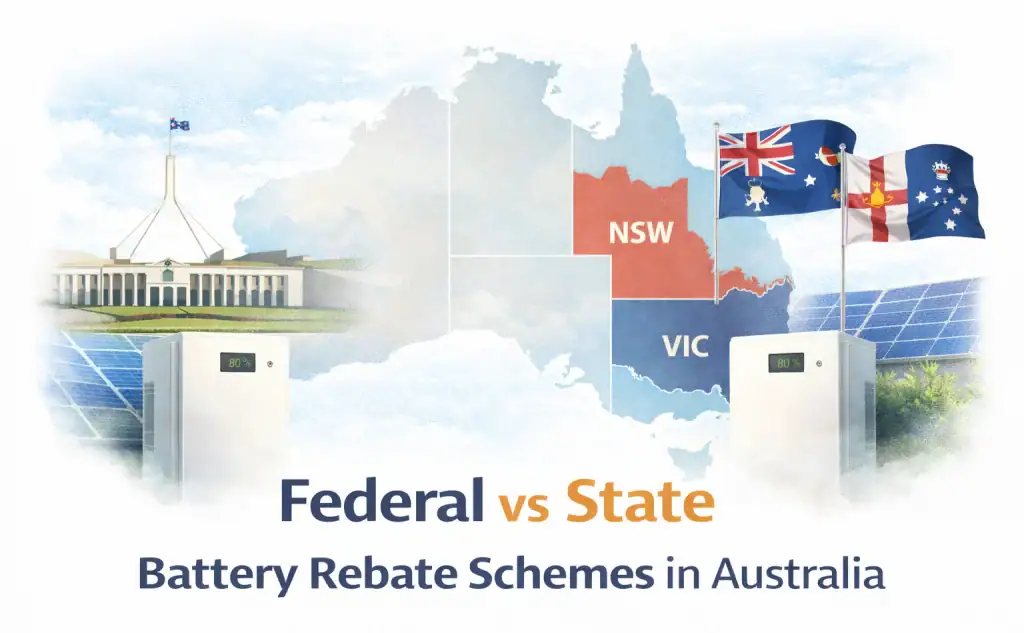
Home batteries are becoming an increasingly common part of Australian households. When paired with solar, they help you store excess […]
Electricity bills continue to rise, and more Australians are looking for ways to save.
One of the biggest opportunities right now is the Federal Government battery rebate, officially called the Cheaper Home Batteries Program.
It offers households and small businesses a chance to reduce the upfront cost of installing a home battery.
This guide explains everything you need to know: what the rebate is, which batteries qualify, how much you could save, and common pitfalls to avoid. By the end, you’ll have a clear picture of whether a battery rebate is right for you.
The Federal battery rebate is a financial incentive provided by the Australian Government to encourage the uptake of home batteries. The official program, the Cheaper Home Batteries Program, gives homeowners and small businesses an upfront discount on approved battery systems.
It works through the Small‑scale Renewable Energy Scheme (SRES).
Installers claim Small‑scale Technology Certificates (STCs) on your behalf. These certificates reduce the price of your battery before you even pay. Essentially, you see the rebate reflected in your quote, making the system more affordable immediately.
The rebate is not a cash payout you claim yourself. It is applied at the point of sale. That means choosing an accredited installer is essential they handle the paperwork for you.
This initiative supports energy independence. Instead of selling your excess solar power back to the grid at low feed-in tariffs, you can store it and use it when electricity prices are high.
For many households, this turns a costly energy bill into a manageable monthly expense.
Timing matters when it comes to the rebate.
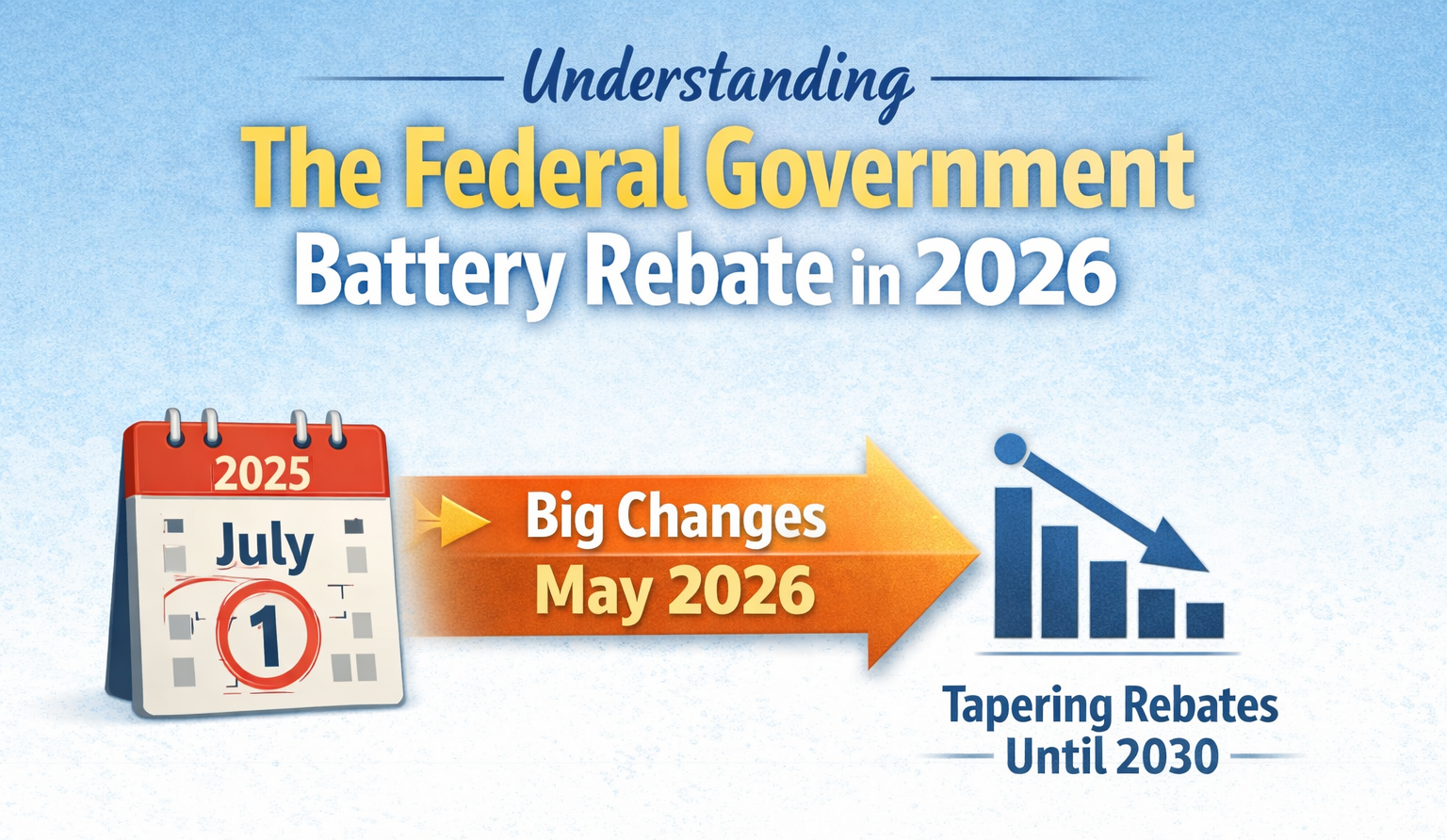
The program officially started on 1 July 2025, with certain rebate values available until 1 January 2026, and adjustments coming into effect on 1 May 2026.
After 1 May, the rebate tapers down, which means acting sooner maximises your savings. The program is designed to run until 2030, but rebate amounts gradually decrease over time.
Households that install a battery before these milestone dates get the highest subsidy. Waiting too long could mean missing the more generous portion of the rebate.
Knowing the timeline helps you plan.
For example, if your installer says the battery won’t be available for three months, you might want to schedule sooner to lock in the higher rebate. Small planning steps can make a significant difference to your savings.
The rebate amount depends on the usable capacity of your battery.
For the initial years of the program, the full rebate applies to the first 14 kWh of usable battery storage. From 15–28 kWh, the rebate is reduced to roughly 60% of the full rate. Any capacity between 29–50 kWh receives about 15% of the rebate.
For context, a typical 10–14 kWh battery can save several thousand dollars. That brings the upfront cost closer to what many homeowners are comfortable paying.
Here’s a simple example: if your battery system costs $12,000 and you install a 13 kWh battery, the rebate might reduce that by about $4,500–$5,000. The exact amount depends on the STC value at the time and your installer’s claim.
The tiered approach ensures households still get a meaningful discount even if they have larger batteries. But the higher the capacity, the smaller the proportion of the rebate per extra kWh.
Planning your battery size carefully is essential for maximising value.
Not every battery qualifies. The program has clear requirements. Firstly, the battery must be on the Clean Energy Council (CEC) approved list. This guarantees that safety and performance standards are met.
Eligible batteries usually range from 5–100 kWh nominal capacity, but the rebate only applies to 5–50 kWh of usable energy. Larger batteries won’t increase your rebate.
Some batteries are VPP-capable, which means they can be integrated into Virtual Power Plants. While participation isn’t mandatory, this feature might give you access to extra income in the future.
Installers must be accredited. That’s non-negotiable.
If you hire someone without proper accreditation, you risk losing the rebate. Only one rebate is allowed per property, so expanding your system later might not attract another full rebate.
The rebate is straightforward, but knowing the steps ensures you don’t miss out. Here’s what you need to know:
Without a registered installer, your system will not qualify. This could mean missing out on thousands in savings. Always confirm the installer is listed on the Clean Energy Council (CEC) website before committing.
Seeing the rebate upfront also helps you compare different systems more easily. Instead of juggling cash refunds or complex applications, the cost on the invoice reflects your actual out-of-pocket expense.
Even after the rebate, batteries are not cheap. Typical costs for a 10–14 kWh system might drop from $12,000–$14,000 to around $7,500–$8,500. The rebate makes the difference more manageable.
In some states, the federal rebate can stack with local incentives, further reducing the price. For example, Western Australia and Victoria occasionally offer extra financial support. In these cases, the total upfront cost could be cut almost in half.
These savings bring battery storage within reach for more households.
But careful comparison is necessary. Not every installer or battery qualifies for both federal and state rebates. Check before signing any contract.
Batteries are only as valuable as the energy patterns in your home. Here’s a deeper look at what affects payback:
How much energy you use versus how much you generate is key. Batteries are most effective for households that use a lot of electricity in the evenings or mornings when solar isn’t producing.
Homes with high daytime consumption may not benefit as much. Tracking energy use for a few weeks before installation can clarify whether a battery will truly cut costs or just sit idle for long periods.
Some areas charge more for electricity at certain times. Using battery-stored energy during peak times can save significantly compared to relying on the grid.
Even small adjustments, like running washing machines or charging electric vehicles during off-peak hours, can enhance savings. Combining behavioural changes with battery storage makes the system more cost-effective.
Too small and you won’t store enough energy; too large and it costs more than it returns.
Matching capacity to your household consumption is critical. Oversized batteries might seem appealing for maximum storage, but the extra cost rarely translates into proportional savings.
A carefully chosen size balances cost and benefit while ensuring your household has enough stored power when needed.
A battery paired with solar panels maximises self-consumption. Without solar, the battery charges from the grid, which may not deliver much savings.
Solar and battery synergy allows you to avoid peak pricing entirely. It also reduces the energy you export to the grid for low feed-in tariffs, meaning you retain more of the energy you produce.
On average, batteries take 5–10 years to pay back, depending on energy use, tariffs, and system cost. Longer lifespans beyond 10 years make them a worthwhile investment.
Consider your household plans.
If you expect to move or remodel within the next few years, the payback period may extend, reducing short-term financial benefits. Long-term planning ensures you actually realise the savings.
Efficiency matters: some batteries lose energy over time. Minimal maintenance and high efficiency can improve savings, while poor-quality units can erode benefits.
Checking warranties and performance guarantees helps avoid surprises. Even small losses in efficiency can affect your electricity savings over the life of the battery, so quality counts more than just initial price.
Even with a rebate, homeowners often make mistakes that reduce savings. Here are six common pitfalls:
Using an installer without proper accreditation voids the rebate. Always check credentials before signing a contract. Accreditation isn’t just about the rebate; it ensures installation is safe and meets government standards. A non-accredited installer could leave you with faulty wiring, which might also void insurance claims if something goes wrong.
The rebate phases down over time. Waiting too long reduces your savings, sometimes by thousands of dollars. Delays can also increase costs if installers raise prices during peak demand periods. By acting sooner, you secure a better deal and avoid scheduling frustrations.
Oversizing to maximise rebate or undersizing to save costs can both backfire. Consider energy needs carefully. Consulting an installer about your typical daily usage helps determine the right capacity. A correctly sized battery ensures you get the most value for your money without overspending.
Wiring, inverter upgrades, or installation fees can add up. Factor these into your total cost to avoid surprises. These hidden costs can sometimes be hundreds or even thousands of dollars. Reviewing the full quote carefully ensures you’re not caught off guard at installation.
Some people pick the cheapest option to get the rebate. Reliability, warranty, and efficiency matter more in the long run.
Cutting corners on quality can lead to early failures and reduced savings. A higher-quality battery might cost more upfront but could last longer and provide more consistent savings over time.
Batteries work best when aligned with household energy use. Failing to match your battery to your consumption reduces effectiveness and extends payback.
Analysing electricity bills for peak consumption hours gives a clear picture of how much storage you really need. Without this step, you may end up with excess capacity or wasted energy.
No. You can install a battery without solar panels. However, pairing it with solar often delivers faster savings and a better payback.
No. The rebate is available once per property. Adding extra batteries later won’t qualify for a new rebate unless they replace the original unit.
The rebate applies to the property, not the homeowner. If you sell, the new owners benefit from the system but cannot claim a rebate again.
No. Only the initial system qualifies. Any upgrades are outside the program’s rebate limits.
Only batteries on the Clean Energy Council (CEC) approved list qualify. Choosing unapproved batteries will disqualify you from the rebate.
Yes. The rebate applies to 5–50 kWh of usable capacity. Installing a larger battery will not increase the rebate amount.
Yes. Without a CEC-accredited installer, your system will not qualify for the rebate. Accreditation also ensures your battery is installed safely and correctly.
The Federal Government battery rebate significantly reduces the barrier to installing a home battery. For households and small businesses, it brings energy storage within reach, helping reduce electricity bills and improve
Batteries are not just about saving money; they give flexibility. You can store energy when the sun shines, use it at night, and even benefit from time-of-use tariffs. With the rebate in place, this opportunity is more affordable than ever.
For Australians looking to take control of energy costs, understanding the rebate, choosing the right battery, and planning carefully is the smart move.
Home batteries are becoming an increasingly common part of Australian households. When paired with solar, they help you store excess […]
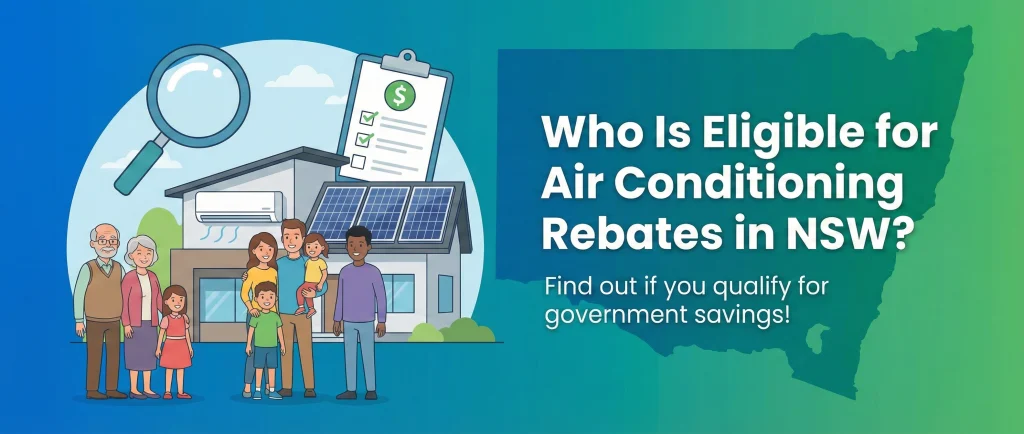
Air conditioning rebates in New South Wales are often misunderstood. Many people assume they work like traditional government grants: apply, […]
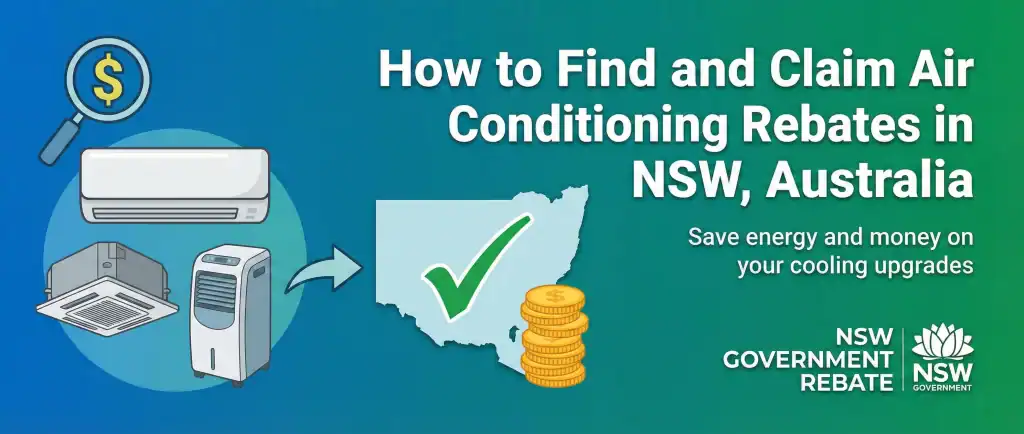
Managing the heat in New South Wales can be a struggle, especially when power bills start to rise. Air conditioning […]
Electricity prices across NSW have been rising, with some households seeing bill increases of up to 9.7%. Most people feel […]







Our energy efficiency experts are here to answer all your questions and guide you through the products, rebates, and installation process.

Upgrade now, pay later with