Quick Answer Yes, instant water heaters are safe when installed and used properly. Modern ones come with pre-installed safety features […]
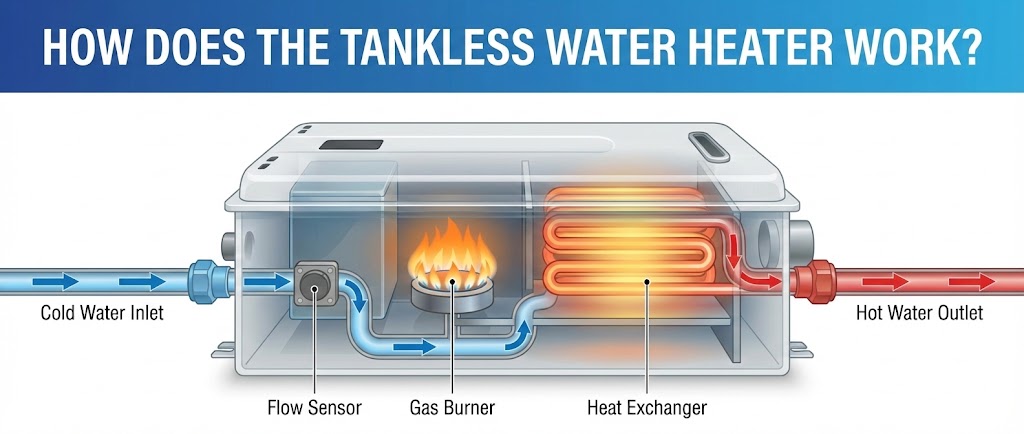
A tankless water heater works by heating water on demand rather than storing it in a tank. When a hot water tap is opened, cold water flows through a heat exchanger where electric elements or a gas burner rapidly raise the temperature to the set level. This process delivers continuous hot water while eliminating standby heat loss and improving overall energy efficiency.
A tankless water heater heats water as it flows through it.
Nothing is stored. Nothing is preheated.
The system stays inactive until water begins moving. The moment the flow starts, internal components respond in sequence.
Sensors read conditions. Control logic reacts. Heat is applied while water is already in motion. Everything happens in real time. That timing defines the system and explains why it is also called an instantaneous water heater.
The tankless water heater operation begins in a dormant state. When no fixtures are drawing hot water, the unit consumes no heating energy. Electrical elements remain off. Gas valves stay closed.
As a hot water valve opens downstream, cold water enters the unit through the inlet pipe. Entry alone is not enough. Movement must reach a specific flow rate before heating starts.
From this point forward, the system behaves dynamically. Water never stops inside the exchanger. Heating output changes continuously. The unit reacts rather than anticipates.
Inside the inlet section, a flow sensor monitors water movement. This sensor may use a rotating turbine, magnetic field variation, or pressure change. Its purpose is precise. Detect active flow and measure its rate.
Every unit has a minimum activation threshold. Below that level, heating remains disabled. This prevents overheating and protects internal components.
When the flow exceeds the threshold, the sensor sends a signal to the control board. That signal confirms that water is moving and that heating can safely begin.
This section drives the entire system. The control board functions as a real-time processor. It does not rely on presets alone. It continuously recalculates heating demand based on live inputs.
The first input is the flow rate. The board receives this value from the flow sensor and converts it into volume per unit time. This tells the system how much water must be heated every second.
The second input is the inlet water temperature. A temperature sensor at the inlet provides this data instantly. This value can fluctuate throughout the day and across seasons, so it cannot be assumed.
The third value is the target outlet temperature set by the user. From these three values, the board calculates temperature rise, commonly expressed as ΔT.
ΔT = Target Outlet Temperature − Inlet Water Temperature
For example, if inlet water enters at 15°C and the target outlet temperature is 50°C:
ΔT = 50 − 15 = 35°C
The control board then links ΔT with the flow rate. Heating demand is proportional to:
Flow Rate × ΔT
This means two things happen instantly:
If flow increases while ΔT stays the same, energy demand rises.
If the inlet temperature drops while the flow stays constant, the energy demand rises.
The control board updates this calculation continuously. Every small change in flow or inlet temperature triggers a recalculation. These updates occur multiple times per second.
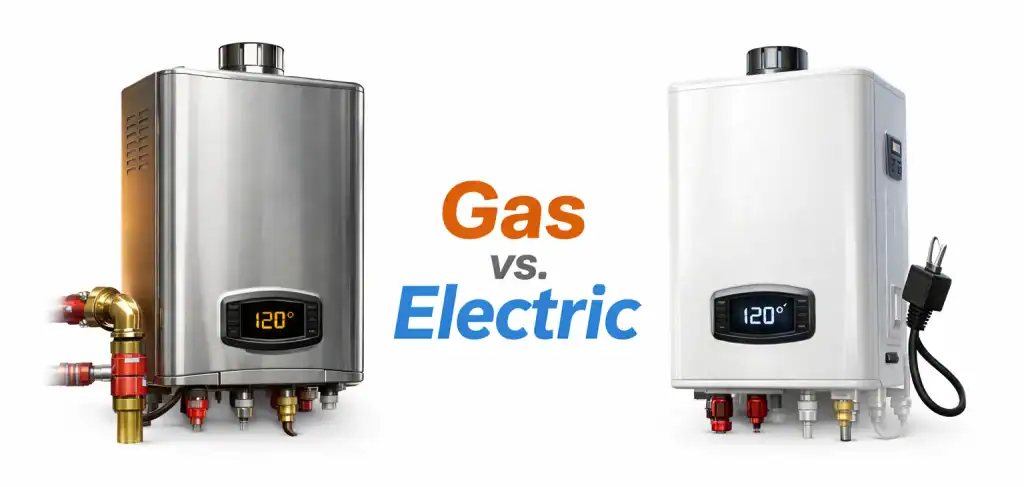
Once demand is calculated, the board determines how much energy the system can apply at that moment. In electric units, this means adjusting the current draw to the heating elements.
In gas units, this means regulating fuel delivery and combustion intensity.
This constant calculation loop is the core of tankless water heater operation. Heating output never stays fixed. It follows demand exactly as it changes.
Water then enters the heat exchanger. This stage defines the tankless water heating process.
The exchanger contains narrow internal channels. These channels force water into turbulent flow. Turbulence increases surface contact and improves heat transfer.
Heat moves from the exchanger walls into the flowing water through conduction and convection. Because the exchanger volume is small, the response time is immediate. Water never stops moving. There is no stored thermal mass. Heat exists only while flow exists.
Energy input begins instantly. In electric systems, resistance elements energise as current passes through them. Heat forms inside the element and transfers directly into the exchanger.
In gas systems, a burner ignites and directs flame across the exchanger surface. Combustion gases exit through a flue while heat remains in the metal.
This explains how tankless water heaters heat water without delay. Heat is applied only during flow. Faster flow demands more energy. Slower flow requires less. The system recalculates output continuously.
A continuous hot water system provides heated water for as long as the flow continues. There is no refill cycle. No recovery stage. Heating persists until flow stops. Capacity still matters.
Each unit has a maximum heating limit based on exchanger size and energy input. If demand exceeds capacity, outlet temperature drops instead of shutting down. Pressure loss occurs as water passes through narrow exchanger paths. This loss is predictable and part of system design.
Temperature sensors operate throughout the heating cycle. Inlet sensors track supply temperature. Outlet sensors measure delivered temperature.
The control board compares the actual outlet temperature with the setpoint. If deviation occurs, output adjusts immediately. This feedback loop keeps the temperature stable even during fluctuating demand. The system works only with live data.
Electric systems respond almost instantly. Energy transfer begins as soon as current flows. Gas systems experience a brief delay due to ignition and flame stabilisation.
Control logic accounts for this delay to prevent temperature fluctuation. Once active, both systems maintain steady output through modulation.
When a hot water valve closes, flow stops. The flow sensor detects the change immediately. Heating disengages. Electric elements deactivate. Gas burners shut down. Residual heat disperses through the exchanger body.
Some gas systems run fans briefly to clear exhaust paths.
Electric systems return directly to standby. Monitoring continues even without flow. Freeze protection, temperature limits, and fault detection remain active.
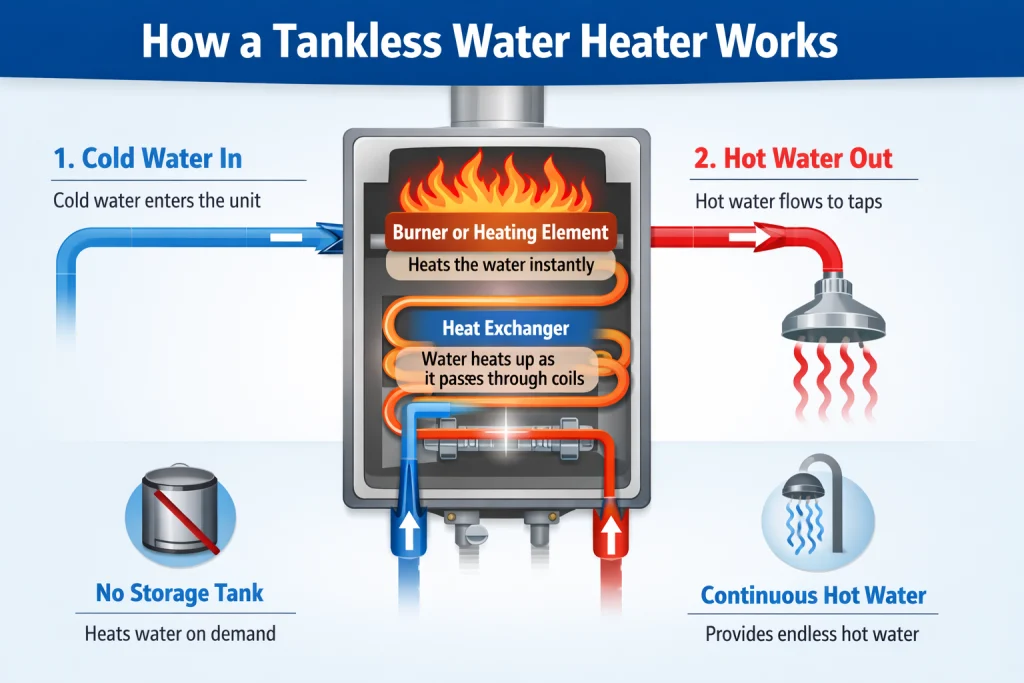
The tankless water heating process does not store heat. It creates it only when required. Through this approach, the system operates as an instantaneous water heater, an on-demand water heater, and a continuous hot water system simultaneously.
Tankless water heaters can be expensive to buy and install. Some homes may need gas or electrical upgrades. Hot water might take a few seconds to reach your taps, and the flow rate can be limited if multiple fixtures run at the same time.
A tankless water heater can supply an entire house, providing reliable hot water to multiple taps and appliances while helping reduce energy bills. Proper installation is key to getting the best performance from the system.
A tankless water heater can handle multiple showers running at the same time, as well as other appliances, but under one condition: The unit must be properly sized for your household’s hot water needs.
Tankless water heaters are very efficient. For homes using 40 gallons or less of hot water per day, they can save 24%–34% compared to traditional tank heaters. Even in homes with high hot water use, around 85–90 gallons daily, they can still be 8%–14% more efficient.
A tankless water heater should not be installed in areas with high humidity, moisture, or dust. Avoid places where it could get splashed with water, or under pipes and air conditioning lines that might leak or drip onto the unit.
Cold water can happen if mineral buildup clogs the system, if the unit is too small for your household’s needs, or if the heater hasn’t been properly maintained.
Tankless heaters can run out of hot water if the flow is too low, mineral deposits build up, the unit is installed incorrectly, or the system isn’t large enough for your needs. Regular maintenance and proper sizing help ensure a continuous hot water supply.
Quick Answer Yes, instant water heaters are safe when installed and used properly. Modern ones come with pre-installed safety features […]
Hot water feels simple. You turn the tap and expect warmth, every time. But behind that moment is a system […]
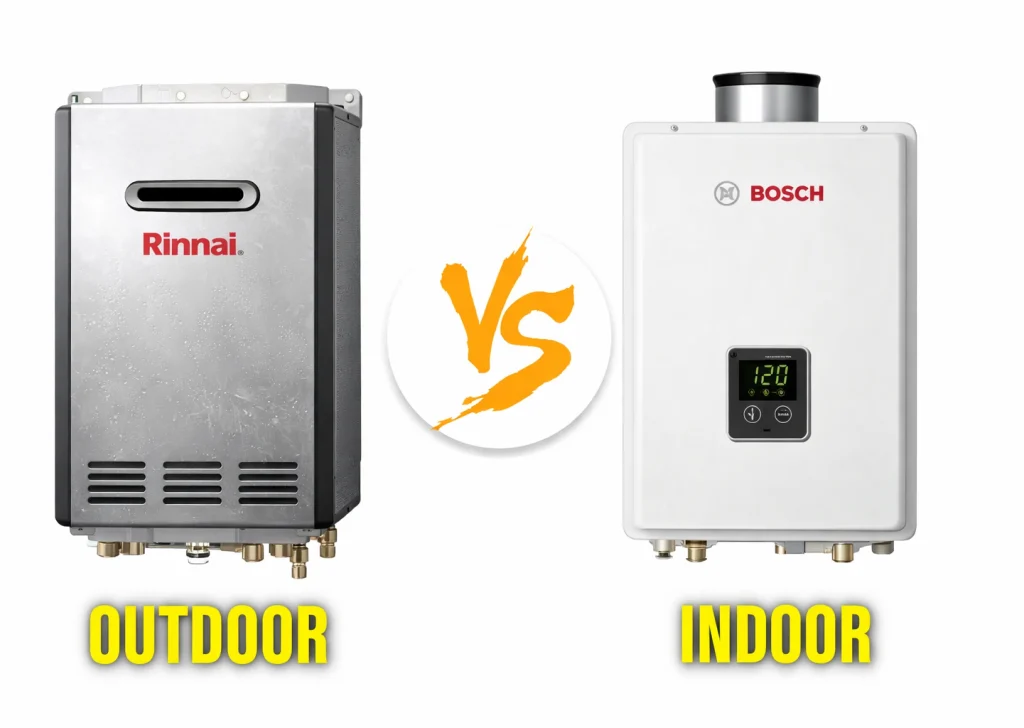
Quick answer The difference between indoor and outdoor tankless water heater setups comes down to placement and protection. Indoor units […]
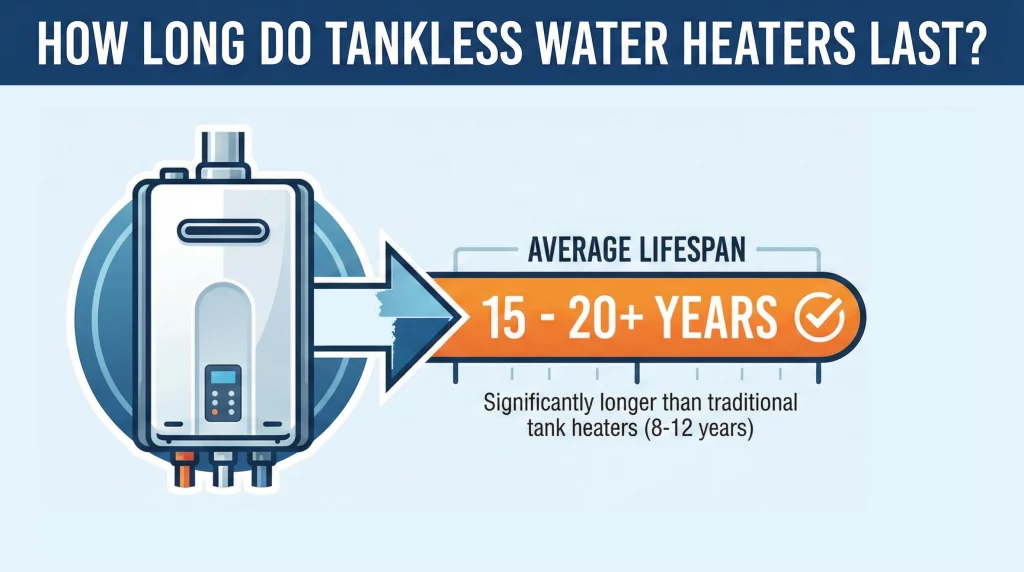
Quick Answer The average life expectancy of a tankless water heater falls anywhere between 15 and 20 years, and often […]




Our energy efficiency experts are here to answer all your questions and guide you through the products, rebates, and installation process.

Upgrade now, pay later with