
Quick Answer: Tesla Powerwall is best for those seeking a premium experience with a built-in solar inverter and superior whole-home […]
| Quick Answer: In Australia, the typical cost of a fully installed solar battery system is between A$6,500 and A$16,000+ in 2026. A standard 10kWh system generally ranges from A$8,000 to A$12,000. Meanwhile, smaller 5kWh systems start around A$4,000-A$6,000 after federal rebates. Larger systems for high-usage homes or businesses can cost over A$15,000. |
The final cost of a solar battery in Australia basically depends on the capacity, brand and installation complexity. But there’s more to the story.
Electricity prices are expected to rise by up to 9.7% in some states, which is why many homeowners are looking for ways to take control of their energy bills.
With solar batteries, you store excess solar energy generated during the day and use it at night or during peak pricing hours. This potentially helps you save hundreds or even thousands of dollars each year.
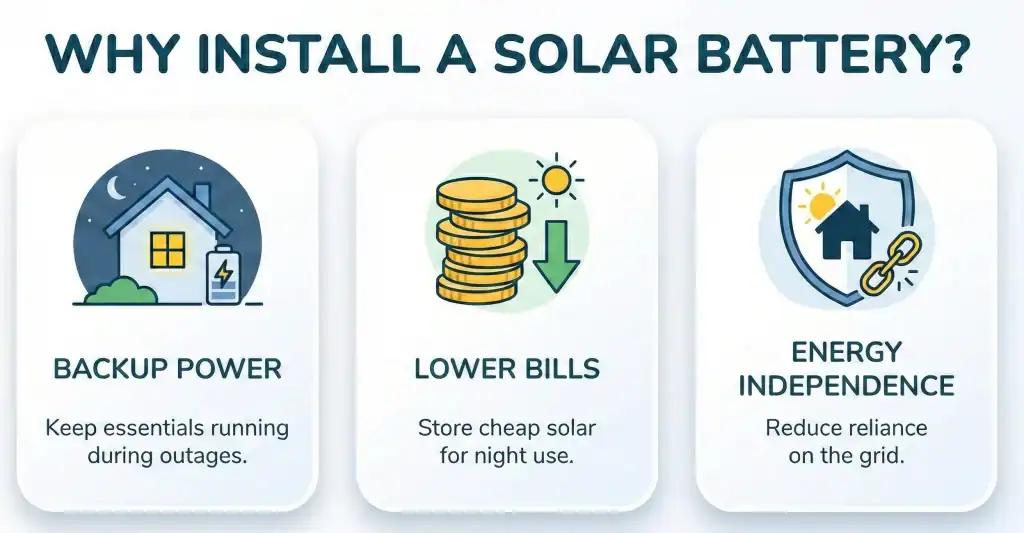
Aussies install solar batteries for many good reasons, which include:
🟩 Backup power: The average household in Australia basically experiences at least one unexpected blackout every year. Some areas like NSW, VIC and QLD can see outages that can last 6–12 hours during storms or heatwaves.
A solar battery can keep essential appliances running, such as the fridge, lights, Wi-Fi and even air-conditioning. For small businesses like cafés or offices, losing power for just 4–6 hours can cost A$500–A$1,000 in lost revenue, and this means batteries are a great investment.
🟩 Lower electricity bills: The average residential electricity price in 2026 is about 34 cents per kWh. Households typically earn 8–10 cents per kWh for exporting excess solar.
That’s a difference of roughly 24–26 cents per kWh. A household using a 10 kWh battery to store daytime solar energy for night-time use can save A$1,200–A$1,500 every year.
On the other hand, small businesses using a 20 kWh battery may see savings of A$2,500–A$3,500 annually.
🟩 Energy independence: Around 60% of Australian households say they want to rely less on the grid because electricity prices keep rising. A solar battery allows you to use your own energy when you want it.
Homes with batteries can cover 50–70% of their night-time energy use from stored solar, and this will depend on battery size and household consumption.
For small businesses, this can cover up to 80% of after-hours electricity use. This reduces reliance on expensive grid power and provides a safety net during price spikes.
Solar batteries are a big investment in 2026. It has become more common than in recent years and a little less expensive.
Here’s what typical installed pricing looks like right now:
| Battery size | Typical installed cost (Australia 2026) |
| 5-6 kWh | A$6,000-A$9,000 |
| 9-11 kWh | A$9,000-A$13,500 |
| 13-15 kWh | A$12,000-A$17,000 |
| 20-30 kWh (small commercial) | A$18,000-A$30,000+ |
| 40-50 kWh | A$35,000-A$45,000+ |
Cost per usable kWh typically ranges from A$800 to A$1,200, including installation. The cost for residential systems tends to be higher per kilowatt-hour compared to commercial ones, since the labour and compliance costs do not scale well.
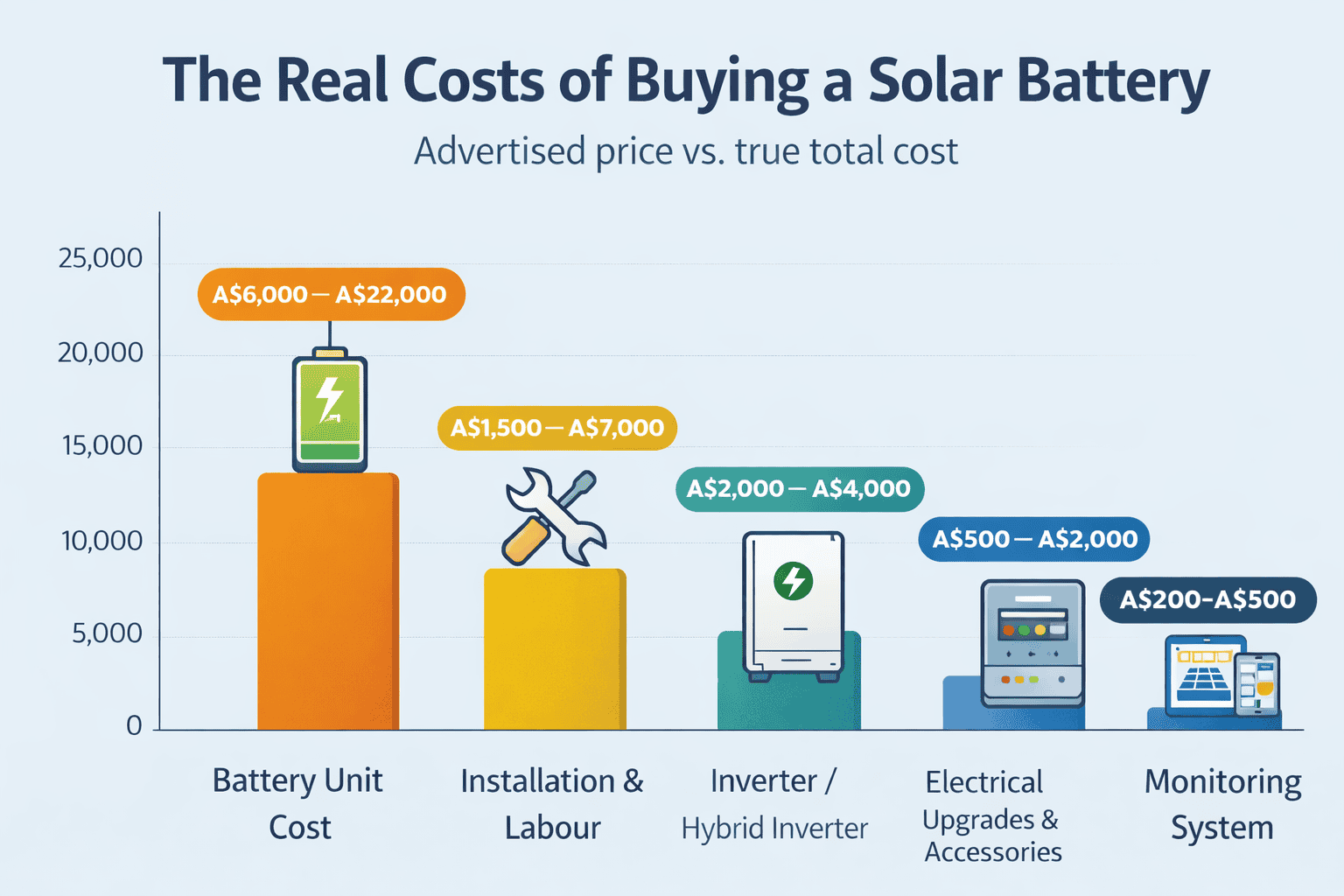
Many people mistakenly believe that when they find a solar battery for sale at a particular price on the internet, this is the price they will ultimately pay. It never is. There are more costs involved. Here is what really adds up:
🟩 Battery Unit Cost
This accounts for around 60-70% of the total cost. For example, a 10kWh battery for households will cost between A$6,000 and A$7,500. Larger commercial-scale batteries like a 25kWh model can cost between A$18,000 and A$22,000.
🟩 Installation & Labour
You’ll have to pay A$1,500–A$3,000 just to connect your battery to your domestic electrical system. Commercial sites can cost A$3,000–A$7,000 depending on complexity.
🟩 Inverter / hybrid inverter (if required)
If the current inverter does not match well with batteries, you will need a hybrid inverter, which costs around A$2,000—A$4,000.
🟩 Electrical Upgrades & Accessories
Some homes also require switchboard upgrades, safety isolators or additional wiring. This can involve an additional A$500–A$2,000.
🟩 Monitoring system
Some smart apps and web-based monitoring may incur an extra cost of a few hundred dollars.
Estimated total installed costs in AUD, including GST, before state-specific rebates.
| Brand & Model | Max Capacity (kWh) | Typical Installed Price (AUD) | Approx. Cost per kWh (AUD) | Warranty |
| Sigenergy (SigenStor) | 54 kWh | $11,500 – $14,500 | $850 – $1,150 | 10 Years |
| Alpha-ESS | 34.2 kWh | $8,200 – $13,500 | $800 – $1,000 | 5 Years |
| Sungrow SBR/SH | 25.6 kWh | $8,800 – $13,500 | $850 – $1,000 | 10 Years |
| Tesla Powerwall 3 | 13.5 kWh | $14,500 – $17,500 | $1,050 – $1,200 | 10 Years |
| BYD Battery-Box | 13.8 kWh | $9,000 – $12,000 | $800 – $1,000 | 10 Years |
| Anker SOLIX X1 | 10.1 kWh | $11,000 – $14,000 | $900 – $1,100 | 10 Years |
| Enphase IQ Battery | 10 kWh (stack) | $12,500 – $15,000 | $1,250 – $1,500 | 10 Years |
| Fox-ESS | 10.2 kWh | $7,500 – $12,000 | $800 – $900 | 10 Years |
| GoodWe Lynx | 9.6 kWh | $8,500 – $11,000 | $850 – $1,000 | 10 Years |
The figures above are “sticker prices.” Through providers like E-Green Electrical, you can often reduce these totals by $3,000 to $5,000, depending on state-specific programs like QLD’s Battery Booster or VIC’s interest-free loans.
There are a few key aspects that can make a solar battery much more costly compared to another. The following are the most important:
Different homes and businesses require different types of solar batteries. In fact, selecting the right size will help save money and ensure you have adequate power when you really need it. Here’s a quick guide:
Solar battery rebates in Australia have undergone significant structural changes. The Federal Cheaper Home Batteries Program, launched in July 2025, remains the primary incentive, providing an upfront discount of approximately 30%.
Rebates act as a direct point-of-sale discount applied by your installer, meaning you only pay the net price.
Solar batteries currently receive approximately $311 per usable kWh. A standard 10 kWh battery attracts a federal rebate of roughly $3,110.
The major change is that as of 1 May 2026, the rebate will transition to a tiered system to discourage “oversizing.” Support will be strongest for standard household sizes and drop significantly for larger capacities.
Common mistakes:
Buying a solar battery isn’t just about the price tag. There are a few more costs you need to know:
Old homes may require a new switchboard to support the battery voltage. This can cost between A$500 and A$2,000.
If your existing inverter is not compatible, you would need to replace it, which can cost A$2,000 to A$4,000.
Some batteries may have associated apps or monitoring systems. Advanced features may cost A$10-A$50 per month.
The batteries have a lifespan of about 10-15 years. Replacing them later in life means extra expense.
The major reasons for the high cost of solar batteries are related to the high cost of manufacturing the advanced lithium-ion technology and installation with appropriate complex and special hardware, such as inverters.
Most solar batteries last 10–15 years. This depends on how much energy you use every day. Lithium iron phosphate (LFP) batteries can last longer, sometimes up to 15 years or 10,000 cycles.
Yes. The battery charges from the electrical grid and offers benefits such as providing backup power during outages and saving money on electricity bills by using time-of-use tariffs.
A bigger solar battery can save more money by storing more excess solar energy for use during high-rate and off-peak times. However, it does not always provide a better financial return. Larger batteries are ideal for high-consumption households. They offer lower installation costs per kWh but a properly sized system for your specific energy usage usually provides the fastest payback period.
The Alpha ESS Smile Series and Sungrow SBR are consistently rated as the most affordable and best budget-friendly solar battery options in Australia. This is especially true when considering the available federal and state government rebates.
Yes! Federal and state programs can cut $3,000–$5,000 or more off the upfront cost, depending on your battery size and eligibility.
Installing at the same time as your solar system is often cheaper. Doing it later can require extra wiring, inverter upgrades, and additional labour.
Larger batteries cost more upfront, but usually reduce the cost per kWh. Premium brands like Tesla or Enphase also add extra for advanced features, software, and longer warranties.
Most systems pay for themselves in about 8–12 years, depending on your energy use, tariffs, and battery size.
They can be. If you want backup power, lower electricity bills, or more control over your energy, a battery can make a real difference, especially for homes using a lot of electricity in the evenings.
Similar to NSW overall: A$6,000–A$17,000 installed. Smaller residential batteries are at the lower end, and larger or premium systems are at the higher end.
A 10 kWh system generally costs A$8,000–A$12,000 installed, depending on the brand and your installation setup.
Installed systems usually cost between A$800–A$1,200 per usable kWh, with larger systems offering better value per kWh.
In NSW, prices generally range from A$6,000 to A$17,000, depending on size, brand, and any rebates available.
A Tesla Powerwall 3 usually costs around A$14,500–A$17,500 installed.
Typically, A$6,000–A$9,000 installed, depending on brand and installation complexity.
Quick Answer: Tesla Powerwall is best for those seeking a premium experience with a built-in solar inverter and superior whole-home […]
Quick Answer Adding a Battery to an Existing Solar System typically costs between A$8,000 and A$20,000+ in Australia. This will, […]
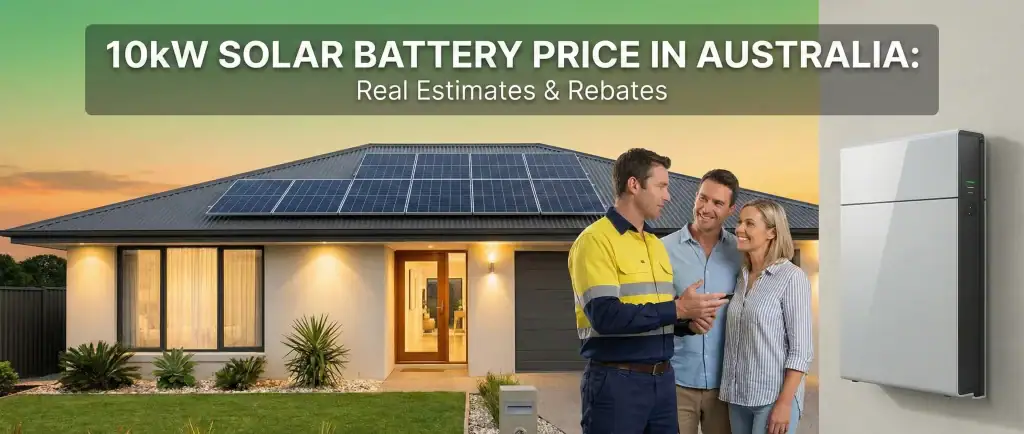
Key Takeaways More Australian households are looking at 10kW solar batteries for one simple reason. Power bills keep climbing, and […]

Australia’s energy landscape is shifting. With electricity prices climbing and solar feed-in tariffs dwindling, the “sunny country” is no longer […]






Our energy efficiency experts are here to answer all your questions and guide you through the products, rebates, and installation process.

Upgrade now, pay later with