Home batteries are becoming an increasingly common part of Australian households. When paired with solar, they help you store excess […]
Heating and cooling your space should feel comfortable, not stressful.
Yet for many households and businesses, HVAC costs feel heavy from the very first quote. The equipment is expensive. Installation adds more. And ongoing energy bills can quietly drain your budget month after month.
This is where HVAC rebates in Australia come into play. These incentives exist to reduce the cost of energy-efficient systems and encourage smarter choices across the country.
Many people ignore them, either because they are unaware or because the process feels unclear. But once you break it down, rebates in Australia are far more accessible than they seem.
With the right approach, you can lower upfront costs, cut long-term bills, and make choices that feel financially sensible while staying compliant with Australian standards.
Let’s talk through how it all works.
HVAC rebates in Australia are financial incentives offered to support energy-efficient heating and cooling systems. They usually come from government programs, energy providers, or state-based authorities.
The idea is simple. Efficient systems use less power, reduce strain on the national energy network, and cost less to run over time.
Rebates across Australia can appear in several forms. Some are instant discounts applied at the time of purchase. Others are cash-back offers paid after installation.
There are also tax-related incentives and utility-based programs that reduce future energy costs.
While the structure varies across states and territories, the goal remains the same. Encourage better systems. Reduce energy waste.
Ease the financial pressure on Australian households and businesses.
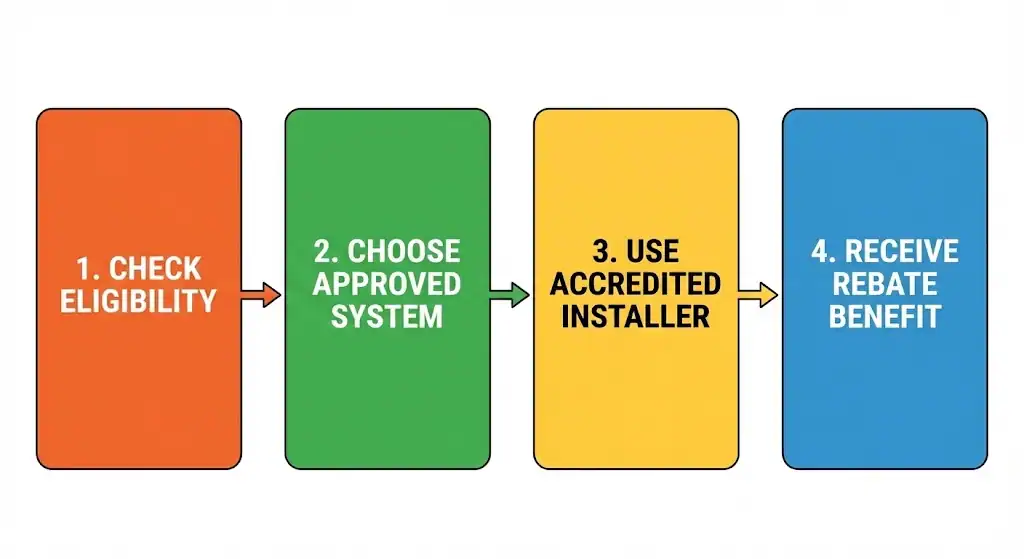
Most Australian rebate programs follow a clear pattern. You choose an eligible system that meets local efficiency standards.
The system must be installed by a licensed professional approved under Australian regulations.
After installation, you submit documents such as invoices, serial numbers, and compliance certificates.
Some rebates are applied immediately.
Others require approval and payment later. Timelines vary by state, but preparation makes the process smoother.
Understanding the steps early means fewer surprises later.
HVAC rebates in Australia are not limited to one group. They are structured to support a wide range of property types and users.
Whether you own, manage, or operate a space, there is a strong chance you may qualify. Understanding where you fit helps you approach the process with confidence.
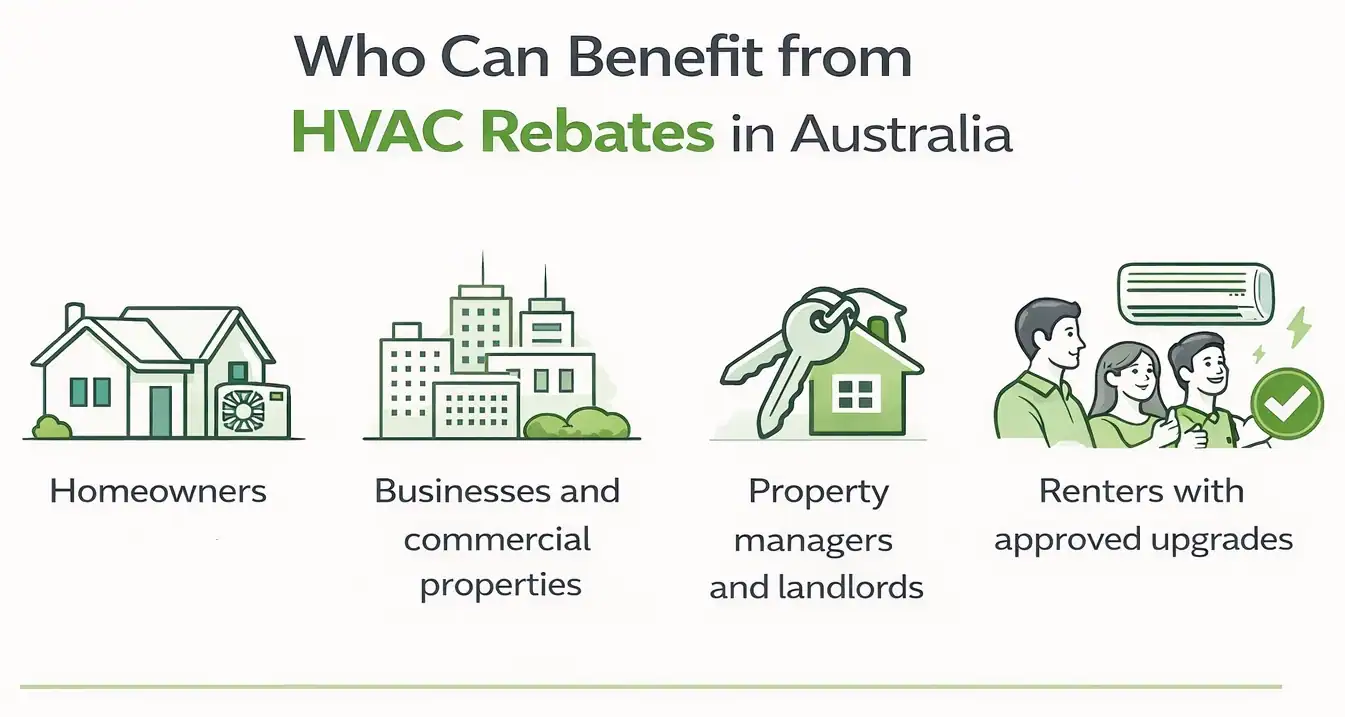
Homeowners in Australia are often the biggest beneficiaries of HVAC rebate programs.
Those replacing older or inefficient systems usually qualify for higher incentives. Rebates help reduce the upfront cost of upgrading to modern systems that use less energy.
Over time, homeowners also benefit from lower running costs. This combination makes rebates especially valuable for long-term savings.
Businesses across Australia can also access HVAC rebates, particularly when upgrading large systems. Commercial spaces tend to consume more energy, so efficiency improvements are strongly encouraged.
Rebates help offset the high cost of installing or replacing multiple units. Lower energy bills also improve operating margins over time. For many businesses, these savings add up quickly.
Property managers and landlords may qualify when upgrading shared or rental properties. Energy-efficient systems improve tenant comfort and reduce maintenance issues.
Rebates help lower upgrade costs while increasing property value. In some cases, incentives apply to multi-unit buildings. These benefits make efficiency upgrades more attractive for long-term property management.
Renters in Australia may also benefit, provided upgrades are approved by the property owner. Some rebate programs support tenant-initiated improvements that reduce energy use.
These upgrades improve comfort while lowering energy bills. While eligibility is more limited, it is still worth checking. Renters should always confirm approval and eligibility before proceeding.
At first glance, some HVAC rebates in Australia seem unusually high.
This isn’t random. Energy efficiency delivers long-term savings for everyone, not just the person installing the system. Lower energy use reduces pressure on infrastructure and helps stabilise supply during peak seasons such as summer heatwaves.
Australian governments and energy providers invest in these programs because prevention is cheaper than expansion. Supporting efficient systems now reduces the need for costly upgrades later.
That’s why incentives can feel surprisingly generous.
The type of HVAC system you choose in Australia plays a major role in determining the rebate amount.
Systems with higher efficiency ratings tend to qualify for better incentives because they use less energy over time.
Heat pumps often receive stronger support since they handle both heating and cooling efficiently in varied Australian climates.
Smart thermostats can also increase eligibility by improving temperature control and reducing waste. Choosing a system that meets or exceeds Australian efficiency benchmarks usually places you in a better rebate bracket.
Installation costs have a direct impact on rebate calculations across Australia.
Larger systems or complex installations often qualify for higher incentives because the upfront expense can be significant. Labour requirements, property layout, and system size all influence the final cost.
Rebate programs often aim to balance these expenses so quality installations are not avoided due to price. Getting accurate local quotes helps you estimate how the installation affects the incentive you may receive.
Timing can strongly influence how much rebate you receive in Australia. Some programs operate within strict funding cycles, meaning rebates may reduce once funds run low.
Seasonal incentives sometimes appear before summer or winter to encourage early upgrades.
Limited-time offers may also increase rebate values for a short window. Planning installation dates carefully helps you avoid missing out due to closed or reduced programs.
Getting the most from HVAC rebates in Australia is about preparation. Rushing into a purchase often leads to missed savings. A little planning goes a long way.
Early research helps you avoid choosing equipment that does not qualify. It also gives you time to compare options without pressure. Being informed early puts you in control of the process.
Australian rebate programs are structured to reward these choices. Looking beyond the initial price helps you see the real value. Efficiency often pays back faster than expected.
Missing documents can delay or cancel a rebate. Keeping everything organised from the start prevents stress later. Digital copies also help if follow-ups are needed.
Many Australian rebates require installation by licensed professionals. Experienced installers often know which systems qualify and how to complete compliance documents correctly.
They may also alert you to incentives you were not aware of. Choosing the right installer can make the difference between approval and rejection.
Different Australian programs reward efficiency in different ways.
Some focus on system type. Others prioritise energy ratings or installation scale. Comparing them side by side helps you see where real value lies.
Sometimes a smaller rebate paired with lower running costs saves more in the long run. Other times, a higher upfront rebate reduces financial pressure immediately.
Looking at total value instead of just rebate size leads to better decisions.
Installing a system at the right time can improve your savings. Some Australian incentives run for limited periods. Others reset annually with new funding. Acting early in these cycles often increases success.
Energy audits may also open access to additional rebates. Planning upgrades alongside assessments can reveal options you didn’t expect.
Missing these deadlines often results in automatic rejection. People usually assume late submissions will still be reviewed, but that rarely happens. Marking deadlines early helps avoid losing money unnecessarily.
This often leads to disappointment when the system fails eligibility checks. Confirming requirements before purchase prevents this issue entirely.
Inexperienced installers may also miss compliance steps. These errors can delay or cancel rebate approval. Choosing qualified installers protects both your system and your incentive.
In some cases, errors result in outright rejection. People often underestimate how closely applications are reviewed. Double-checking paperwork before submission saves time and frustration.
HVAC rebates in Australia are often just one part of the savings picture. Many programs are structured to support long-term efficiency, not just the initial installation.
These additional benefits can reduce ongoing costs and improve system performance over time. Understanding these extras helps you see the full value of upgrading.
Combining incentives can significantly reduce the total cost of an HVAC upgrade. Many people miss this opportunity by applying to only one program. Checking compatibility between incentives can unlock extra savings.
Over time, these lower costs can exceed the value of the initial rebate. Reduced energy use also stabilises monthly bills. This creates savings that continue long after installation.
They also help identify further opportunities to save energy. This support adds long-term value that is often overlooked.
Rebate programs in Australia change often.
Staying informed helps you plan upgrades more effectively. Official government websites are a good starting point. Energy provider updates are also useful.
A lot of the HVAC rebate and incentive info lives right on government energy sites. They often list current rebate programs for air conditioners, heat pumps, and other energy-efficient upgrades. For example:
Australian Government energy rebates page — lists federal and state/territory rebate programs.
Some states, like NSW and Victoria, have dedicated pages for upgrading household systems, including HVAC and cooling rebates or discounts.
Licensed Australian HVAC professionals often know which incentives are active. Asking them early can uncover options you may have missed.
Installers working with accredited systems and state programs often know:
HVAC rebates in Australia offer practical financial relief during system upgrades.
They reduce upfront costs, support efficient choices, and lower long-term energy expenses. With preparation and awareness, the process becomes manageable.
Taking time to research, compare programs, and plan installation can make a noticeable difference. Comfort doesn’t have to come with financial strain.
With the right steps, savings become part of the decision, not an afterthought.
All installations must strictly adhere to AS/NZS 3000:2018 (Wiring Rules).
Specifically, for rebates like the VEU (Victoria) or ESS (NSW), the system must be on a dedicated circuit if it draws more than 10A.
Furthermore, since the 2025/2026 updates, most states require Type A RCDs (Residual Current Devices) for inverter-driven HVAC units to handle pulsating DC leakage, which standard Type AC RCDs cannot detect.
Rebates are calculated based on Energy Savings Certificates (ESCs) in NSW or Victorian Energy Efficiency Certificates (VEECs) in Victoria.
One certificate typically represents one tonne of CO2 equivalent abated over the equipment’s lifetime.
The “deemed” savings are determined by the unit’s GEMS (Greenhouse and Energy Minimum Standards) registry rating and the climate zone of your installation.
Generally, no. Most 2026 rebate programs require the decommissioning of an inefficient host (like a ducted gas heater or old resistive electric heater) and its replacement with a high-efficiency reverse-cycle heat pump.
A smart thermostat alone rarely generates enough “abatement” to trigger a standalone government rebate unless bundled with a full system upgrade.
Federal incentives like Small-scale Technology Certificates (STCs) are subject to a “decline rate.”
Every year (and sometimes every six months), the “deeming period” (the number of years of future energy savings you can claim upfront) reduces as the program approaches its 2030 sunset.
In 2026, the STC multiplier is lower than it was in 2025, effectively reducing the “point-of-sale” discount.
To prevent “double-dipping” or keeping old inefficient units as backups, you must provide geo-tagged photos of the old unit’s nameplate and its destroyed state (e.g., a hole drilled in the coil or refrigerant recovery certificates).
Without these “before and after” digital proofs with GPS metadata, accredited providers cannot mint the certificates required for your rebate.
Yes. To qualify for 2026 incentives, most states now require a minimum Seasonal Energy Efficiency Ratio (SEER) or HSPF (Heating Seasonal Performance Factor) that exceeds standard retail units.
For example, many programs now mandate a CoP of at least 3.5, meaning for every 1kW of electricity consumed, the system must move at least 3.5kW of heat.
In NSW, you can now earn PRCs in addition to ESCs. While ESCs reward general energy savings, PRCs specifically reward systems that reduce strain on the grid during summer peaks (2:30 PM – 8:30 PM).
To qualify, your HVAC system often needs to be DRED-enabled (Demand Response Enabling Device), allowing the utility to adjust the load during grid emergencies subtly.
Home batteries are becoming an increasingly common part of Australian households. When paired with solar, they help you store excess […]
Air conditioning rebates in New South Wales are often misunderstood. Many people assume they work like traditional government grants: apply, […]
Managing the heat in New South Wales can be a struggle, especially when power bills start to rise. Air conditioning […]
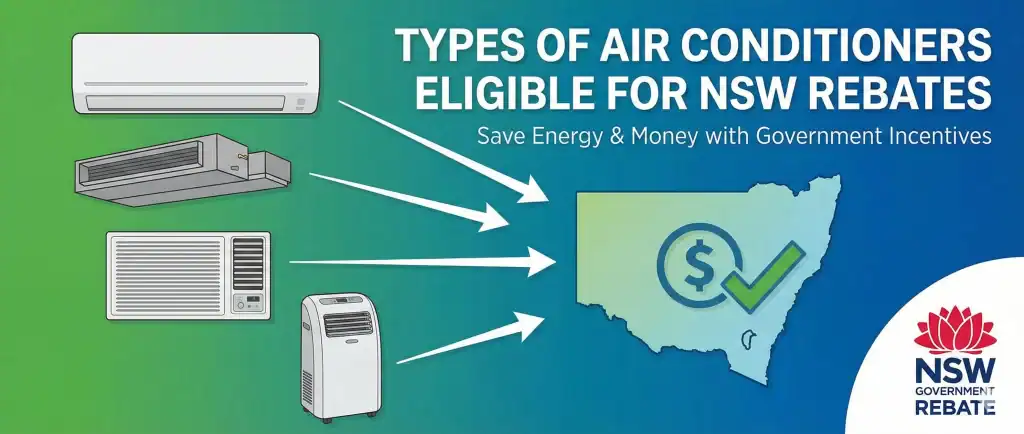
Electricity prices across NSW have been rising, with some households seeing bill increases of up to 9.7%. Most people feel […]
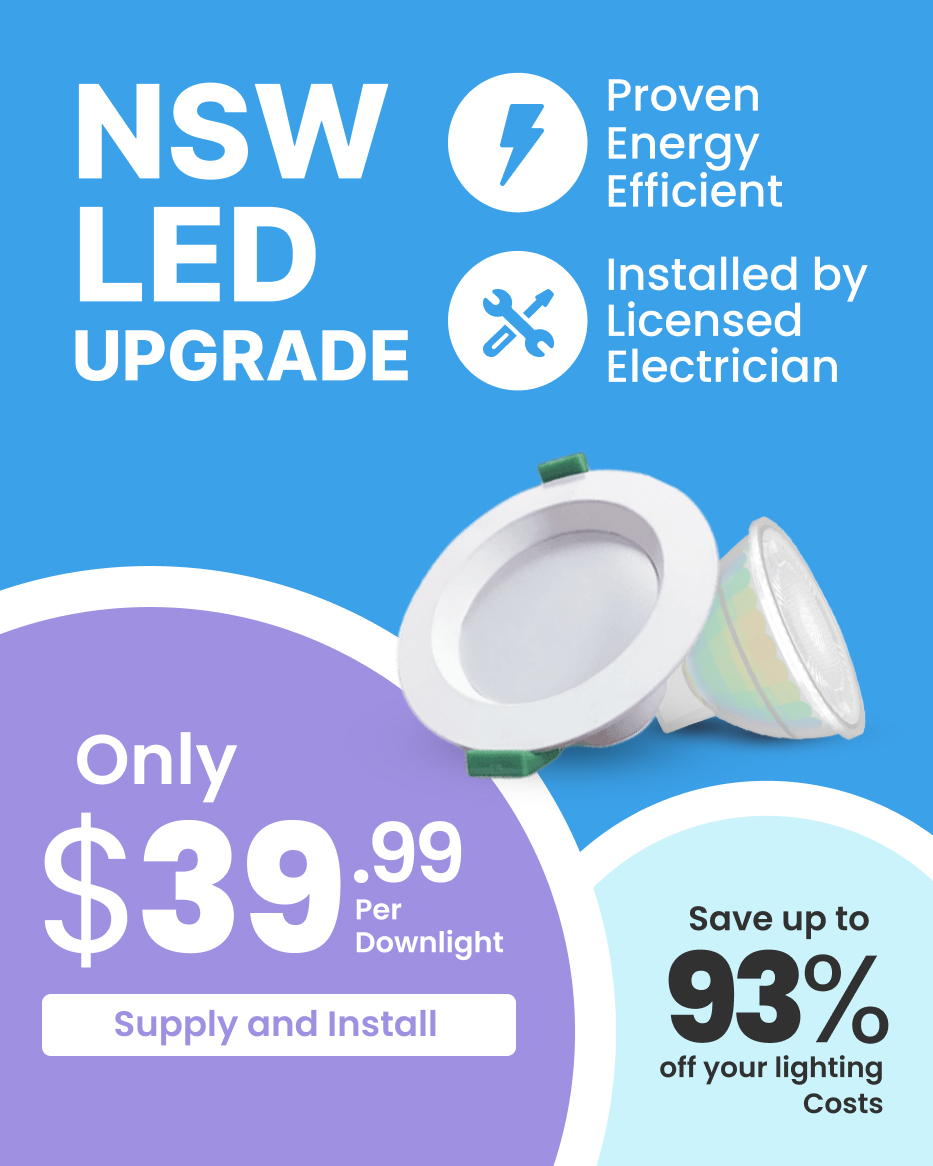



Our energy efficiency experts are here to answer all your questions and guide you through the products, rebates, and installation process.

Upgrade now, pay later with