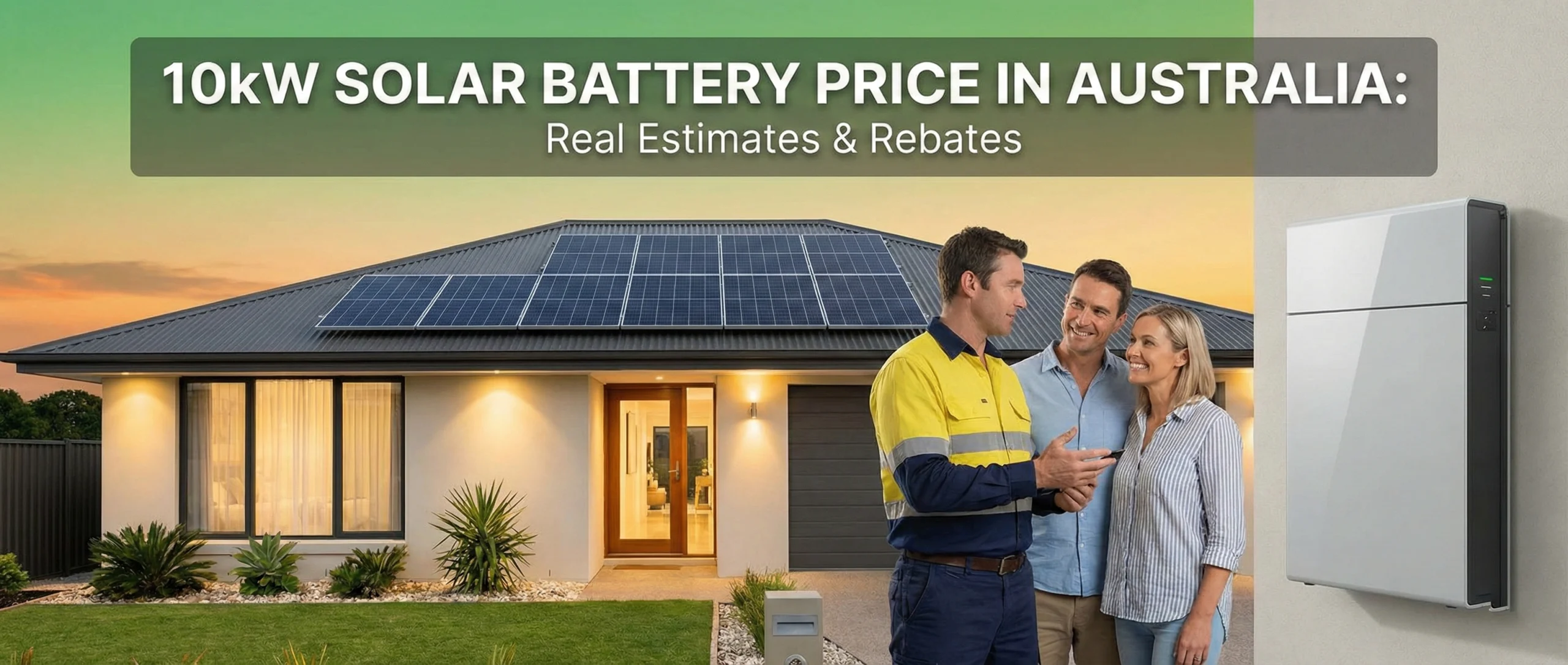
A 10kW battery can support most homes, but not everything at once
Around 20–30 solar panels are commonly paired with a 10kW battery
Best suited to households with high evening electricity use
More Australian households are looking at 10kW solar batteries for one simple reason.
Power bills keep climbing, and grid reliability isn’t what it used to be. Add frequent blackouts in some areas and falling solar feed-in rates, and storing your own energy starts to make sense.
This article answers the most common questions people ask before committing to a 10kW battery—costs, Capacity, Panels, and what it actually runs in day-to-day life.
How Much Is a 10kW Battery for Solar in Australia?
Before looking at numbers, it helps to know what you’re paying for. A 10kW battery price isn’t just about capacity. It reflects warranty length, cycle limits, backup capability, and brand support.
Here’s how the costs usually break down.
Typical price range (battery only) A 10kW battery unit alone usually costs between $6,000 and $10,000 in Australia. Entry-level models sit at the lower end, while premium brands with longer warranties and higher cycle ratings sit at the top.
Batteries with blackout support and better monitoring features tend to cost more, but they also offer more flexibility in daily use.
Price with installation Once installation is included, total costs often land between $8,000 and $15,000. This includes labour, safety equipment, system testing, and compliance certification. Homes that are battery-ready stay closer to the lower end of that range.
Why do costs vary between brands and installers? Pricing changes based on battery chemistry, warranty period (often 10 years), usable capacity, and installer experience. Two systems may look similar on paper, but perform very differently over time.
✅ Quick Answer: Most Australian households pay around $10,000–$13,000 installed for a quality 10kW battery system.
✅ Good to Know: Cheaper batteries can cycle out sooner, which increases long-term replacement costs.
Installation labour costs Labour typically accounts for $1,500–$3,000 of the total cost. This covers mounting the battery, electrical connections, system testing, and paperwork. Straightforward installs take less time and cost less.
Electrical upgrades Older homes may need switchboard upgrades or circuit separation. These upgrades can add $500–$2,000, depending on complexity. While it adds cost, it also improves safety and reliability.
Inverter compatibility Homes without a compatible inverter may need a hybrid or battery-ready inverter. This can add $2,000–$4,000 if not already installed.
✅ Note: Backup functionality increases installation time and cost due to extra wiring.
Can a 10kW Battery Run a Whole House?
This question comes up constantly, and the answer depends on expectations. A 10kW battery doesn’t give unlimited electricity. It gives stored electricity.
What matters is how that energy is used.
What “whole house” really means For lighting, refrigeration, internet, TVs, and small appliances, a 10kW battery performs well. These loads are steady and predictable. High-draw appliances change the picture quickly. When people say “whole house,” they usually mean living normally — lights on, fridge running, TV going, maybe the air con in the background. A 10kWh battery handles everyday essentials comfortably. These loads are steady and predictable. The challenge starts when high-draw appliances switch on. Electric ovens, ducted air conditioning, or multiple heavy appliances running together can drain stored energy much faster. So yes, it can power your home — just not everything at once without limits.
Essential loads vs everything running Running a fridge (150–200W), lights (300–500W), TV (100–200W), and internet is easy. Add electric cooking, heating, and multiple AC units, and stored energy drains fast.
Daytime vs nighttime performance During the day, solar panels reduce battery drain. At night, the battery does all the work.
✅ Quick Answer: Yes, with limits and smart usage.
✅ Remember: Once stored energy is used, the system switches back to the grid.
Is 10 kW Enough to Run a House?
For many homes, yes. For all homes, no.
Small, medium, and large households Small households using 10–15 kWh per day often find 10kW more than sufficient. Medium households using 15–25 kWh usually manage comfortably. Larger homes using 30+ kWh per day need to manage peak usage carefully.
Typical Australian energy usage The average Australian home uses about 18–22 kWh per day, which fits well within a 10kW battery system when paired with solar.
With solar vs without solar With solar, the battery refills daily. Without it, the battery empties once and stays empty.
✅ Key Takeaway: 10kW works best when paired with solar and sensible usage habits.
How Many AC Units Can Run on a 10kW Power Supply?
Cooling is one of the biggest energy draws in a home, especially in summer.
Average AC power consumption A typical split system uses 700–1,500 watts while running. Startup demand is higher but short-lived.
Split systems vs ducted One or two split systems can usually run at the same time. Ducted systems often draw 3–5 kW, limiting what else can run.
Real-world scenarios Running two split systems plus basic household loads is realistic. Running multiple large systems at once is not.
✅ Quick Answer: Usually 1–2 split systems, depending on size and efficiency.
✅ Warning: Starting multiple AC units at once can overload the system.
How Many Solar Panels Are Needed for a 10kW Battery?
It is a mistake to size a solar system based purely on the battery’s capacity. The panels have a dual job: they must power your home in real-time while generating enough surplus to fill the 10kWh “tank” before the sun goes down. If the array is too small, you’ll rarely see a full charge.
For most Australian households, the standard recommendation is 25 panels (400W each).
This 10kW configuration provides the necessary headroom to charge the battery while simultaneously running constant loads like refrigeration and air conditioning. For maximum benefits, opt for 26 to 28 panels.
They compensate for reduced production during the winter months. That extra capacity ensures the battery reaches 100% even on shorter, cloudier days when solar yields naturally drop.
Ultimately, a 10kWh battery is only an asset if you have the solar capacity to fill it. Undersizing the array results in an undercharged battery and forced reliance on the grid during expensive peak evening periods.
✅ Good to Know: More panels improve winter and cloudy-day performance.
How Many 400W Solar Panels Do I Need for 10kW?
This one comes down to simple maths, then real-world adjustments.
Roof space considerations Each panel needs about 1.7–2 m², so 25 panels require roughly 45–50 m² of roof space.
Orientation and efficiency losses Losses from shading and angle often push recommendations to 26–28 panels.
✅ Quick Answer: Around 25 panels, with slight variation based on roof layout.
How Much Will a 10kW Battery Save Me?
Savings depend on how and when electricity is used.
Electricity bill reduction Many households see savings of $1,000–$2,000 per year, depending on tariffs and usage patterns.
Time-of-use optimisation Using stored energy during peak pricing hours avoids the most expensive grid rates.
Feed-in tariff impact Lower export rates make self-consumption more valuable than selling power back to the grid.
✅ Note: Two identical systems can deliver very different savings.
2026 Solar Battery Price: Before vs. After Rebates
Gross Price vs. Net Price
The Gross Price is the total cost of your battery system before any government discounts. This figure covers the battery itself, the inverter, and the actual labor for installation.
Installers quote this full price because the federal rebate is tied to the day the unit is bolted to your wall, not the day you sign the contract.
This means that if an installation delay pushes your job past a scheduled rebate drop, the Gross Price stays the same, but your out-of-pocket costs will rise.
Right now, the federal rebate gives you roughly $311 for every usable kWh of storage.
For a standard 10kWh battery, that’s a $3,110 upfront discount that the installer takes off your bill immediately.
However, this is changing soon. On May 1, 2026, this rate drops to $252 per kWh, which will instantly make a 10kWh system about $600 more expensive than it is today.
2026 Price Comparison (10kWh Systems)
Budget / Entry-Level: Systems from brands like Alpha ESS or Goodwe usually have a gross price between $11,500 and $13,000. Once the federal rebate is applied at the point of sale, your actual cost drops to between $8,400 and $9,900.
Mid-Range / Best Value: This category includes popular brands like Sungrow or Sigenergy. These carry a gross price of $13,500 to $15,500, but the rebate brings your final out-of-pocket cost down to $10,400 – $12,400.
Premium / High Performance: Top-tier hardware like the Tesla Powerwall 3 or Enphase is priced between $16,000 and $18,500 gross. After the rebate is deducted, you are looking at a final price of $12,900 – $15,500.
Key Incentives & Deadlines
The May 1st “Rebate Cliff”: This is the most important date on the calendar. To get the higher discount, your system has to be fully installed and turned on before May 1st. Simply signing a contract isn’t enough; the physical work must be finished to lock in the lower price.
State Stacking (NSW): If you live in New South Wales, you can often “stack” extra savings by joining a Virtual Power Plant (VPP). This can add up to $1,100 in extra credits, which can bring the total cost of a budget 10kWh system down into the $7,000 range.
Frequently Overlooked Questions About 10kW Batteries
These are the questions people often forget to ask.
Can it work during blackouts? Only if backup functionality is included and installed.
How long will it last? Most quality batteries last 10+ years or 6,000–10,000 cycles, depending on use.
✅ Good to Know: Battery lifespan depends more on usage patterns than calendar time.
Final Quick Recap
Cost: $8,000–$15,000 installed
Capacity: Suitable for most households
Panels: Around 25 x 400W panels
Ideal users: Homes with high evening usage
Conclusion
A 10kW solar battery sits in a practical middle ground for many Australian homes.
It’s large enough to make a real difference to power bills and energy independence, without being excessive for average household use.
When paired with the right number of solar panels, it helps shift daytime generation into the evening, where electricity costs are often highest.
That said, a 10kW battery isn’t a magic switch that replaces the grid entirely. Its value depends on how electricity is used, how often heavy appliances run together, and whether the system is sized properly from the start.
Homes that plan their usage, understand their daily consumption, and invest in high-quality components tend to get the best results.