Hot water usage refers to all the energy consumed to heat water for domestic purposes. While this is often overlooked, […]
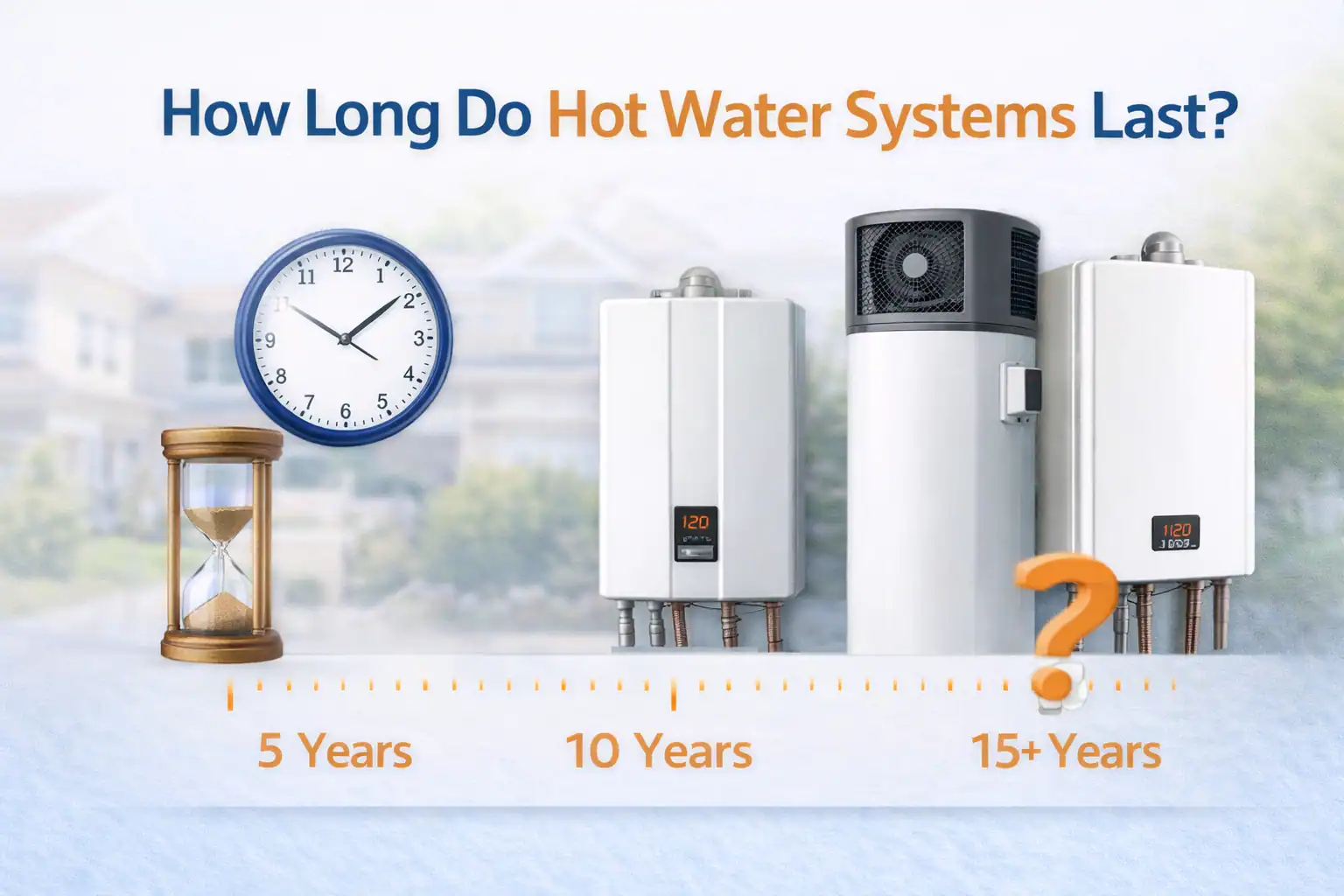
Quick Answer:
Hot water systems generally last between 8 and 20 years, with the average lifespan for most storage tank systems being 8-12 years. Lifespan depends on type, water quality, and regular maintenance.
Typical Lifespan by Type:
Hot water systems can last ten, fifteen or maybe twenty years. However, it depends because two homes can install the same system in the same year and end up with very different outcomes. One unit might still be ticking along years later. The other could be leaking, tripping, or barely keeping up long before that.
That gap usually has nothing to do with luck. It comes down to how the system is built, how hard it’s pushed, what kind of water runs through it, and whether anyone ever looks after it.
This article breaks down hot water system lifespan by type, factors that quietly shorten or extend service life, and more.
A hot water system doesn’t suddenly stop working on its “expiry date.” Most systems decline slowly. Output drops. Recovery time stretches. Fault codes start popping up. Small leaks appear. Energy use creeps higher.
From a technical point of view, end of life usually means one of four things has happened.
In storage systems, the tank itself often decides the outcome. Once corrosion breaks through the steel, the game is over. In more complex systems, the tank may still be fine, but electronics, compressors, or heat exchangers call time first.
So when we talk about lifespan, we’re really talking about the point where the cost of a repair—like a cracked tank or a burnt-out compressor—outweighs the value of a new and more efficient unit.
Typical lifespan: 10–15 years
This type of hot water heater is the most popular in Australia.
It basically heats and stores water in an insulated tank.
The inside of a steel cylinder contains a heating element, which is a metal coil that becomes hot to heat the water. They’re very inexpensive to purchase, not to mention easy to install, which has made them a popular choice for several decades.
🟩 Hard water scale thickness vs heat transfer efficiency:
In parts of Australia with high mineral content, calcium carbonate builds up on the heating element.
Just 3mm of scale can drop heating efficiency by 15% to 20%. This makes the element run hotter for longer and eventually causes it to burn out or stress the tank wall.
Anode inspection/replacement intervals: This is the most ignored maintenance task.
The sacrificial anode is a metal rod that corrodes so your tank doesn’t. If you replace this every 3 to 5 years, you can literally double the life of an enamel tank.
🟩 Operating temperature setpoints (60°C vs 50°C):
Pushing a system to higher temperatures increases the internal pressure and speeds up chemical corrosion. Meanwhile, lowering the thermostat slightly (while staying above the 60°C safety limit for bacteria) can reduce wear.
🟩 Off-peak vs continuous power cycling: Usually, off-peak heating happens once a day. This means the water goes from cold to very hot in one big burst. Continuous systems keep the water topped up.
The constant expansion and contraction from off-peak cycles can lead to “metal fatigue” over many years.
Typical lifespan: 8–12 years
Gas storage units operate similarly to electric ones but use a gas burner at the bottom and a flue running through the centre.
They are popular because they have a faster “recovery rate”—they heat water more quickly than electric elements. While the tanks face the same corrosion risks as electric models, the way they heat the water is slightly more “gentle” on the internal lining.
These units are sturdy, but the gas valve and pilot light assembly are common points of failure as the unit hits the 12-year mark.
In an electric tank, the element gets incredibly hot in one tiny spot. In a gas unit, the flame spreads the heat across the entire base of the tank. This “gentle” approach means the tank lining isn’t under as much localised stress.
In addition, because the heat rises through the central flue, the water warms up more evenly. You don’t get the same “hot spots” that can cause the protective lining to crack or flake off prematurely.
Typical lifespan: 15–20+ years
Gas instantaneous systems take a different approach. No tank. No stored hot water. When you open a tap, cold water flows through a compact heat exchanger while a burner fires up to match demand. Close the tap, and the system rests.
Removing the tank removes one of the most common failure points in hot water systems. There’s no standing water slowly attacking steel. That’s why these systems last longer.
🟩 Scale accumulation:
Water passes through very thin copper pipes called a heat exchanger. Scale buildups in this area can impede water flow and make the machine heat up.
🟩 Thermal stress cracking:
This is where the metal is stressed by moving from 15°C to 50°C in a few seconds. Cracks can develop in the heat exchanger in 20 years if the above changes continue to occur rapidly.
🟩 Failure of Sensors:
All these devices are intelligent. There are flow sensors and oxygen sensors. If any one of these small electronics fails and is not replaced, the entire device will not function.
Typical lifespan: 10–15 years
Electric instantaneous systems heat water on demand using very powerful heating elements. There’s no tank, no stored volume, and no waiting for recovery. You turn on the tap, and the element fires instantly.
They draw a large amount of power in a short time. That heat is concentrated in a small space. Elements, relays, and internal wiring all take a hit every time the system ramps up. Over time, that adds wear.
They work best as point-of-use units. One bathroom. One sink. Maybe a small apartment. When people try to stretch them beyond that, lifespan drops fast.
Electrical supply also matters. Voltage fluctuations and undersized cabling create extra heat in components that were already running hot. That combination is often what ends these systems early.
Typical lifespan: 10–15 years (tank), 7–12 years (compressor)
Heat pump systems are extremely different from other heaters. They usually extract the warmth from the surrounding air and transfer it into the stored water via a refrigeration cycle.
This drives running costs down, but it introduces more moving parts than any other residential hot water system.
Inside a heat pump unit, there is a compressor, fan, evaporator, condenser, expansion valve, sensors, and a control board, all working together. When everything is properly balanced, they run efficiently and quietly. In case something goes wrong, wear increases quickly.
The storage tank, which is part of the heating and cooling system of a heat pump, is very much like an ordinary electric tank.
It has a refrigeration system sitting on top of a water tank. You’ve got a compressor, a fan, and a series of sensors all working together. If any of these parts fail, the system won’t heat, even if the tank is perfectly fine.
You have to think of these as two separate machines. The tank will likely last 15 years, but the compressor—which is the “engine”—usually has a shorter life.
In coastal areas of Australia, salt air can eat the evaporator coils in under a decade if they aren’t treated with a protective coating.
The most common killer is compressor wear. If the unit is undersized, it runs for 18 hours a day to keep up with demand. This actually shortens its life.
Refrigerant leaks are also a factor. A tiny vibration can cause a rub-through in the copper piping, leading to gas loss. Once the gas is gone, the compressor works harder, overheats, and dies.
Typical lifespan: 15–20 years (collectors), 10–15 years (tank & components)
Solar is a great long-term play for the Australian sun. The glass panels (collectors) on the roof are very durable.
They handle sun, rain, and wind for 15-25 years. The tank, which is either on the roof or on the ground, follows the same rules as other storage tanks and can last for 10-15 years.
The main point of failure is often the “circulator pump” or the “backup element” used on cloudy days.
What is so confusing is that people hear stainless steel and automatically think that it is what makes the system last longer. Others say that the enamelled tank is better just because that’s what plumbers have always used.
However, the truth is in the chemistry, in the coats, in your water.
Let’s break it down properly.
The tank is still basically a steel tank, even if it is lined with enamel.
Mild steel is usually used for this purpose. Steel rusts in the presence of oxygen and water. This is why the inside of the tank is sprayed with a glass-like coating of enamel.
If the enamel is in good condition, water will never come into contact with the steel.
But there’s a problem. Enamel is not flexible. Steel expands and contracts with every cycle of heating and cooling. Microscopic flaws are generated in the lining over time. You can’t spot them. But the water can.
All that changes with the sacrificial anode.
The anode rod will be made of magnesium or aluminium, which will be more reactive than steel. Corrosion will attack the anode first. As long as it still has material, the tank will be intact.
After the depletion of the anode and the formation of cracks within the enamel, corrosion will directly attack the steel tank. This constitutes a point where failure is certain to happen.
So, enamel-lined tanks never “fail suddenly” on people. Failure happens if maintenance was halted or if the anode quietly disappeared years ago.
Stainless steel has a completely different mechanism for protection. No coating at all. Nor anode, in most variants. Nor any sacrificial component.
Rather, the corrosion protection provided by stainless steel involves chromium, which exists in the steel alloy. Chromium oxidises and creates a passive layer of oxide around the steel. This passive layer self-heals. If scratched, it heals. That’s the major gain here.
Water is in direct contact with metal, but metal is self-protecting.
However, there is an important condition to this protection.
It is susceptible to chlorides. Chlorides attack the passive layer and cause it to break down, and this results in a localised attack in the form of pits, holes, and/or stress corrosion cracks. It starts moving and spreading rapidly.
This is why stainless tanks can function so well in certain areas but fail miserably in others.
The concentration of chloride ions in water is the most critical factor considered when deciding whether to use stainless steel or enamel.
Stainless steel tanks can resist low to moderately high levels of chlorides. However, once the levels exceed the specified tolerance, the danger increases significantly.
Chloride levels in some environments, such as the coastline, bore water, or a treated municipal supply, may be high.
Enamel-lined tanks, on the other hand, are not impacted by chlorides. The presence of the enamel surface provides protection. The chlorine ions do not corrode it like stainless alloys.
In low-chloride, neutral-pH water, stainless steel tanks generally last much longer than those lined with enamel.
There is no anode depletion. No coating cracking. No creep from internal corrosion. Fatigue is still there, but corrosion is slowed dramatically.
This is why stainless tanks work so effectively in urban water supplies where the chemistry is controlled. It’s possible for them to last 20+ years.
“Enamel tanks, even well-maintained ones, are still protected with consumable coatings. Once the maintenance is ignored, the deterioration progresses rapidly. Stainless tanks do not have that problem.”
You’ll pay a premium for stainless steel—often 20% to 30% more upfront. But you have to do the “Aussie math.” Over 20 years, an enamel system might require two anode replacements (about AUD 200–AUD 300 each) and will likely need to be replaced entirely at least once.
The stainless steel unit is a “set and forget” investment that usually pays for itself by avoiding that second replacement cycle.
A family of five using the hot water all morning puts more stress on the metal than a single person. Every time the water heats up, the tank expands. Every time it cools, it contracts. This “breathing” eventually causes microscopic cracks in the lining.
Legally, hot water must be stored at at least 60°C to kill Legionella bacteria. However, some people crank it to 70°C. For every 10°C increase, you significantly speed up the chemical reactions that cause corrosion.
If a plumber doesn’t install a “pressure limiting valve,” your tank is under too much stress from the street mains. In many Australian suburbs, water pressure can spike at night, and without a valve, your tank is taking those hits directly.
If your system is tucked away in a tiny crawl space or behind a fixed deck, it won’t get serviced. It’s that simple. If a plumber has to spend two hours just reaching the valves, you’re less likely to call them for a routine check. Systems that are easy to access usually get their anodes changed and their relief valves flicked, which adds years to their life.
Installing a 135L tank for a household of six is a “duty cycle mismatch.” The system will be running at 100% capacity constantly. This “usage intensity” means the heating elements or burners never get a rest. It’s better to have a larger tank that works easily than a small tank that’s constantly struggling to keep up.
In Australia, “water” isn’t the same everywhere. What comes out of a tap in Melbourne is vastly different from what you’ll find in Alice Springs or the Perth hills.
“Hard water” contains high levels of dissolved calcium and magnesium. When heated, these minerals solidify into scale.
Stainless steel is a premium choice, but it has a limit. Most manufacturers specify a chloride limit (often around 200mg/L). If you exceed this, the chloride ions “eat” the protective film on the stainless steel. This causes it to fail much faster than a cheap enamel tank would.
The pH scale runs from 0 (acidic) to 14 (alkaline). Australian drinking water is usually kept between 6.5 and 8.5. If your water leans towards the acidic side (common in some bore water setups), it becomes “aggressive” and will strip the copper right out of your heat exchangers and pipework.
Installing a water softener can save your appliances, but it’s not a magic fix for hot water.
Most hot water heaters are not replaced when they stop functioning.
They are replaced when they stop working well. From a technical standpoint, there are definite indicators that specify when a system is no longer useful just because it heats water. Let’s find out more about those markers.
“The older the system, the more it struggles to work. In more than a decade, the storage tank is filled with ‘sludge’ – mineral sediment and rust flakes. The gunk collects at the bottom, just where the heat is applied.”
Always use the 20% rule. This means that once your tank reaches an average of 1/5 full of sediment, your heater will need to be left on for an extended period of time to heat up your water and struggle through your mud.”
If your power and gas bills have been steadily increasing by 15 to 20% without any change in your usage patterns, that is when your heating system is probably struggling against the internal buildup.
Corrosion deteriorates the tank walls, pressure relief valves seize, gas burners build up incomplete combustion residues, and electrical connections deteriorate due to heat cycling.
Smaller tanks are most susceptible, but even larger ones can develop leaks. The problem is that corrosion doesn’t spread evenly; it localises. All it takes is one thin spot.
In gas systems, aging heat exchangers can develop micro-cracks. These don’t always cause immediate failure, but they increase the risk of flue gas leakage into the cabinet.
Carbon monoxide incidents often trace back to systems that were still “working.”
Electrical systems have various risks associated with them, particularly with aging components. Insulation breakdown, overheated terminals, and stuck relays become more common as components age.
This is the most frustrating way a system dies. You might have a perfectly good tank, but if the specific gas controller or the proprietary circuit board for your 18-year-old heat pump is no longer made, you’re stuck.
Some people try to use “near-enough” parts from other models. In Australia, this is not allowed. If a part isn’t a certified match, it can void your home insurance and create a serious safety hazard. If the manufacturer says “part no longer available,” the unit must be replaced.
Australia’s building codes and environmental laws are tightening up.
For example, in Victoria, new regulations coming into force from 1 March 2027 mean that if a gas hot water system in an existing home reaches “end-of-life” and cannot be easily repaired, it must be replaced with an electric alternative, such as a heat pump.
Picking the longest-lasting hot water system in Australia is more about matching the technology to your local conditions. If you want a unit that stays the course for 20 years or more, a Gas Instantaneous system or a Stainless Steel Tank is your best bet, provided your water isn’t too salty.
These systems avoid the “tank rot” that kills cheaper units. On the flip side, if you’re chasing the lowest energy bills with a Heat Pump, you have to accept a shorter mechanical lifespan for that complex compressor engine.
Hot water usage refers to all the energy consumed to heat water for domestic purposes. While this is often overlooked, […]
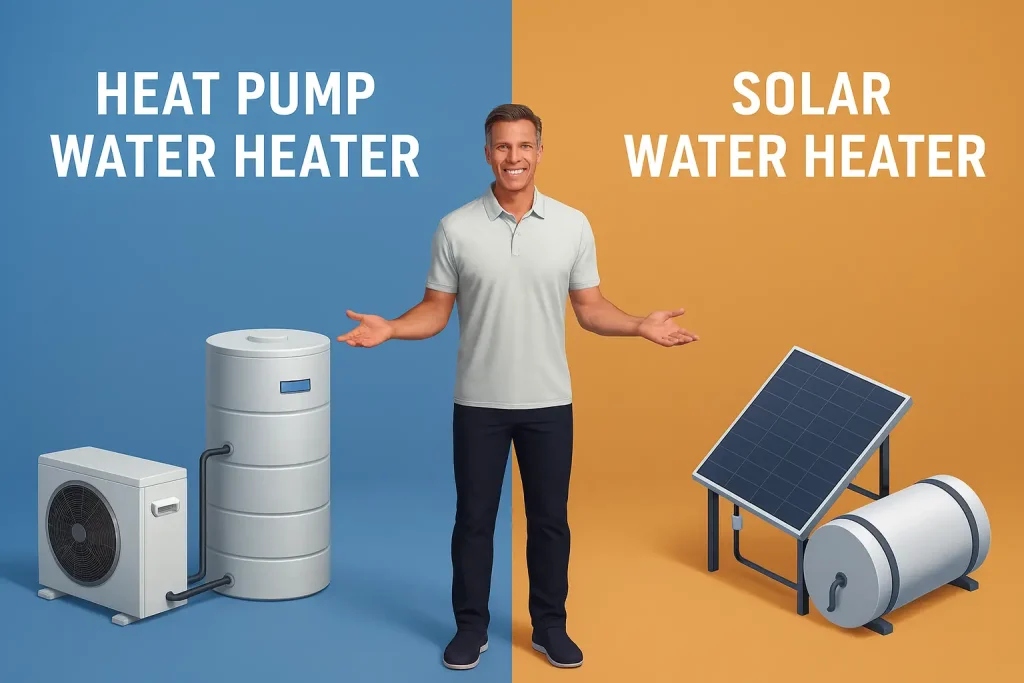
Most households use 50 to 70 litres of hot water a day, and most people don’t realise how much energy […]
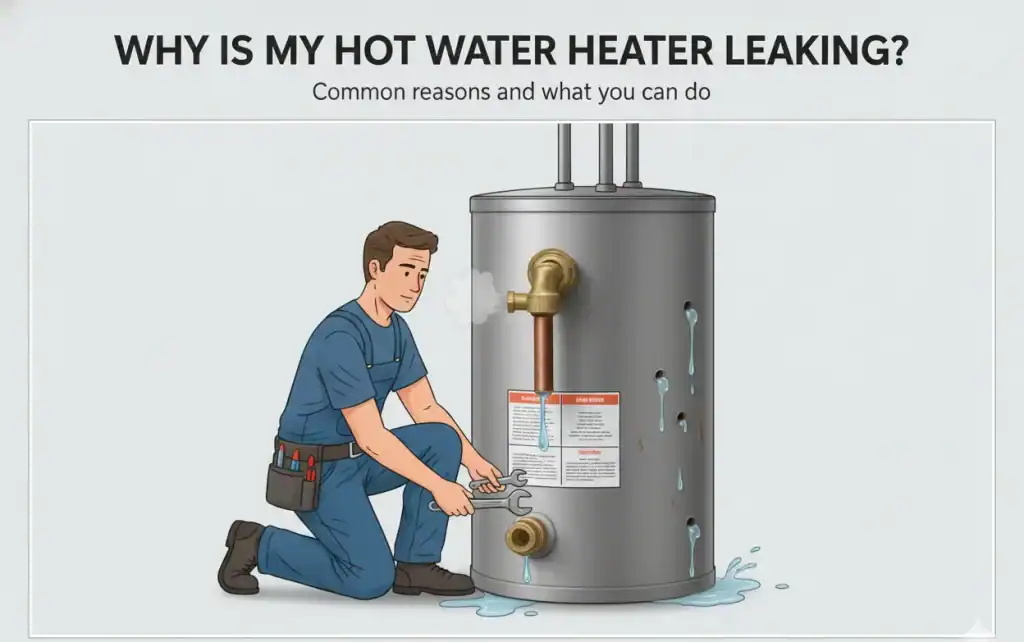
Just imagine it’s a chilly Aussie morning, you’re craving a long, hot shower… but instead, you step into a puddle […]

Hot water is now a modern necessity. But the cost you’re paying for it might be heating more than just […]




Our energy efficiency experts are here to answer all your questions and guide you through the products, rebates, and installation process.

Upgrade now, pay later with