Quick Answer Yes, instant water heaters are safe when installed and used properly. Modern ones come with pre-installed safety features […]
Quick Answer:
Continuous flow (tankless) water heaters are now the standard choice for modern Australian homes. They offer the luxury of endless hot water by heating it instantly via a heat exchanger only when a tap is turned on.
That basically removes standby heat loss, which accounts for roughly 15–30% of energy use in older storage systems, depending on age and insulation.
Over a year, that can translate into hundreds of dollars for an average household.
However, in the Australian market, the effectiveness of these units is entirely dependent on correct sizing. When the unit is undersized, the result is immediate.
Water temperature drops, flow slows, and morning routines clash.
On the other hand, over-sizing causes a different problem. Higher upfront cost, bigger gas demand and sometimes a full gas line upgrade that wasn’t needed in the first place.
With more than 40% of new Australian homes now built with two or more bathrooms, correct sizing is a must.
This guide breaks the sizing process step by step. We’ll also compare the electric and gas tankless sizing, the common sizing mistakes people make and more.
Selecting a tankless system in Australia requires shifting your mindset from volume (how much water is stored) to flow (how much water can be heated at once). If you miss either of them, the performance drops.
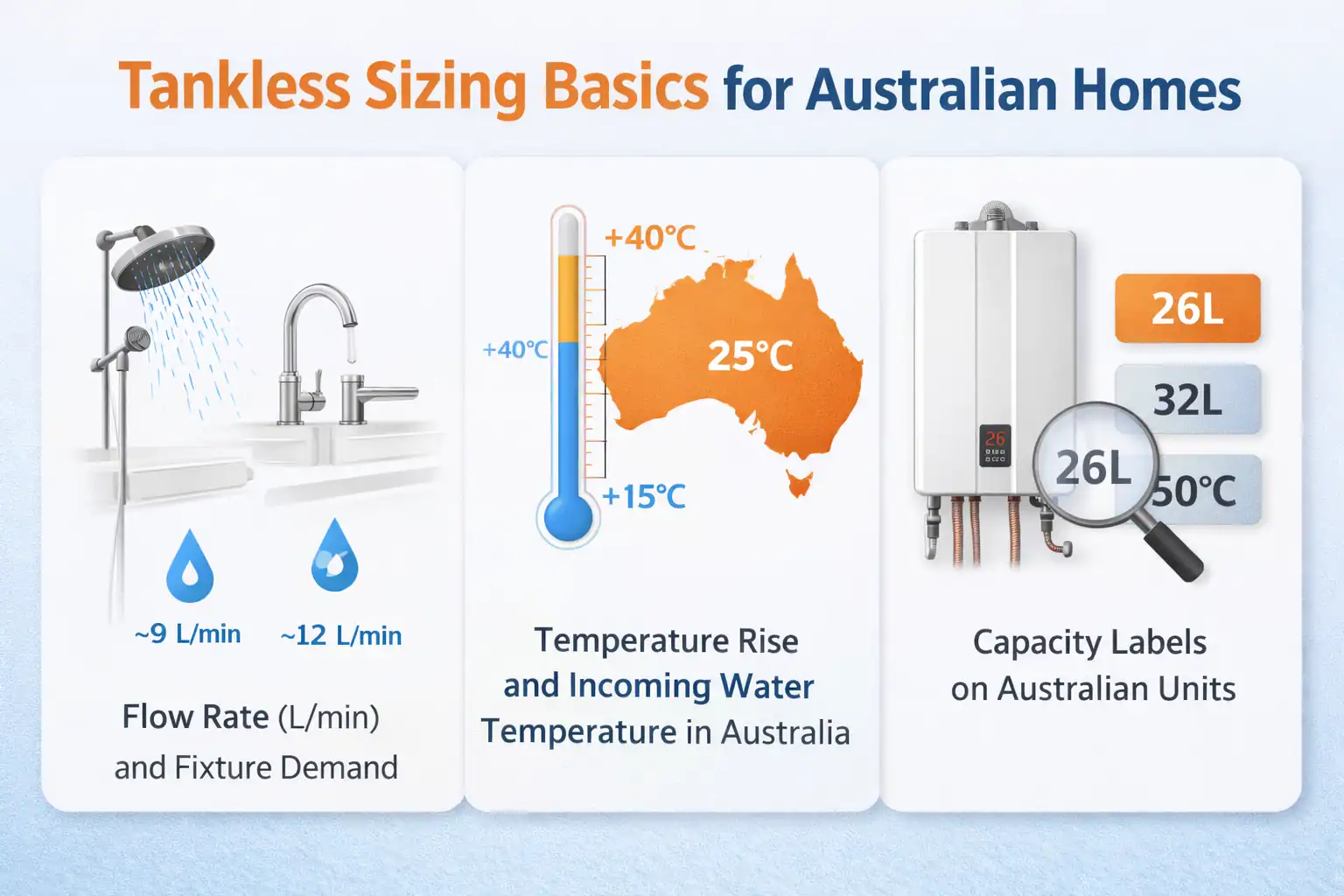
Tankless units are sized by their flow rate, which is measured in litres per minute (L/min).
This denotes the highest rate at which a tankless water heater can release hot water simultaneously without failing to meet temperature requirements.
To determine your needs for a tankless water unit, calculate your needs for each fixture based on what needs to be turned on at once.
The Water Efficiency Labelling and Standards (WELS) scheme is very important as well. This is because Australian homes are mostly equipped with new fixtures that have a restricted flow rate for the purpose of conserving water.
This impacts your sizing needs for the heater directly.
Typical Australian Fixture Flow Rates:
WELS ratings mean a lot, particularly for new homes.
A 4-star shower can save as much as 40% water compared with water usage from older fixtures. However, WELS helps solve the peak demand problem but doesn’t solve it entirely.
Two efficient showers, for instance, will consume 14-18 litres every minute, which is before the installation of a tap or an appliance is done.
Temperature rise is the difference between the cold water entering your home and the hot water exiting the heater. The Plumbing Code in Australia often specifies that the hot water must be no more than 50°C when supplied to bathrooms to avoid scalding.
However, the hot water heater itself can be usually set to 60°C to prevent the growth of Legionella bacteria.
Furthermore, your geographic location heavily influences the workload of your heater:
🟩 Southern & Alpine Regions (TAS, VIC, ACT, NSW Highlands): In winter, incoming water can drop to 5°C. To reach a 50°C output, the unit must achieve a 45°C temperature rise.
🟩 Northern Regions (QLD, NT, Northern WA): Winter inlet temperatures may stay around 20°C, requiring only a 30°C rise.
Winter sizing matters here. You should always size your unit based on the coldest winter day.
A heater that provides 26 L/min in a Brisbane summer might only provide 18 L/min in a Hobart winter simply because it takes longer to heat the freezing inlet water.
The gas continuous flow systems sold in Australia are usually labelled by their maximum flow rate at a stated temperature rise. This is commonly around 25°C. You’ll see figures like 20 L/min, 24 L/min, or 26 L/min on the box.
Meanwhile, electric Instantaneous Units work differently.
They tend to have lower L/min flow rates than gas systems. Unless you already have a 3-phase connection available, electric tankless systems are best used for “Point-of-use” systems.
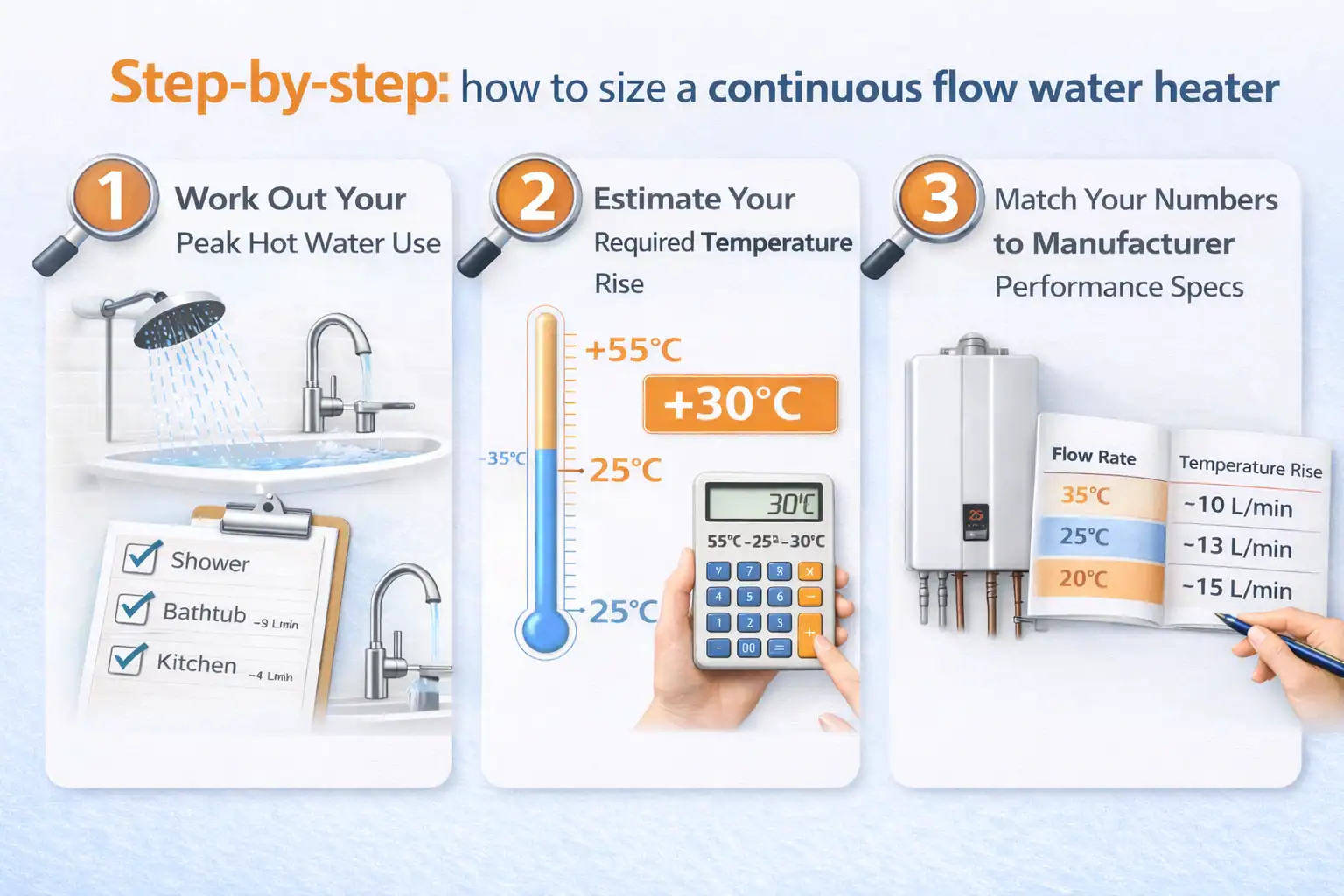
Once you understand flow rate and temperature rise, sizing becomes simple. Here are the three steps to follow:
Begin by determining your busiest period of the day. It is likely in the morning or in the evening when most people are probably utilising hot water at the same time. Now, make a list of all the fixtures that could be in use at the same time. Common combinations can be:
Worked Examples:
Determine how much “heavy lifting” the burner or element needs to do. Calculate your rise (°C) as follows:
Target Temperature: Normally 50°C in the case of bathrooms or 60°C in the case of kitchens/laundry.
Inlet Water Temperature: This depends on your Australian climate zone.
1. Cold Zone (TAS, VIC, ACT, NSW Highlands): Winter inlet can be 5°C to 10°C.
2. Temperate Zone (Sydney, Perth, Adelaide): Winter inlet should ideally be around 12°C to 15°C.
3. Warm Zone (Brisbane, Darwin, Cairns): Winter inlet rarely drops below 18°C to 20°C.
Example: If you are in Melbourne (5°C winter water) and you want 50°C at the tap, then you need a temperature rise of 45°C. However, if you are in Brisbane (20°C winter water), you only need a temperature rise of 30°C.
A unit labelled as “26L” is rated for a 25°C rise. When the temperature difference differs, the flow rate will be lower. Most reputable Australian brands, such as Rinnai or Rheem, supply a “Flow Rate vs. Temperature Rise” graph in their manuals. Therefore, you have to:
Choosing between electric and gas directly affects how much hot water you can get at once, how stable the temperature is, and whether the system actually keeps up in winter.
Gas systems are widely preferred in Australian homes that have multiple bathroom fixtures due to their high energy density. They handle cold Australian winters effectively, maintaining high flow rates even when the incoming water is near freezing.
They are readily available in sizes up to 32 L/min, which can comfortably support three simultaneous showers.
Electric tankless systems heat water using electrical elements. This limits how much energy they can deliver at any one time.
These are best for “point-of-use” applications, such as a single ensuite, a granny flat, or a kitchen renovation where running a gas line is too expensive.
However, in southern states during winter, a standard single-phase electric unit may only provide enough heat for a single low-flow shower.
| Feature | Gas Continuous Flow | Electric Instantaneous |
| Common sizes | 16L, 20L, 26L, 32L per min | 7L, 9L, 12L, 20L+ per min |
| Best for | Multi-bathroom family homes | Single bathrooms, studios, sinks |
| Winter performance | Excellent | Poor |
| Infrastructure need | 20mm Gas line/LPG bottles | 32-40 Amp circuit (or 3-phase) |
Climate plays a bigger role in sizing than many people realise. Below is a summary of sizing by climate zone.
In these areas, the gap between the freezing street water and your hot shower is huge.
You must size conservatively. If a sizing chart says a 20L unit is fine for two bathrooms, but you’re in Hobart, ignore it. Go for the 26L or 32L. You need that extra headroom for the winter months.
You have an advantage. Since your cold water is often already 25°C, a 16L unit can actually perform like a 20L unit.
You can often save money by choosing a slightly smaller unit without sacrificing comfort. However, don’t go too small if you have a massive rain-head shower because those things can exceed 15 L/min on their own.
Coastal regions like Perth or Adelaide experience mild winters but can have sudden cold snaps. Always size your system for the lowest recorded winter inlet temperature.
If you have a house full of teenagers, look for the following features:
Usually, most sizing problems come from a few repeated assumptions. These mistakes don’t usually show up on day one; they show up on cold mornings, busy evenings, or the first winter after installation.
This is the most common option, and it’s a risky one because two homes can both have two bathrooms and need completely different systems.
The demands from a home with small and staggered showers will differ from a home with two rain showers, a tap in the kitchen, and a washing machine operating simultaneously. The calculation does not relate to bathroom numbers alone.
A design that works fine in the summer might struggle significantly in the winter if designed for ‘average’ conditions.
In the southern states, the temperature of the inlet water might even dip below 10°C, thus adding a further 15-20°C temperature rise in the winter.
A design failing to consider the winter performance might throttle the hot water.
Normally, the flow rate indicated on the box as the “headline” flow rate assumes a temperature difference of 25°C.
If the difference is 40°C, the flow rate could be 30 to 40 percent lower than indicated. Without looking at the “performance chart,” the average homeowner assumes that the unit’s flow rate is higher than it really is.
Many homes simply aren’t ready to support high-output systems without upgrades.
Large gas units often require increasing the size of the gas lines or increasing the MJ supply. Electric models may require switchboard upgrades from the utility company.
Choosing the right tankless water heater in Australia involves knowing when your household actually uses hot water, how cold your winter inlet temperature gets, and whether your gas or electrical setup can support the system you want.
If you get those things right, a continuous flow heater feels effortless.
If you miss one, you’ll notice it every morning. Ensure you size for winter, size for peak use, and read the performance charts properly. This will help keep your system quiet, consistent and reliable for years.
List every hot water outlet in the home. Showers, taps, dishwasher, washing machine. Work out which ones may run at the same time. Add their flow rates together. Then check how cold the incoming water is in your area and choose a unit that can heat that flow to about 50–60 °C.
The unit can’t heat water fast enough. When demand rises, temperature drops. Showers go lukewarm, taps fluctuate, and the system runs flat out all the time, shortening its life.
Electric units need high amperage. Many homes can’t support large electric models without switchboard upgrades. Gas units need enough gas flow and pressure. If supply is limited, the heater must be smaller, even if demand is higher.
Use one large unit if the home has short pipe runs and central demand. Use multiple smaller units if bathrooms are far apart or demand is spread out. Multiple units reduce heat loss and improve response time.
If you add bathrooms, rain showers, or more occupants, demand rises. Choosing a unit with extra capacity now avoids costly upgrades later.
Southern states have colder inlet water, which needs more heating power. Northern areas need less. The colder the incoming water, the larger the unit required for the same flow.
Quick Answer Yes, instant water heaters are safe when installed and used properly. Modern ones come with pre-installed safety features […]
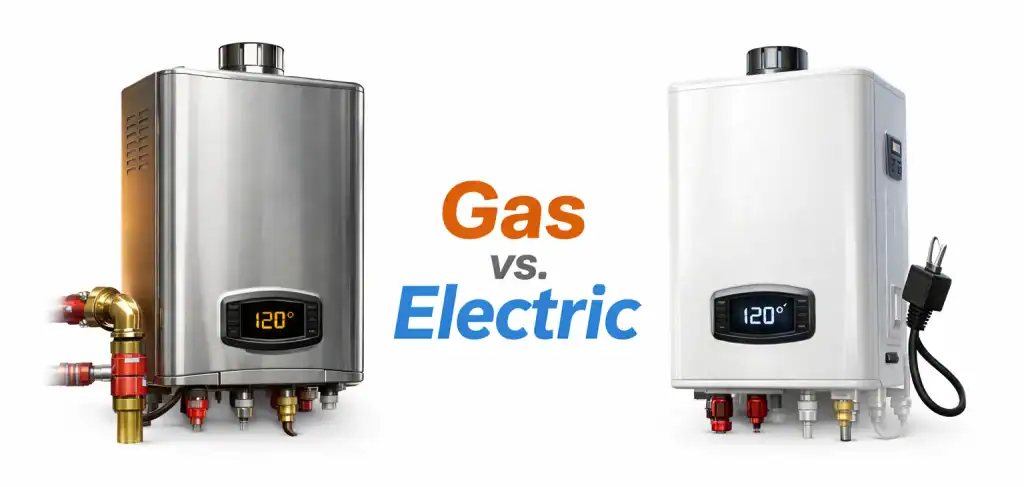
Hot water feels simple. You turn the tap and expect warmth, every time. But behind that moment is a system […]
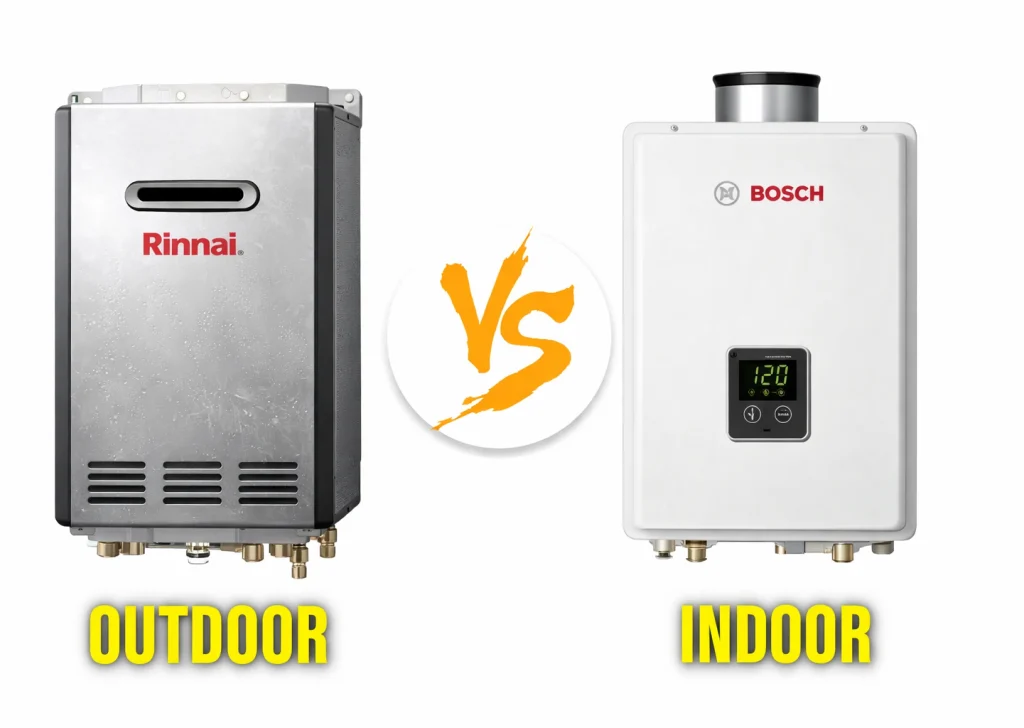
Quick answer The difference between indoor and outdoor tankless water heater setups comes down to placement and protection. Indoor units […]
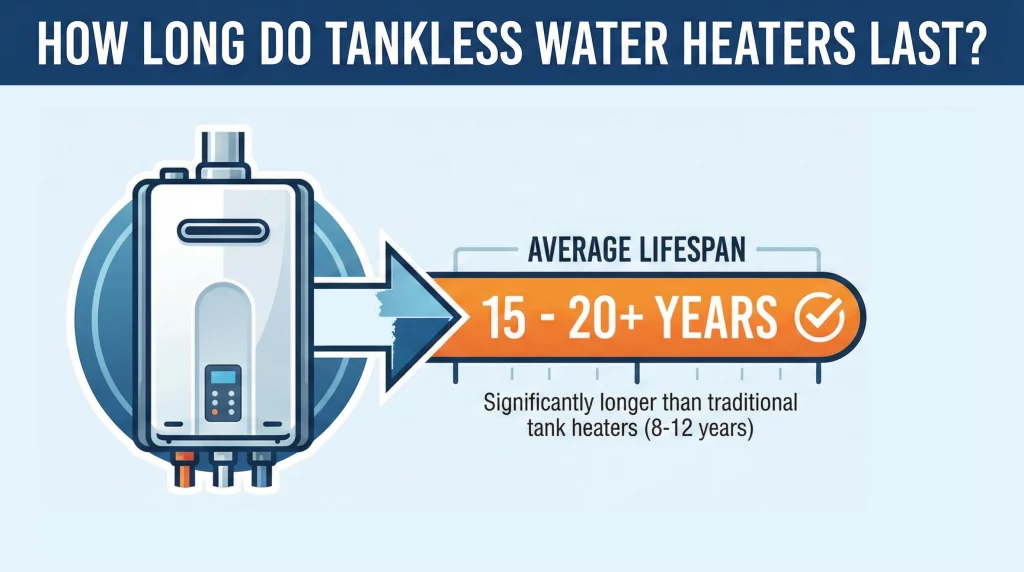
Quick Answer The average life expectancy of a tankless water heater falls anywhere between 15 and 20 years, and often […]




Our energy efficiency experts are here to answer all your questions and guide you through the products, rebates, and installation process.

Upgrade now, pay later with