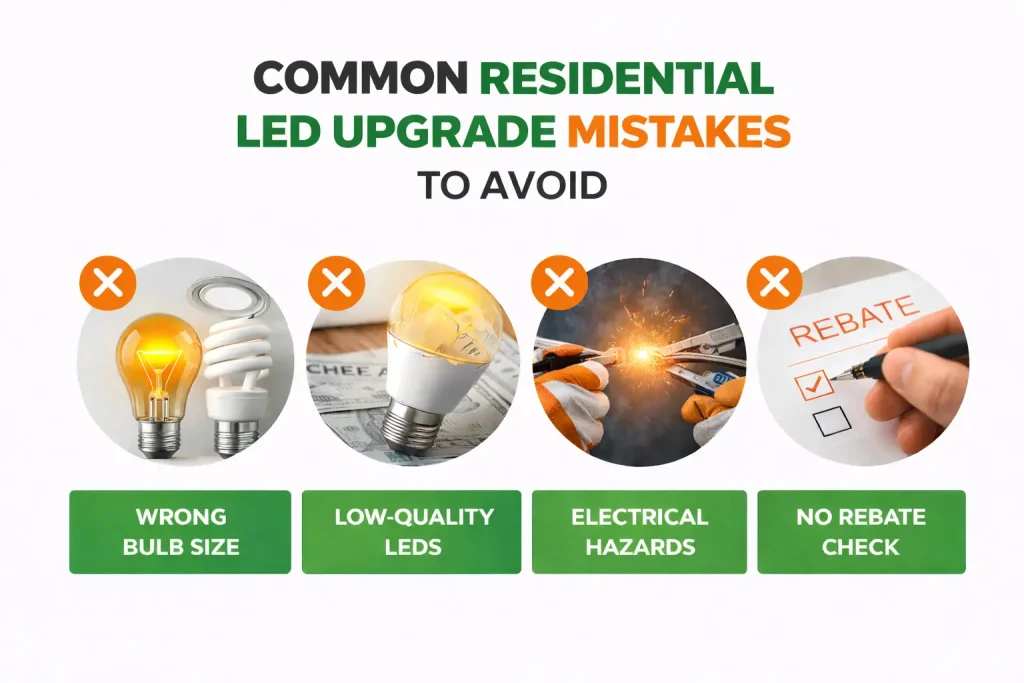
Did you know that around 10% of your household electricity budget goes to lighting? It’s such a huge bill that […]
Electricity prices in some Australian states are rising to over 40 cents per kWh, and we are all busy now exploring every possible way to keep our energy usage down.
While many of us focus on monitoring heavy appliances like air conditioners, hot water systems, and fridges, a few know that upgrading to LED lighting can make a difference.
It is easy to ignore because lights don’t seem like a huge load, but when they run for hours every day, the bill builds up over time.
LEDs are interesting not just because they are efficient, but because they change two costs at the same time: electricity and maintenance.
That combination is what actually creates the savings.
If you are considering a residential LED upgrade and want certainty that you will make actual savings, this post is meant for you. It breaks everything down in a practical way, so you will have no doubts at the end.
Most homes in Australia have around 37 light points, according to data from the Australian Government’s YourHome guide. LED bulb prices aren’t fixed, but in 2026, you generally pay between $5 and $20 for a reliable mid-range bulb.
Let’s assume an average of $12 for each bulb and see how the math works.
If you are just swapping bulbs and your fittings already support LEDs (like standard screw or bayonet globes), the cost is simple:
Nothing complicated and no hidden costs. Just a straight replacement if you know how to do it properly.
If you live in a traditional home with halogen downlights, you need a professional for your residential LED upgrade. Halogen downlights don’t always allow simple swaps because their old transformers can cause LEDs to flicker or fail. A licensed electrician is needed to swap the fittings and ensure the wiring is safe.
Already, you can see the gap is not small. But once the LEDs are installed, the savings stay the same because they come from how much power the bulbs use, not how they were fitted.
This is the main reason LEDs actually pay back. A halogen bulb typically runs at about 50W. An LED equivalent sits closer to 7W. That difference doesn’t sound dramatic until you scale it across the whole house.
The house goes from roughly 1.85kW of lighting load down to 0.259kW. Now let’s put that into real usage. Assume lights are on about 4 hours per day.
The difference looks small daily, but it builds up.
As you can see, at first glance, it doesn’t look like much, but over a full year, that difference becomes hard to ignore.
This part gets ignored a lot, but it matters more than people expect over time. Halogen bulbs usually last 1,000–2,000 hours. In real homes, that means replacements every year or two. LEDs last around 25,000 to 50,000 hours. In simple terms, that can stretch close to a decade or more.
Instead of constantly buying and replacing bulbs, you basically stop thinking about them.
DIY Scenario:
Payback = 444 ÷ 766.86 ≈ 0.58 years
So the upgrade pays for itself in roughly 7 months. After that, the savings are simply ongoing.
Professional Scenario:
Payback (lower end) = 2,925 ÷ 766.86 ≈ 3.8 years
Payback (higher end) = 5,515 ÷ 766.86 ≈ 7.2 years
Even on the higher end, the system still pays itself off within its working life, which is usually well over 10 years.
Electricity savings over 10 years:
766.86 × 10 = $7,668.60
Maintenance savings:
≈ $925
Total benefit:
≈ $8,593.60
Now subtract installation:
Low-cost install:
8,593.60 − 2,925 = $5,668.60 gain
High-cost install:
8,593.60 − 5,515 = $3,078.60 gain
After 10 years, the savings comfortably outweigh the upfront investment.
This is where things can change quite a bit depending on where you live. State programs are still active in 2026 to help reduce the upfront cost.
Example Rebate Impact:
If you qualify for a free LED upgrade and only pay a $300 flat fee for the electrician:
Payback = 300 ÷ 766.86 ≈ 0.39 years. That’s roughly 4 to 5 months to recover the full cost.
This changes the decision completely for most households. What would normally take a few years to recover drops to just a few months.
In today’s world, energy ratings are a major selling point. Buyers prefer homes with low running costs, and LED upgrades are a sure way to achieve this.
According to recent data, homes with energy-efficient features tend to sell for 5% to 10% than those without.
While a residential LED upgrade alone may not create that full increase, it still adds to the bigger picture by reducing energy use and improving how the home presents.
Halogens produce noticeable warmth. In a hot Australian summer, 37 halogens in your ceiling are like having several tiny heaters running, which adds load to your air conditioning. LEDs stay cool, helping your home stay a bit more comfortable for less.
A residential LED upgrade makes sense in almost every scenario when you look at it over time. DIY is fast and cheap, usually paid back in under a year. Professional installation takes longer to recover but is still strong long-term, especially with rebates involved.
The key point is this: the savings don’t depend on behaviour. You don’t have to change how you live. The lights just use less power every day.
Not really. For a standard home, a decent mid-range bulb around $12 is the sweet spot. You can spend $80 on a “prestige” brand, but you won’t actually see a difference in your daily life or your power bill. Paying more usually just buys you a fancy box, not a better light.
Depends on how much you do yourself. Swapping bulbs in a standard house is about $444. If you need a pro for a full retrofit, you’re looking at $2,925 to $5,515. But if you tap into the state rebates in NSW or SA, that cost can drop to $300 for the whole job. Big difference.
Look at your current setup. Standard screw-in or bayonet lamps? Simple LED bulbs work perfectly. But if you’ve got those old, hot halogen downlights, go with integrated LED fittings. They’re safer, run way cooler, and actually last in a ceiling cavity.
The “sticker shock” is the big one; they cost more upfront than old globes. Also, older houses can be a pain. Sometimes existing dimmers or transformers don’t work fine with the new tech, so you might need a sparky to do some minor tweaks.
Most charge $50 to $110 per light, plus a call-out fee of around $150. One light is fine, but a whole house adds up fast. Best bet? Get a fixed quote for the entire project instead of paying by the hour.
No. They’re built for long hours. Unlike old bulbs that burn out if you leave them on, LEDs stay cool. They’re basically the workhorses of the house. Leave them on all day if you need to; they can handle it.
Look for a fair price around $5–$20. Pick a colour between 3000K (warm) and 4000K (neutral). Check that the brightness fits the room and make sure there’s a solid warranty. If it’s dirt cheap and has no guarantee, skip it.
Did you know that around 10% of your household electricity budget goes to lighting? It’s such a huge bill that […]

So, you are fed up with the old light bulbs that keep flickering, increasing your electricity bills, and failing when […]
How does it feel walking through your home and noticing the mismatched bulbs? Those flickering tubes in the garage or […]
Almost every household in Australia is now looking into a residential LED upgrade. And honestly, it’s easy to see why. […]






Our energy efficiency experts are here to answer all your questions and guide you through the products, rebates, and installation process.

Upgrade now, pay later with