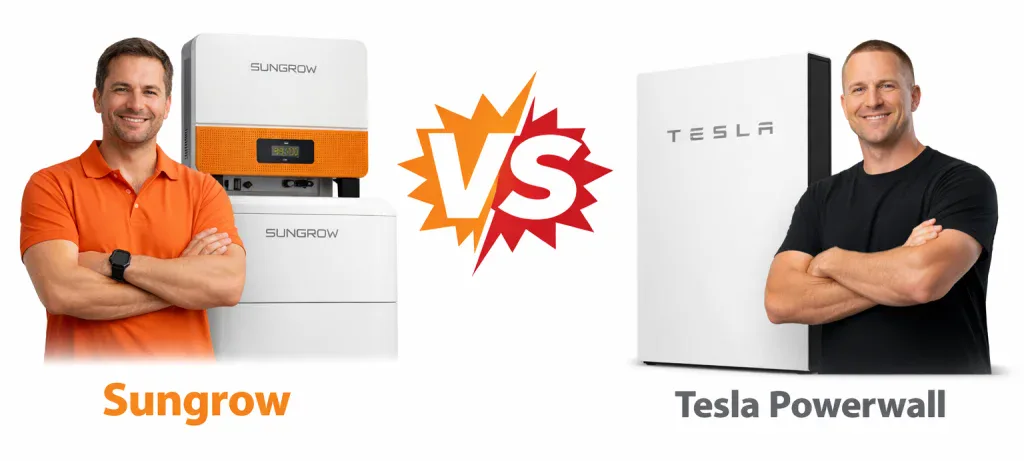
Quick Answer: Tesla Powerwall is best for those seeking a premium experience with a built-in solar inverter and superior whole-home […]

Australia’s energy landscape is shifting. With electricity prices climbing and solar feed-in tariffs dwindling, the “sunny country” is no longer just about panels. It is about storage.
Sungrow brand has rapidly become a household name in Australian solar. Known globally as an inverter titan, Sungrow has carved out a massive slice of the residential battery market with its SBR and SBH series.
This review explores how these batteries stack up in our harsh climate. We will look at whether they offer genuine value for your money. Is this the right choice for your home in 2026?
Let’s find out.
Australia leads the world in rooftop solar per person. But the “solar soak” changed things. Many households now export excess power during the day for almost nothing. Sometimes it is as low as 2 cents.
Then, they buy it back at night for 30 cents or more. It feels like a losing battle.
A solar battery bridges this gap. By storing your midday harvest, you can power your home through the evening peak.
You maintain independence during grid outages. It helps you reduce reliance on a volatile electricity market. Plus, it just feels good to use your own clean energy.
Founded in 1997, Sungrow is a heavy hitter. They have a massive global presence. In Australia, they have been on the ground since 2012. They have a dedicated service centre in Sydney. This matters.
Unlike some brands that disappear after a year, Sungrow is “bankable.”
They have a 100% bankability rating. This means they have the cash to stick around. If you need a warranty claim in eight years, they will likely be there to answer the phone.
Sungrow’s residential lineup centres on high-voltage systems. They are modular. Think of them like a stack of silver blocks. Here is your table clearly formatted:
| Model | Module Size | Capacity Range | Target Use |
| SBR Series | 3.2 kWh | 9.6 kWh – 25.6 kWh | Standard homes |
| SBH Series | 5.0 kWh | 10 kWh – 40 kWh | Large families |
The SBR is the most common sight in Australian garages. You can start small and add more modules later. This flexibility is a huge plus for growing families.
(a) Capacity & Scalability
The “Stack and Play” design is their biggest selling point. The SBR series allows you to stack up to eight modules per unit. For massive needs, you can connect four units together. That is a lot of storage.
(b) Performance & Efficiency
Sungrow allows for a 100% Depth of Discharge. You can use every bit of the energy you store. Their round-trip efficiency is high. Very little power is lost when moving energy in and out of the cells.
(C) Battery Chemistry & Lifespan
They use Lithium Iron Phosphate (LFP) technology. This is vital for Australia. LFP is stable. It handles high heat better than other types. It is also safer, with a much lower risk of fire.
(d)Smart Features & Monitoring
The iSolarCloud app provides the data. It shows energy flow and battery health. Some find it a bit technical. However, once you learn the layout, it provides deep insights into your savings.
Summer in Australia is brutal. Batteries hate extreme heat. Sungrow units are built to handle it. They are rated for outdoor installation, though shade is best.
In real-world terms, these batteries help smooth out usage. They take the “spikes” out of your bill. When the sun goes down, the battery kicks in instantly. You won’t even notice the switch.
A 9.6 kWh Sungrow SBR system typically costs between $7,500 and $9,500 installed. This depends on your location and the installer.
Compare this to a Tesla Powerwall. The Tesla is great, but it often costs much more. Sungrow offers a lower entry price for similar capacity. If you already have a Sungrow inverter, the value is hard to beat.
🟩 Modular and Expandable Design
You don’t have to guess your future energy needs on day one. Sungrow’s stackable system allows you to start with a smaller capacity, like 9.6 kWh, and add more modules later.
That’s helpful if you plan to buy an EV, install air conditioning, or simply expect higher usage in the future. It reduces upfront pressure. And it gives you flexibility.
🟩 Strong Performance in Hot Australian Climates
Australia gets seriously hot. Garages and outdoor walls can reach extreme temperatures in summer. Sungrow uses Lithium Iron Phosphate (LFP) chemistry, which handles heat better than older lithium types. It’s also known for greater thermal stability.
🟩 High Efficiency and Full Depth of Discharge
Sungrow batteries offer around 95–97% round-trip efficiency. That means most of the energy you store is available when you need it.
They also support 100% Depth of Discharge (DoD). In simple terms, you can use the full stored capacity without harming the battery. You’re paying for every kilowatt-hour. It’s good to know you can actually use it.
🟩 Competitive Pricing Compared to Premium Brands
Sungrow typically costs less than Tesla Powerwall for similar usable capacity. For homeowners who already plan to install a Sungrow hybrid inverter, the combined package often delivers strong value. You’re getting solid specs without paying a premium for brand recognition. If budget matters and for most households it does, that’s important.
🟩 Best Performance Within the Sungrow Ecosystem
Sungrow batteries integrate most smoothly with Sungrow hybrid inverters. If you already have a different inverter brand and don’t want to replace it, compatibility becomes more complicated.
You may need additional hardware, which increases cost. So it’s ideal for new systems or full upgrades, less convenient for simple retrofits.
🟩 App Interface Feels More Technical Than Some Rivals
The iSolarCloud monitoring platform provides detailed data. That’s great if you like numbers.
But compared to more consumer-polished apps like Tesla’s, the interface can feel slightly technical or less intuitive for some users. It works well. It just doesn’t feel as slick.
The Ideal Buyer: A homeowner looking for a reliable, safe, and expandable system. If you are installing a new 6.6 kW or 10 kW solar system, a Sungrow “Inverter + Battery” package is currently the most cost-effective way to achieve energy independence in Australia.
The “Skip it” Buyer: Those with an existing non-hybrid inverter who don’t want to replace it. In this case, an AC-coupled battery like the Tesla Powerwall might be a simpler (though more expensive) retrofit.
Installation is fast. The modules plug into each other without messy wires. Still, you must use an accredited installer. Check the unit occasionally for dust or debris. Keep the area around it clear for airflow. Beyond that, it is mostly “set and forget.” The software handles the rest.
The Sungrow Solar Battery is a benchmark for a reason. It is not about flashy ads. It is about working well in our sun.
It is safe, scalable, and priced right. For the average Aussie home, it hits the sweet spot. You get high-end specs without paying for a logo. It is a solid investment for long-term savings.
It can reduce it a lot. But “zero” depends on your habits. If your solar system is large enough and most of your electricity use happens at night, a battery can slash grid imports. If you run heavy appliances late at night or have modest solar generation, you’ll still draw some power from the grid. The battery shifts energy. It doesn’t create extra sunshine.
This is a real concern. Sungrow uses LFP chemistry, which tolerates heat better than many older lithium types. That’s helpful in places where garages turn into ovens in January. Still, placement matters. A shaded wall or protected garage space is smarter than full afternoon sun exposure. Heat management affects long-term performance, so installation location isn’t something to rush.
Then you’re in the dark. A battery can only supply what it has stored. If it’s fully discharged and there’s no sunlight to recharge it, backup won’t magically continue. Some homeowners choose to reserve a small percentage of battery capacity for emergencies. That way, there’s always a safety buffer. It’s worth discussing this setting with your installer.
Very quiet. No loud fans are running constantly. You might hear a soft hum during high activity periods, but most people don’t notice it at all. Once installed, it tends to fade into the background. You’ll probably think about it more than you actually hear it.
Oversizing. Or undersizing. Some buy too small and feel disappointed when it empties early each night. Others buy very large systems that take much longer to pay off. The smartest move is simple. Match the battery to your actual consumption data. Not your guess. Not your neighbour’s setup.
Most Sungrow batteries are designed to last around 10 years, which matches their product warranty. Because they use LFP (Lithium Iron Phosphate) chemistry, they tend to handle daily cycling better than older lithium battery types. That said, lifespan depends on how heavily you use it. A battery that’s cycled deeply every single day will age faster than one that’s lightly used. Proper installation, good airflow, and sensible settings also help protect long-term performance.
In many cases, yes. Sungrow offers both hybrid and retrofit-compatible options. However, compatibility depends on your current inverter and system design. Some homes may need an inverter upgrade or additional hardware to make everything work smoothly. It’s not always a plug-and-play situation. The best approach is to have an installer assess your current setup before assuming it can be added easily.
Quick Answer: Tesla Powerwall is best for those seeking a premium experience with a built-in solar inverter and superior whole-home […]
Quick Answer Adding a Battery to an Existing Solar System typically costs between A$8,000 and A$20,000+ in Australia. This will, […]
Key Takeaways More Australian households are looking at 10kW solar batteries for one simple reason. Power bills keep climbing, and […]
Quick Answer A solar battery can be worth it. It’s ideal if your household uses most electricity in the evening, […]





Our energy efficiency experts are here to answer all your questions and guide you through the products, rebates, and installation process.

Upgrade now, pay later with