

For Sydney homeowners wanting to replace an old electric or gas hot water system, a heat pump can provide a […]

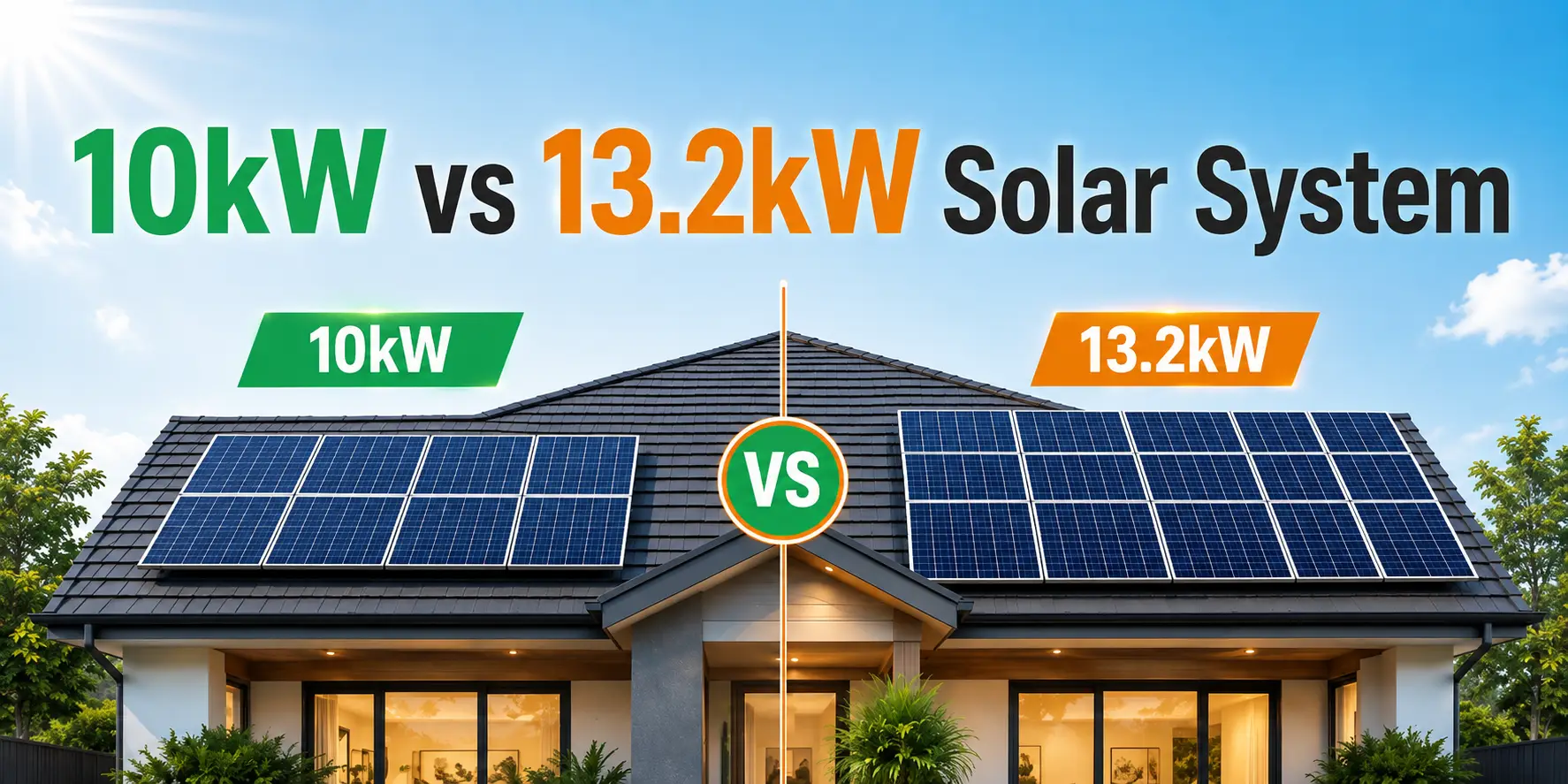
For many Sydney homes, 10kW is the better value choice when the household uses around 25 to 40kWh of electricity per day and wants substantial solar generation without paying for capacity it may not use.
A 13.2kW system can make more sense for homes with genuinely high electricity consumption, substantial daytime loads, large families, multiple air conditioners, pool equipment, electric hot water, EV charging or plans for significant battery storage.
The important point is that 13.2kW is not automatically better simply because it is bigger. The additional panels only create additional value when your household can use, store or otherwise benefit from the extra electricity.
In simple terms:
Choose 10kW if you want a large residential system that provides strong generation without requiring as much roof space or investment.
Choose 13.2kW if your electricity demand is high enough to use the additional generation and you have sufficient suitable roof space.
| Feature | 10kW Solar System | 13.2kW Solar System |
| Panel capacity | 10kW | 13.2kW |
| Example with 440W panels | About 23 panels | 30 panels |
| Indicative Sydney daily generation | Around 36 to 40kWh | Around 48 to 50kWh |
| Indicative annual generation | Around 13,000 to 15,000kWh | Around 17,500 to 18,000kWh |
| Typical household usage | 25 to 40kWh/day | 35 to 50kWh+/day |
| Approximate panel footprint | Around 45 to 50m² | Around 60 to 70m² |
| Upfront cost | Lower | Higher |
| Additional generation | — | Around 3,000 to 5,000kWh/year |
| Best suited to | High energy use homes | Very high energy use homes |
| Limited roof space | Better suited | Requires considerably more space |
| Battery pairing | Very good | Excellent where consumption is high |
| Main advantage | Strong balance of size, cost and generation | Greater generation for very high demand |
Disclaimer: These are indicative figures rather than guarantees. Actual solar production depends on the panel technology, roof orientation, tilt, shading, temperature, inverter performance, system design and location within Sydney.
A 10kW solar system has a total solar panel capacity of approximately 10 kilowatts.
Using 440W panels as an example, around 23 panels would be required:
23 × 440W = 10,120W = 10.12kW
The exact panel count depends on the wattage and specifications of the panels selected.
A well designed 10kW system in Sydney can generate roughly 36 to 40kWh of electricity per day on an annual average basis.
Production will vary considerably throughout the year. A sunny summer day can produce much more, while cloudy winter weather can produce considerably less.
Over a full year, a suitable 10kW system could generate roughly 13,000 to 15,000kWh.
A 10kW system can be a strong fit for:
The major advantage of 10kW is simple.
It provides substantial solar generation without moving into the much larger roof requirement of a 13.2kW system.
A 13.2kW solar system increases panel capacity substantially compared with 10kW.
Using 440W panels as an example:
30 × 440W = 13,200W = 13.2kW
That means approximately 30 panels would be required, compared with around 23 panels for a 10kW system.
The exact number can change if you choose panels with a different wattage.
A well designed 13.2kW system in Sydney can generate around 48 to 50kWh per day on an annual average basis, depending on the site and system design.
That can translate to roughly 17,500 to 18,000kWh of annual generation.
A 13.2kW system therefore represents a serious amount of solar generation for a residential property.
It is not simply a slightly larger version of a 10kW system.
A 13.2kW system is more appropriate for homes with:
For an ordinary lower consumption household, 13.2kW could simply provide more solar than the property can use efficiently.
This is one of the most important parts of the comparison.
A 13.2kW system has 32% more panel capacity than a 10kW system.
That gives the larger array considerably more potential to generate electricity.
A rough Sydney comparison is:
| 10kW | 13.2kW | |
| Daily generation | ~36 to 40kWh | ~48 to 50kWh |
| Annual generation | ~13,000 to 15,000kWh | ~17,500 to 18,000kWh |
| Additional annual generation | — | ~3,000 to 5,000kWh |
Note: These figures are estimates rather than guarantees.
A north facing roof with little shading could perform very differently from a roof with shading or an unfavourable orientation.
The important point is the additional generation available from the 13.2kW system.
If your home uses only 25kWh per day, that additional capacity may create a substantial surplus of electricity.
If your home regularly uses 45kWh per day, the additional generation becomes much more useful.
Not necessarily.
This is where solar comparisons can become misleading.
The 13.2kW system has 32% more panel capacity, but that does not mean your electricity bill will automatically fall by 32% more.
Why?
Because the value of solar depends on what happens to the electricity after your panels generate it.
If you use the electricity directly in your home, you avoid buying electricity from your retailer.
If you cannot use it immediately, you may store some in a battery or export it to the grid.
Exported electricity earns a feed in tariff according to your electricity plan, which can be considerably lower than the price you pay for grid electricity.
So the financial value of the additional 3.2kW depends heavily on self consumption.
A 13.2kW system will cost more because it requires more panels and installation equipment.
The additional cost can come from:
But the correct question is not simply:
Which system is cheaper?
It is:
Is the additional cost of 13.2kW justified by the additional electricity it can produce and the value your household can obtain from it?
Consider two homes.
The household uses around 28kWh per day.
A 10kW system could already provide substantial solar generation relative to the home’s consumption.
Moving to 13.2kW would increase generation, but the household may not have enough daytime demand to consume all of that additional electricity.
Some of the extra generation could therefore be exported.
The household uses around 45kWh per day.
This home has a much greater electricity demand.
The additional generation from 13.2kW has a better chance of being consumed directly, stored in a battery or used for things such as EV charging.
The larger system could therefore provide considerably more value.
This is why the cheapest system is not always the best system, and the largest system is not always the best system either.
This is one of the biggest practical differences between 10kW and 13.2kW.
Using approximately 440W panels:
Around 23 panels would be required.
Depending on panel dimensions and layout, the panel footprint could be around 45 to 50 m².
Around 30 panels would be required.
The panel footprint could be around 60 to 70m², depending on the panels selected.
However, panel footprint is not the same as the total roof area required for a compliant installation.
Your installer needs to consider access, roof edges, panel spacing, maintenance requirements and obstructions.
A 13.2kW system can require a surprisingly large amount of suitable roof space.
Important factors include:
A large roof does not automatically mean a 13.2kW system will fit efficiently.
Your actual electricity consumption should be one of the first things you check.
| Average Daily Electricity Use | System to Consider |
| Under 20kWh | 10kW may already provide substantial capacity |
| 20 to 30kWh | 10kW is often the stronger starting point |
| 30 to 40kWh | Compare 10kW and 13.2kW |
| 40 to 50kWh | 13.2kW becomes increasingly attractive |
| 50kWh+ | 13.2kW or a larger system may be worth assessing |
These are starting points rather than hard rules.
Two homes can consume the same amount of electricity but have very different solar requirements.
For example, one household might use most of its electricity at night.
Another might run air conditioning, pool equipment, hot water and an EV during the day.
The second household has much more opportunity to use solar directly.
If your household uses around 20 to 30kWh per day, 10kW deserves serious consideration first.
A 13.2kW system may produce more electricity than the household can use efficiently.
For households using around 30 to 40kWh per day, the decision becomes more balanced.
10kW can provide excellent generation.
13.2kW becomes more attractive if electricity consumption is increasing or daytime demand is substantial.
For a home using 40kWh or more per day, 13.2kW can make considerably more sense.
The additional generation can help reduce the amount of electricity purchased from the grid.
If consumption reaches 50kWh or more per day, a 13.2kW system deserves serious consideration.
At this level, 10kW may leave a substantial amount of electricity demand to be supplied by the grid.
However, the household should still assess whether an even larger system, battery or different energy strategy would provide better value.
Air conditioning can significantly increase electricity consumption in Sydney.
But having air conditioning does not automatically mean you need 13.2kW.
The important question is how much electricity your cooling and heating systems actually consume.
A home with occasional split system use may be perfectly well served by 10kW.
A large property that regularly operates several systems or ducted air conditioning can benefit from the additional generation available from 13.2kW.
There is also a major advantage here.
Air conditioning often operates during the day when solar production is strongest.
That creates an opportunity to consume more of the solar electricity directly rather than exporting it.
For a high consumption home, this can improve the value of the larger system.
A battery can change the value equation.
Without a battery, excess midday solar may be exported to the grid.
With a battery, some of that electricity can be stored for later use.
This can make 13.2kW more attractive for a high consumption household.
For example, imagine a home with:
There are several ways for that household to use the additional solar generation.
But adding a battery does not automatically make 13.2kW the better choice.
The battery itself has a cost and finite storage capacity.
The whole system needs to be designed around the home’s actual electricity profile.
An EV can substantially increase household electricity consumption.
The effect depends on:
A household with an EV that regularly charges during daylight can directly use more solar energy.
For a household with high annual driving and substantial charging demand, the additional capacity of 13.2kW may be useful.
For occasional EV use, 10kW may still be sufficient.
The important thing is to estimate the additional electricity consumption from the EV rather than choosing a larger solar system simply because you own one.
The panel capacity is only one part of the solar system.
The inverter also needs to be appropriate for the installation.
With a larger 13.2kW array, inverter selection becomes particularly important.
Your installer needs to consider:
This matters because panel capacity, inverter capacity and export capacity are not the same thing.
A solar array can have more panel capacity than inverter capacity.
Likewise, having a 13.2kW array does not mean the property can export 13.2kW to the electricity grid.
Connection and export requirements depend on the property, network and system configuration.
Your installer should confirm the applicable requirements before finalising the system.
This ultimately comes down to self consumption.
Imagine two households.
Uses 28kWh per day.
A 10kW system may already produce substantial solar relative to the home’s demand.
Moving to 13.2kW increases generation, but some of the additional electricity could become surplus.
Uses 45kWh per day.
A 10kW system can make a major difference, but the household still has substantial electricity demand.
The additional generation from 13.2kW has a much better chance of being consumed or stored.
Therefore:
10kW can offer better value for moderate to high consumption.
13.2kW can offer better value when electricity demand is genuinely high.
This is why the size of your electricity bill alone is not enough.
You need to understand how much electricity you use and when you use it.
The larger your solar system becomes, the more important self consumption can become.
Imagine your panels produce a large amount of electricity around midday.
If your household is using electricity at that time, the solar energy can replace electricity you would otherwise buy from the grid.
But if nobody is home and the major appliances are switched off, much of that electricity could be exported.
The difference becomes particularly important when moving from 10kW to 13.2kW.
The question is no longer simply:
Can the panels generate more electricity?
They obviously can.
The question becomes:
What will you do with those additional kilowatt hours?
If the answer includes air conditioning, pool equipment, hot water, EV charging, battery storage and other daytime loads, the larger system can become much more attractive.
Start with 10kW.
Compare 10kW and 13.2kW carefully.
Look at your daytime consumption and future electricity needs.
13.2kW becomes increasingly attractive.
The additional generation has a better chance of being used.
A 13.2kW system deserves serious consideration, although your installer should assess whether a larger system or additional battery capacity would be practical and financially worthwhile.
10kW is likely easier to accommodate.
13.2kW may make better use of the available space.
Not automatically.
A 13.2kW system produces more solar electricity.
But the additional generation only creates additional value when your household can use, store or otherwise benefit financially from it.
For a home using 25kWh per day, 13.2kW could provide more capacity than necessary.
For a home using 45kWh per day, 10kW could leave useful solar potential untapped.
The right question is therefore not:
“Which system produces more?”
13.2kW wins that comparison easily.
The better question is:
“Which system produces the right amount of electricity for my home at the right cost?”
| Your situation | Better starting point |
| 20 to 30kWh/day | 10kW |
| 30 to 40kWh/day | Compare both |
| 40 to 50kWh/day | 13.2kW |
| 50kWh+/day | 13.2kW or larger |
| Limited roof space | 10kW |
| Large roof | Either, depending on demand |
| High daytime electricity use | 13.2kW becomes more attractive |
| Large EV charging load | 13.2kW may be worthwhile |
| Large pool load | 13.2kW may be worthwhile |
| Large battery planned | Compare both based on consumption |
| Moderate electricity consumption | 10kW |
These are guidelines, not fixed rules.
Remember to consult a professional to design your actual electricity bills and usage profile.
For many Sydney homes with high electricity consumption, 10kW offers an excellent balance between system size, roof space, generation and cost.
It is already a substantial residential solar system and can provide a large amount of electricity without requiring the additional panels and roof area of a 13.2kW system.
A 13.2kW system becomes more compelling when electricity consumption is genuinely high, the property has enough suitable roof space and the household can make good use of the additional generation through daytime consumption, battery storage, EV charging or other significant loads.
The difference is meaningful:
10kW: roughly 36 to 40kWh of average daily generation under suitable Sydney conditions.
13.2kW: roughly 48 to 50kWh of average daily generation under suitable Sydney conditions.
So if your home uses around 25 to 35kWh per day, 10kW may provide the better balance.
If your home consistently uses around 40 to 50kWh or more, 13.2kW deserves a much closer look.
Before choosing, check your recent electricity bills, calculate your average daily consumption and look at when your household uses electricity.
Because the best solar system is not the biggest one you can fit on your roof.
It is the one that gives your home the best use of every kilowatt of solar capacity you pay for.
Get in touch with E-Green Electrical for a professional solar assessment based on your home’s electricity consumption, roof space and future energy needs.
For Sydney homeowners wanting to replace an old electric or gas hot water system, a heat pump can provide a […]

If you own or rent a property in NSW, you can make eligible home energy upgrades without paying the full […]

Quick Answer If you are choosing between Reclaim and Rheem, the better option depends on what matters most to you. […]

Quick Overview If you are a commercial property owner, facility manager, or business operator in Australia and plan to install […]








Our energy efficiency experts are here to answer all your questions and guide you through the products, rebates, and installation process.

Upgrade now and pay later with the Home Energy Saver Program!