

For Sydney homeowners wanting to replace an old electric or gas hot water system, a heat pump can provide a […]

Quick Answer
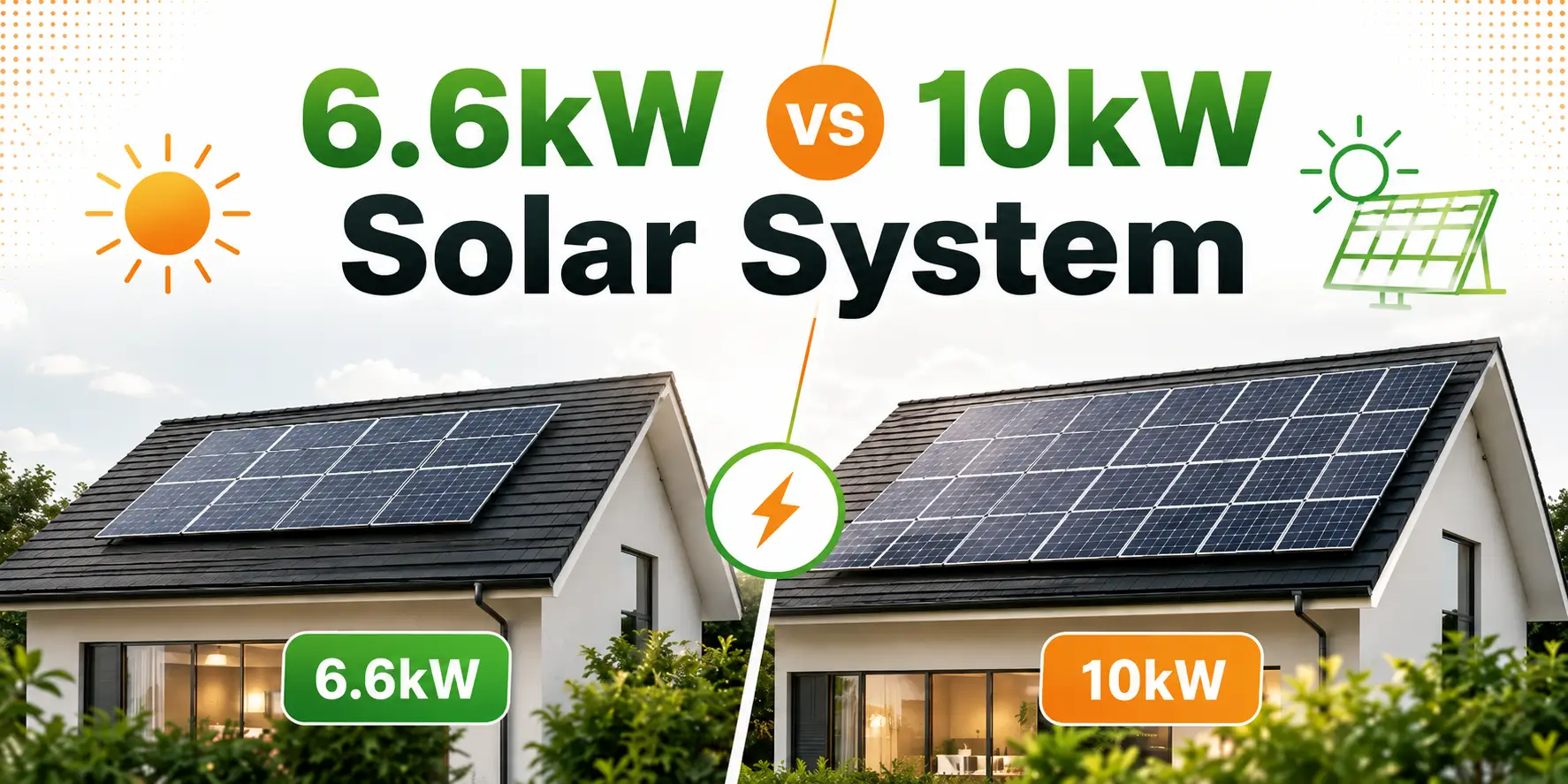
For most Sydney homes, 6.6kW is the better choice if your household uses around 15 to 25kWh of electricity per day and you want a lower upfront cost with strong value.
A 10kW system makes more sense for households that regularly use around 25 to 40kWh per day, especially larger families or homes with high electricity demand.
The important point is that a 10kW system is not automatically better simply because it is bigger. The right solar system should match your household’s electricity usage, available roof space, when you use power, and whether your energy needs are likely to increase in the future.
In simple terms:
Choose 6.6kW if your electricity use is moderate and you want a cost effective system.
Choose 10kW if your household has higher electricity consumption and can make good use of the additional generation.
| Feature | 6.6kW Solar System | 10kW Solar System |
| Panel capacity | 6.6kW | 10kW |
| Example with 440W panels | About 15 panels | About 23 panels |
| Typical daily generation in Sydney | Around 25 to 30kWh | Around 38 to 45kWh |
| Typical annual generation | Around 9,000 to 11,000kWh | Around 14,000 to 16,000kWh |
| Typical household usage | 15 to 25kWh per day | 25 to 40kWh+ per day |
| Approximate usable roof area | Around 30 to 35 m² | Around 45 to 50 m² |
| Upfront cost | Lower | Higher |
| Potential savings | Strong for moderate users | Higher potential for high users |
| Limited roof space | Better suited | Requires more space |
| High electricity demand | May be insufficient | Better suited |
| Battery pairing | Suitable | More generations available for storage |
| Main advantage | Strong value without unnecessary capacity | More generation for homes with higher demand |
Remember: These are indicative figures. Actual solar generation depends on panel efficiency, roof orientation, shading, weather, system design and other site conditions.
A 6.6kW solar system has a total solar panel capacity of 6.6 kilowatts.
For example, a system using 440W panels would require approximately 15 panels as demonstrated below:
15 × 440W = 6,600W = 6.6kW
The 6.6kW figure refers to the combined rated capacity of the panels. It does not mean the system produces 6.6kWh every hour throughout the day.
Solar generation changes constantly depending on sunlight, weather, panel orientation, shading, temperature and other conditions.
For a typical Sydney installation, a well designed 6.6kW system may generate roughly 25 to 30kWh on an average day, although individual days can be considerably higher or lower.
Across a year, that could amount to roughly 9,000 to 11,000kWh of electricity.
A 6.6kW system can be a strong fit for:
The main advantage is straightforward.
You get substantial solar generation without paying for a much larger system that your household may struggle to use.
A 10kW solar system has a total panel capacity of approximately 10 kilowatts.
Using 440W panels as an example, you would need around 23 panels as shown below:
23 × 440W = 10,120W = 10.12kW
The exact panel count depends on the panel wattage selected and the final system design.
A well designed 10kW system in Sydney may generate roughly 38 to 45kWh per day on average, with annual generation potentially reaching around 14,000 to 16,000kWh.
That is considerably more generation than a 6.6kW system.
The question is whether your household can actually make good use of it.
A 10kW system can make sense for:
The important question you should ask yourself is not simply:
Can you install 10kW?
It is:
Can your home make good use of the additional electricity?
This is where the difference becomes easier to understand.
A 10kW system has about 51.5% more panel capacity than a 6.6kW system.
All else being equal, that allows it to generate substantially more electricity.
A rough Sydney comparison looks like this:
| 6.6kW System | 10kW System | |
| Daily generation | ~25 to 30kWh | ~38 to 45kWh |
| Annual generation | ~9,000 to 11,000kWh | ~14,000 to 16,000kWh |
| Approximate additional annual generation | — | ~5,000kWh+ |
These figures are estimates rather than guarantees.
A north facing roof with little shading can perform very differently from a roof with significant shading or an unfavourable orientation.
The important difference is the additional generation available from the larger system.
If your home uses only 15kWh per day, a system capable of producing around 40kWh on a good day could create substantial excess generation.
If your home uses 35kWh per day, however, the additional capacity of the 10kW system becomes much more useful.
A 10kW system will naturally cost more because it requires more equipment and installation work.
The additional cost can come from:
However, the cheapest system is not necessarily the best value.
The more useful question is:
How much additional electricity will the 10kW system produce, and how much of that electricity can your household actually use?
Consider two homes.
The household uses around 18kWh per day.
A 6.6kW system may already provide substantial solar generation relative to the home’s electricity demand.
Moving to 10kW would increase generation, but the household may not have enough daytime demand to use all of the additional electricity.
The household uses around 35kWh per day.
A 6.6kW system may still reduce the home’s electricity bills significantly, but the household could remain heavily reliant on grid electricity at times when solar production is insufficient.
The additional generation from a 10kW system could therefore have considerably more value.
This is why the cheapest system is not always the best system, and the largest system is not always the best system either.
The answer depends heavily on self consumption.
Self consumption means using the electricity generated by your solar panels directly in your home.
This matters because solar electricity can have different financial values depending on what happens to it.
When you use solar electricity yourself, you avoid purchasing that electricity from your retailer.
When you export unused electricity to the grid, you receive a feed-in tariff according to your electricity plan.
This means a larger system can generate more electricity without necessarily delivering proportionally greater savings.
Suppose your 6.6kW system produces plenty of electricity during the day and your household uses much of it.
That electricity directly reduces your grid purchases.
Now imagine upgrading to 10kW.
The additional panels produce more electricity, but if your home has relatively low daytime consumption, some of that extra generation may be exported.
The 10kW system still produces more solar energy.
But the financial value of that additional energy depends on how much your household can use or store.
This is one of the biggest reasons you should not choose a solar system based solely on its maximum generation.
Roof space is another important difference between 6.6kW and 10kW.
The exact area depends on the panels selected and the installation layout.
Using modern panels around 440W:
Approximately 15 panels may be required.
This generally means around 30 to 35 m² of usable roof area, depending on panel dimensions and installation requirements.
Approximately 23 panels may be required.
This generally means around 45 to 50 m² of usable roof area.
But having enough total roof area does not automatically mean a solar system will fit.
Your installer also needs to consider:
A roof may have 50 m² of surface area but considerably less than 50 m² of suitable solar space.
Your average daily electricity consumption is one of the best starting points when comparing system sizes.
| Average Daily Electricity Use | System to Consider |
| Under 15kWh | 6.6kW may provide more than enough capacity |
| 15 to 25kWh | 6.6kW is often a strong fit |
| 25 to 30kWh | Compare 6.6kW and 10kW |
| 30 to 40kWh | 10kW becomes increasingly attractive |
| 40kWh+ | 10kW or a larger system may be worth assessing |
These figures are starting points, not strict rules.
Your electricity consumption can change considerably between seasons.
For example, a Sydney household may use considerably more electricity during hot weather because of air conditioning.
The best decision therefore comes from looking at your actual electricity bills and, where available, your interval usage data.
For a couple or small household using around 15 to 20kWh per day, 6.6kW is often the more sensible starting point.
You get substantial solar generation without paying for unnecessary additional capacity.
For a family using around 20 to 25kWh per day, the decision becomes more balanced.
A 6.6kW system may provide excellent value.
A 10kW system could make more sense if the household expects electricity consumption to increase.
For a household consistently using 30kWh or more per day, 10kW deserves serious consideration.
The additional generation can help cover a larger proportion of the home’s electricity requirements.
If your home regularly consumes 35 to 40kWh or more, a 10kW system can provide considerably more useful generation than a 6.6 kW system.
At this point, choosing 6.6kW simply because it costs less upfront could leave significant solar potential unused.
Air conditioning can increase household electricity consumption considerably, particularly during Sydney’s hotter periods.
But simply having air conditioning does not automatically mean you need a 10kW solar system.
The important question is how much electricity your air conditioning adds to your overall daily consumption.
There is also an advantage to solar powered cooling: air conditioning often operates during the day when solar generation is strongest.
For a home with occasional split system use, 6.6kW may be sufficient.
For a home with substantial cooling demand, particularly one that regularly operates ducted air conditioning for long periods, 10kW can provide more useful generation.
Your actual electricity consumption should determine the final choice.
A battery changes the calculation because excess solar electricity can be stored rather than immediately exported.
During the middle of the day, your panels may produce more electricity than your home needs.
A battery can store some of that energy for use later.
This can make a larger solar system more attractive, provided the household has enough electricity demand and storage capacity to use the additional generation.
Before choosing, consider:
A 10kW system can be particularly useful where the household has enough consumption or battery storage to make use of its additional generation.
An electric vehicle can increase household electricity consumption significantly.
However, buying an EV does not automatically mean you need a 10kW solar system.
The impact depends on:
If you can regularly charge your EV during daylight hours, solar can directly supply some of the electricity required.
If most charging happens overnight, you may need to rely on stored or grid electricity.
For households expecting their electricity consumption to rise substantially after buying an EV, 10kW can provide more useful headroom than 6.6kW.
If you’re upgrading an existing solar system, check your inverter before choosing between 6.6kW and 10kW.
Your existing inverter may be able to work with a larger number of panels, but it has a limit. So:
This can make 6.6kW the simpler upgrade if your existing inverter can support it. A 10kW upgrade may make more sense if your home needs the extra solar generation and you’re prepared for the additional inverter cost if required.
Before choosing your upgrade, find out what your existing inverter can support. It could change which option gives you the better overall value.
There is no universal winner.
If you want to narrow down the choice quickly, start with your average daily electricity consumption.
Using under 20kWh per day?
Start by looking closely at 6.6kW.
Using 20 to 25kWh per day?
6.6kW will often make sense, although future electricity needs should also be considered.
Using 25 to 30kWh per day?
This is where both systems deserve a proper comparison.
Using more than 30kWh per day?
10kW becomes increasingly attractive.
Using 40kWh or more?
A 10kW system is worth serious consideration, although a professional assessment can determine whether a larger system would be practical and financially worthwhile.
Not necessarily.
A 10kW system produces more electricity.
But more generation only becomes more valuable when your home can use, store or otherwise make good financial use of that additional electricity.
For a household using 18kWh per day, a 10kW system may provide more capacity than necessary.
For a household using 35kWh per day, 6.6kW may leave too much of the home’s electricity demand uncovered.
The better system is therefore the one that matches your:
For many Sydney households, 6.6kW remains an excellent starting point.
It provides substantial solar generation, requires less roof space and costs less than a 10kW system. For households using around 15 to 25kWh per day, it can offer an excellent balance between system size, cost and potential savings.
But if your household regularly consumes 25 to 40kWh or more per day, the additional generation from a 10kW system can make the higher upfront investment worthwhile.
The decision should not be:
“Which system is bigger?”
It should be:
“Which system will produce the right amount of electricity for my home?”
Before choosing, review your recent electricity bills, calculate your average daily consumption and consider how your energy use could change over the next few years.
If you’re still deciding between 6.6kW and 10kW, a professional site assessment can compare your roof space, expected generation, household consumption and system design to determine which option makes the most sense for your Sydney home.
Get in touch with E-Green Electrical for a professional solar assessment and a straightforward quote tailored to your home’s energy needs.
For Sydney homeowners wanting to replace an old electric or gas hot water system, a heat pump can provide a […]

If you own or rent a property in NSW, you can make eligible home energy upgrades without paying the full […]

Quick Answer If you are choosing between Reclaim and Rheem, the better option depends on what matters most to you. […]

Quick Overview If you are a commercial property owner, facility manager, or business operator in Australia and plan to install […]







Our energy efficiency experts are here to answer all your questions and guide you through the products, rebates, and installation process.

Upgrade now and pay later with the Home Energy Saver Program!