

For Sydney homeowners wanting to replace an old electric or gas hot water system, a heat pump can provide a […]

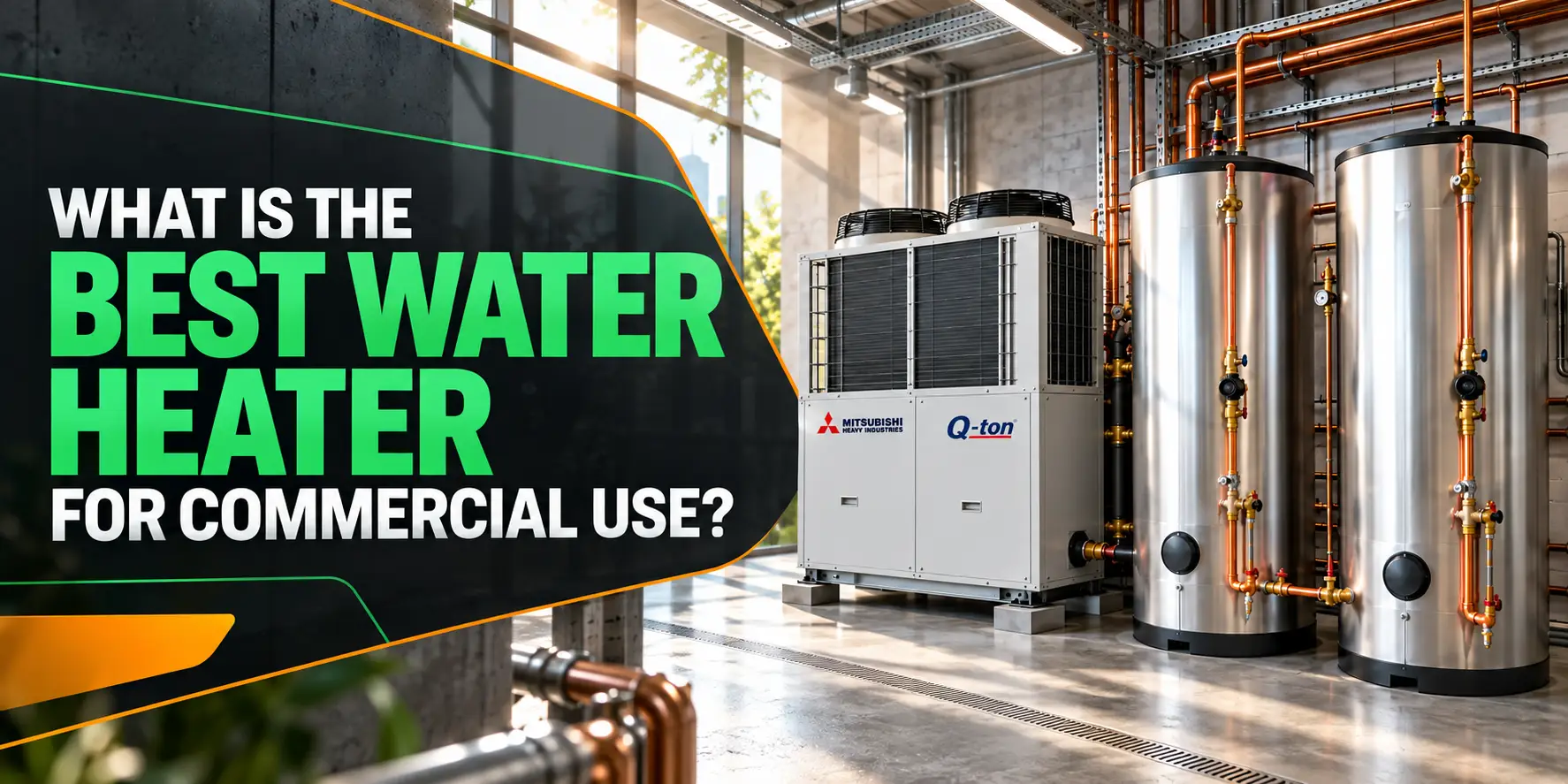
The best hot water system for commercial use is a properly sized heat pump. It can use significantly less electricity than a conventional electric water heater while providing the storage, heating capacity, and recovery rate needed for high-volume hot water demand.
For instance, our Q-TON has a COP of up to 4.3, meaning it can deliver up to 4.3 units of heat for every unit of electricity it consumes under the stated test conditions. Moreover, each Q-TON provides 30 kW of heating capacity and can produce hot water from 60°C to 90°C.
It’s especially suitable for larger businesses because you can connect up to 16 Q-TON units to provide a combined heating capacity of 480 kW. This allows the system to scale with the hot water demand of properties such as hotels, gyms, aged-care facilities, apartment buildings and commercial kitchens.
Other options include electric, gas and solar water heaters, but the best choice ultimately depends on the property’s hot water demand, peak usage, available space, energy supply and required temperature.
| System | Energy efficiency | Upfront cost | Running cost | Space requirement | Best suited to |
| Commercial heat pump | High; often COP 3–4+ | Higher | Low | Storage and airflow required | Hotels, gyms, aged care, laundries and restaurants |
| Electric storage | Approximately 1:1 heat output | Low–moderate | High | Tank space required | Small businesses with low or intermittent demand |
| Electric instantaneous | Approximately 1:1 | Moderate | Potentially high | Low storage space | Low-volume, point-of-use applications |
| Gas storage | Moderate | Moderate | Depends on gas prices | Tank, flue and gas connection | Sites already equipped for gas |
| Gas continuous flow | High output and fast recovery | Moderate–high | Depends on gas prices | Less tank space; gas and flue needed | Sites with variable demand and limited storage |
| Solar hot water | Low purchased-energy use | High | Low–moderate | Suitable roof and storage required | Properties with strong solar exposure and daytime demand |
Note: Performance and cost vary by equipment, tariff, climate, incoming water temperature and operating pattern.
A commercial heat pump is one of the best options for businesses that need large volumes of hot water because it delivers more heat per unit of electricity. The NSW Government says heat pumps can exceed 400% efficiency, compared with around 90% for a gas boiler, which means businesses with high hot water demand can produce the heat they need while using less energy.
This efficiency also makes heat pumps well suited to larger systems where hot water demand changes throughout the day. They can be combined with storage tanks, multiple units and solar power, allowing businesses to store hot water for peak periods, increase capacity when needed and use more of their own solar electricity. The NSW Government recently recognised this potential through its $1 million Heat Pump Feasibility Grant, which offered eligible businesses up to $30,000 to cover up to 75% of feasibility-study costs. This is, however, no longer available since 30th April 2026.
For larger commercial hot water installations, we recommend the MHI Q-TON because its 30 kW heating capacity provides strong heating output for businesses with high hot water demand. Moreover, its 60°C–90°C output range allows it to produce the higher water temperatures required for demanding commercial applications.
Where demand increases, we can connect up to 16 Q-TON units to provide 480 kW of combined heating capacity. This allows the system to scale with your hot water needs without requiring you to replace the system as your demand grows.
Electric water heaters can be a practical option for businesses with lower hot water demand or limited installation space. They are relatively simple to install and operate, making them suitable where upfront simplicity matters more than long-term energy efficiency.
However, conventional electric storage heaters use electricity directly to heat the water, so they generally consume more energy than a heat pump producing the same amount of hot water. That means if a business has high or continuous hot water demand, this type of heater can lead to higher running costs over time.
So, we only recommend them for smaller commercial applications where hot water demand is limited and a simpler system is preferred. However, where a business needs large volumes of hot water, we would generally recommend a properly sized heat pump instead.
Gas water heaters can be suitable for businesses that need fast water heating and high hot water recovery. They can provide hot water quickly, which can be useful for commercial sites with periods of high demand.
However, gas systems are generally less energy efficient than heat pumps. As said above, the NSW Government notes that heat pumps can exceed 400% efficiency, compared with around 90% for a gas boiler. This means a gas system may require more energy to produce the same amount of useful heat.
So, we would generally only recommend gas where site requirements or existing infrastructure make it a practical choice. But for businesses looking to reduce energy use and running costs, we would generally recommend a properly sized heat pump instead.
Solar water heaters can be a good option for businesses that want to use renewable energy, lower hot water costs, and reduce emissions. They are particularly suitable for businesses that use most of their hot water during sunlight hours, when the system can make the most of available solar energy.
However, solar water heating depends on sunlight, so performance can vary with weather, season, and the amount of hot water a business needs. This means a backup heating system may still be required when solar energy is not enough to meet demand.
| Business type | Likely best starting option | Main reason |
| Hotel or accommodation | Modular heat pump with storage | Predictable morning and evening peaks |
| Restaurant or commercial kitchen | Heat pump with sufficient recovery and backup | Heavy daily washing and cleaning demand |
| Gym or aquatic facility | Heat pump with large thermal storage | Concentrated shower demand |
| Aged-care facility | Redundant heat-pump configuration | Reliability and continuous availability |
| Apartment complex | Centralised modular system, subject to metering design | High combined demand |
| Small office or retail premises | Small electric or heat-pump system | Relatively low demand |
| Industrial process site | Engineered system assessment | Temperature and process requirements vary significantly |
These are starting points, not guarantees. Industrial processes in particular can require a more specialised assessment.
We recently worked on a commercial hot water project for a mid-sized Sydney apartment complex. The building replaced electric storage tanks with a centralised heat pump system.
Before the upgrade, the building had inconsistent hot water, rising energy bills and complaints during peak periods. After the upgrade, the building used more than 50% less energy. Hot water reliability also improved, and maintenance issues fell.
The project involved a multi-tenant building where dozens of residents could use hot water at similar times. The system therefore needed enough storage, recovery capacity and effective water distribution to meet demand during peak periods.
The project reinforced something we see across commercial hot water installations: energy efficiency matters, but the system also needs to match the way the property actually uses hot water.
Commercial hot water systems need to account for both total water consumption and peak demand. The main factors include:
The basic calculation for the energy required to heat water is:
Thermal energy (kWh) = Litres × 4.186 × Temperature rise (°C) ÷ 3600
Each part of the formula has a specific purpose:
For example, consider a business that uses 3,000 litres of water per day. If the incoming water temperature is 18°C and the required water temperature is 60°C, the temperature rise is:
60°C − 18°C = 42°C
The calculation then becomes:
3,000 × 4.186 × 42 ÷ 3600 = approximately 146.5 kWh
This means the business needs about 146.5 kWh of thermal energy to raise 3,000 litres of water from 18°C to 60°C, before accounting for heat losses or other system factors.
For a heat pump, the electrical energy required will be lower because the system moves heat from the surrounding air into the water rather than producing all the heat directly. The COP tells you how much thermal energy the heat pump can provide for each unit of electricity it uses.
Heat-pump electricity use = Required thermal energy ÷ COP
With a COP of 3.5:
146.5 ÷ 3.5 = approximately 41.9 kWh
So, under these simplified conditions, the heat pump would use about 41.9 kWh of electricity to provide 146.5 kWh of heat.
Actual electricity use can vary with ambient temperature, incoming water temperature, storage losses, system controls and equipment performance.
The Mitsubishi Heavy Industries Q-TON is our featured commercial heat pump for high-volume hot water applications. We use it for demanding sites such as hotels, apartment buildings, gyms, aged care facilities and other properties with substantial hot water requirements.
The Q-TON delivers 30 kW of heating capacity, giving a single unit the output required for many commercial applications. When a property needs more hot water than one unit can provide, the system can scale by connecting multiple 30 kW units together, with up to 16 units providing a combined 480 kW of capacity.
The high-temperature output is another reason Q-TON suits commercial applications. It can produce 60°C to 90°C hot water, while its anti-Legionella sanitary cycle supports hot water hygiene.
Q-TON also handles cold conditions well. It can operate at ambient temperatures as low as −25°C and maintain full heating capacity down to −7°C, which helps maintain hot water production when temperatures fall.
Efficiency is another main reason we use Q-TON. Its published COP of 4.3 under intermediate-season conditions means the system produces about 4.3 units of heat for every unit of electricity it consumes, which helps reduce the electricity cost of producing hot water.
Yes. NSW businesses can access financial incentives for eligible commercial heat pump water heaters through the Energy Savings Scheme (ESS). The current ESS rules include commercial heat pump water heaters, with the latest rules taking effect on 7 September 2026.
The incentive is provided through Energy Savings Certificates (ESCs), so there is no single fixed rebate amount for every commercial installation. The available incentive depends on the equipment, installation and energy savings achieved. Eligible installations can include replacing existing electric or gas hot water systems with air-source heat pump water heaters.
Therefore, if you are a NSW business considering a commercial heat pump, it is worth checking your eligibility before purchasing. An eligible installation can potentially receive an upfront financial benefit through the scheme.
There was also separate NSW Government support for businesses considering heat pumps. The Heat Pump Feasibility Grant offered eligible businesses up to $30,000, covering up to 75% of project costs for feasibility studies. However, applications for this grant are now closed, with the application period ending on 30 April 2026.
A properly sized commercial heat pump is generally the most energy-efficient option. The NSW Government says heat pumps can exceed 400% efficiency, compared with around 90% for a gas boiler. At E-Green, we supply and install MHI Q-TON commercial heat pumps for businesses looking to reduce energy use and running costs.
You size a commercial hot water system around peak demand, not average daily use. The main factors are how much hot water the business needs, when demand peaks, the required water temperature, storage capacity, and recovery rate.
The system should have enough storage and heating capacity to meet busy periods, while the heat source must be able to recover the stored water before the next peak. This helps avoid running out of hot water without paying for unnecessary capacity.
A good commercial heat pump should generally have a COP of 3 or higher. Commercial heat pumps typically achieve around 3–5, meaning they can produce 3–5 units of heat for every unit of electricity consumed under the relevant test conditions.
However, COP varies with operating conditions, including ambient temperature and water temperature, so it is important to compare products using the same test conditions.
A commercial heat pump can reduce energy use by around 30% or more. In one NSW Government-supported project, AstraZeneca estimated a 33.8% reduction in energy consumption compared with its existing boilers. However, the actual savings depend on the system being replaced, hot water demand, and operating conditions.
Yes. The Q-TON produces hot water from 60°C to 90°C, making it suitable for commercial applications that require high-temperature sanitary hot water. It also has an anti-Legionella sanitary cycle and can maintain its full heating capacity down to −7°C.
Yes. A properly sized commercial heat pump can meet hotel or gym peak demand when combined with enough hot water storage and recovery capacity. For example, a Rheem commercial case study shows a fitness centre using 1,230 litres of storage to meet its specified peak demand.
The system must be sized around peak demand, storage, and recovery rate rather than average daily use.
Yes, depending on the model. For example, our Mitsubishi Heavy Industries Q-TON can supply hot water up to 90°C at ambient temperatures as low as −25°C and maintain 100% heating capacity down to −7°C. This makes it suitable for commercial sites that need reliable hot water even in colder conditions.
Yes. Commercial heat pump water heaters are currently covered by the NSW Energy Savings Scheme, including eligible replacements of existing gas or electric systems and certain new installations.
There is no standard payback period. Calculate it using:
Additional upfront cost ÷ annual energy saving = simple payback period
Yes. A properly sized commercial heat pump can replace a gas boiler for hot water. The NSW Government says heat pumps can exceed 400% efficiency, compared with around 90% for a gas boiler. However, the system still needs to be correctly sized for the business’s hot water demand, storage, and required recovery rate.
Yes, where a hot water outage would disrupt the business. Multiple heat pumps, additional storage, or backup heating can keep hot water available if one part of the system is unavailable. This can be particularly important for hotels, gyms, hospitals, and other businesses with continuous hot water demand.
There is no one-size-fits-all storage capacity for a commercial hot water system. The tank should be sized around peak demand, heat pump capacity and recovery rate, so enough hot water is available during busy periods.
A larger tank can help businesses such as hotels and gyms handle short periods of high demand, while the heat pump reheats the stored water for the next peak.
For Sydney homeowners wanting to replace an old electric or gas hot water system, a heat pump can provide a […]

In NSW, eligible households may receive an upfront discount when replacing an existing electric or gas water heater with an […]
Hot water replacement means removing an existing water heater and installing a new system that suits your home’s hot water […]
For most people, buying a hot water system is only a priority when building a new home, moving in, or […]




Our energy efficiency experts are here to answer all your questions and guide you through the products, rebates, and installation process.

Upgrade now and pay later with the Home Energy Saver Program!