

For Sydney homeowners wanting to replace an old electric or gas hot water system, a heat pump can provide a […]


Quick Answer
The amount of hot water your household uses per day varies from one family to the next. It depends on how many people live in your home, how long your showers are, the flow rate of your showerhead, how often you take baths, and how much hot water you use for things such as laundry, dishes, and taps.
To figure out how much your family is likely to use, apply the Australian Government’s YourHome guidance. It estimates that one person uses about 50 litres of hot water per day.
Then multiply that figure by the number of people in your home.
Here’s what it will likely look like for different household sizes:
| Household Size | Estimated Hot Water Per Day | Estimated Hot Water Per Year |
| 1 person | 50 litres | 18,250 litres |
| 2 people | 100 litres | 36,500 litres |
| 3 people | 150 litres | 54,750 litres |
| 4 people | 200 litres | 73,000 litres |
| 5 people | 250 litres | 91,250 litres |
| 6 people | 300 litres | 109,500 litres |
Keep in mind that this is a starting estimate. Your actual use can be higher or lower depending on your household’s daily hot-water habits.
As mentioned above, the Australian Government’s YourHome guidance uses about 50 litres of hot water per person per day as a typical figure.
Therefore, for one person:
1 × 50 litres = 50 litres of hot water per day
Over a year, that is approximately:
50 × 365 = 18,250 litres
However, actual use can vary considerably. Someone who takes short showers and uses very little hot water around the home may use less than 50 litres a day, while someone who takes long showers or regular baths may use considerably more.
A simple way to estimate household hot water use is to multiply the number of people by 50 litres.
2 × 50 = 100 litres per day
A two-person household would therefore use approximately 100 litres of hot water per day as a general estimate.
3 × 50 = 150 litres per day
A three-person household would use approximately 150 litres per day.
4 × 50 = 200 litres per day
A four-person household would use approximately 200 litres of hot water per day.
5 × 50 = 250 litres per day
A five-person household would use approximately 250 litres per day.
6 × 50 = 300 litres per day
A six-person household would use approximately 300 litres per day.
These are starting estimates. Your actual household consumption depends on how and when you use hot water.
Start with the 50-litre-per-person benchmark and then consider your household’s actual habits.
The basic calculation is:
Number of people × 50 litres = estimated daily hot water use
For example:
4 people × 50 litres = 200 litres per day
You can then adjust your estimate based on your household.
If everyone takes short showers and you rarely use hot water for other purposes, your actual consumption may be below 200 litres.
If everyone takes long showers, several people take baths, and hot water is frequently used for laundry and other purposes, your household could use considerably more.
Showers and baths account for much of the hot water used in Australian homes, but washing machines, dishwashers and hand dishwashing also contribute to household demand.
The average Australian shower lasts around 7 to 8 minutes, although individual shower times vary. Australian Government calculations commonly use 8 minutes as a standard shower duration when illustrating water use.
A standard shower uses around 9 to 15 litres per minute, while water-saving showerheads can reduce the flow to around 9 litres per minute or less.
Using an 8-minute shower as a typical example, this works out to roughly 40 to 80 litres of hot water, depending on the shower flow rate and the amount of hot water mixed with cold water.
A bath can use around 95 to 150 litres of water, depending on the size of the bath and how full you make it.
However, you do not need all of that as hot water. You add cold water to reach a comfortable temperature, so only part of the bath water comes from your hot-water system. If several people in your household take baths regularly, this can quickly add to your daily hot-water use.
Your washing machine can also use hot water when you choose a warm cycle. A typical warm cycle can use around 80 to 100 litres of water per load, although this varies between machines and programmes.
And again, the whole 80 to 100 litres is not hot water. Your machine mixes hot and cold water, so only part of the load adds to your household’s hot-water use.
A dishwasher typically uses around 11 to 15 litres of water per cycle. More efficient models can use less. For example, the Australian Government gives 9.5 litres per wash for a 14-place-setting, 6-star dishwasher, compared with 17 litres for a 3-star model.
So, if you run your dishwasher once a day, it adds a relatively small amount to your household’s daily hot-water use compared with showers.
Washing dishes by hand can use around 10.5 litres of water per person per day. How much hot water you actually use depends on how you wash your dishes and how long you leave the hot tap running.
If you wash dishes under a running hot tap, this can add more to your daily hot-water use than if you fill the sink or a basin first.
These figures are useful as general planning estimates. Actual household hot-water use will vary depending on the number of people in the home, shower duration, appliance efficiency and daily habits.
The total amount of hot water used during a day is one thing. When you use it is another.
For example, a four-person household might use around 200 litres throughout the day, but if all four people shower within a short period in the morning, much of that demand occurs at the same time.
Another household of four might spread its showers throughout the morning and evening.
The total daily volume could be similar, even though the pattern of use is very different.
This is why the number of people in a household alone does not tell you exactly how much hot water the household will use.
Your household may use much more or less hot water than another household, even if you have the same number of people. Your daily habits make a big difference.
You can reduce your daily hot water use by making a few simple changes to how you use showers, taps, washing machines and dishwashers. You don’t have to change everything at once. Even small changes to your daily routine can reduce the amount of hot water your household uses.
Your shower is one of the easiest places to cut back on hot water use. The longer you stay under the shower, the more water you use.
Try to keep your showers shorter and use a shower timer if you find it difficult to keep track of time. The Australian Government’s YourHome recommends aiming for showers of less than four minutes as one way to reduce water use.
The flow rate of your showerhead can make a big difference in how much water you use. An inefficient showerhead can use 15 to 25 litres per minute, while a WELS 5-star model can use as little as 4.5 litres per minute.
The Australian Government gives the example of a family of four replacing a 15 L/min showerhead with a 9 L/min model. This could save around 70,000 litres of water a year. A 6 L/min model could save around 105,000 litres a year.
Don’t leave a tap running while you brush your teeth, wash your hands, or do other quick jobs around the sink. A tap without a flow controller can use more than 16 litres of water per minute.
So, if you don’t need hot water, move a mixer tap fully to the cold position instead of leaving it in the centre. It helps because a centre-position mixer can draw hot water even when you only need a small amount of water.
You don’t need warm or hot water for every load of washing. Use a cold wash when it suits the clothes you’re washing, particularly for everyday loads that don’t need a hot cycle.
You can also reduce how often you use the washing machine by waiting until you have a full load. If your machine has an economy or water-saving setting, use it when appropriate for the size of the load.
Running the dishwasher before it has a full load can mean more washes throughout the week. Wait until you have enough dishes for a full load, then use the economy cycle if your dishwasher has one.
You also don’t need to rinse plates under the tap before loading them. Scrape leftover food into the bin or compost instead and let the dishwasher do the cleaning.
A dripping hot water tap can waste water throughout the day, even when you’re not using the sink. A leak that seems small can add up when it continues around the clock.
Check your taps regularly and fix leaks as soon as you notice them. YourHome notes that a tap leaking at one drip per second can waste more than 12,000 litres of water a year.
The Australian Government’s current benchmark is about 50 litres of hot water per person per day.
That gives you a simple starting point:
Your actual hot water consumption can be higher or lower, mainly depending on how many people use hot water, how long they shower, shower flow rate, baths, laundry, dishwashing, and other household habits.
So, if you are trying to estimate how much hot water your Australian household uses each day, start with 50 litres per person and then adjust the figure according to your actual usage patterns.
For Sydney homeowners wanting to replace an old electric or gas hot water system, a heat pump can provide a […]

In NSW, eligible households may receive an upfront discount when replacing an existing electric or gas water heater with an […]
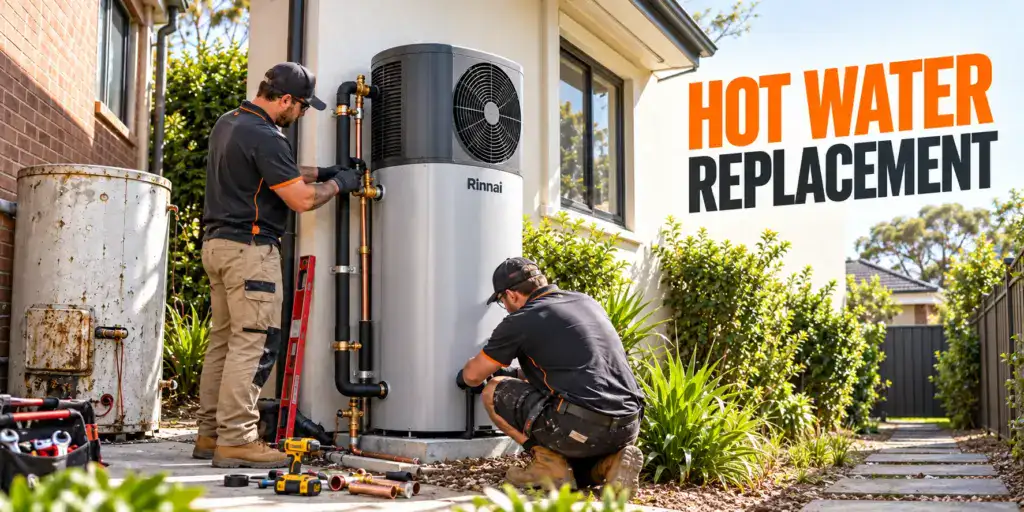
Hot water replacement means removing an existing water heater and installing a new system that suits your home’s hot water […]

For most people, buying a hot water system is only a priority when building a new home, moving in, or […]








Our energy efficiency experts are here to answer all your questions and guide you through the products, rebates, and installation process.

Upgrade now and pay later with the Home Energy Saver Program!