If you are a commercial property owner, facility manager or business operator in Australia, installing an energy-efficient commercial heat pump […]
Quick Answer
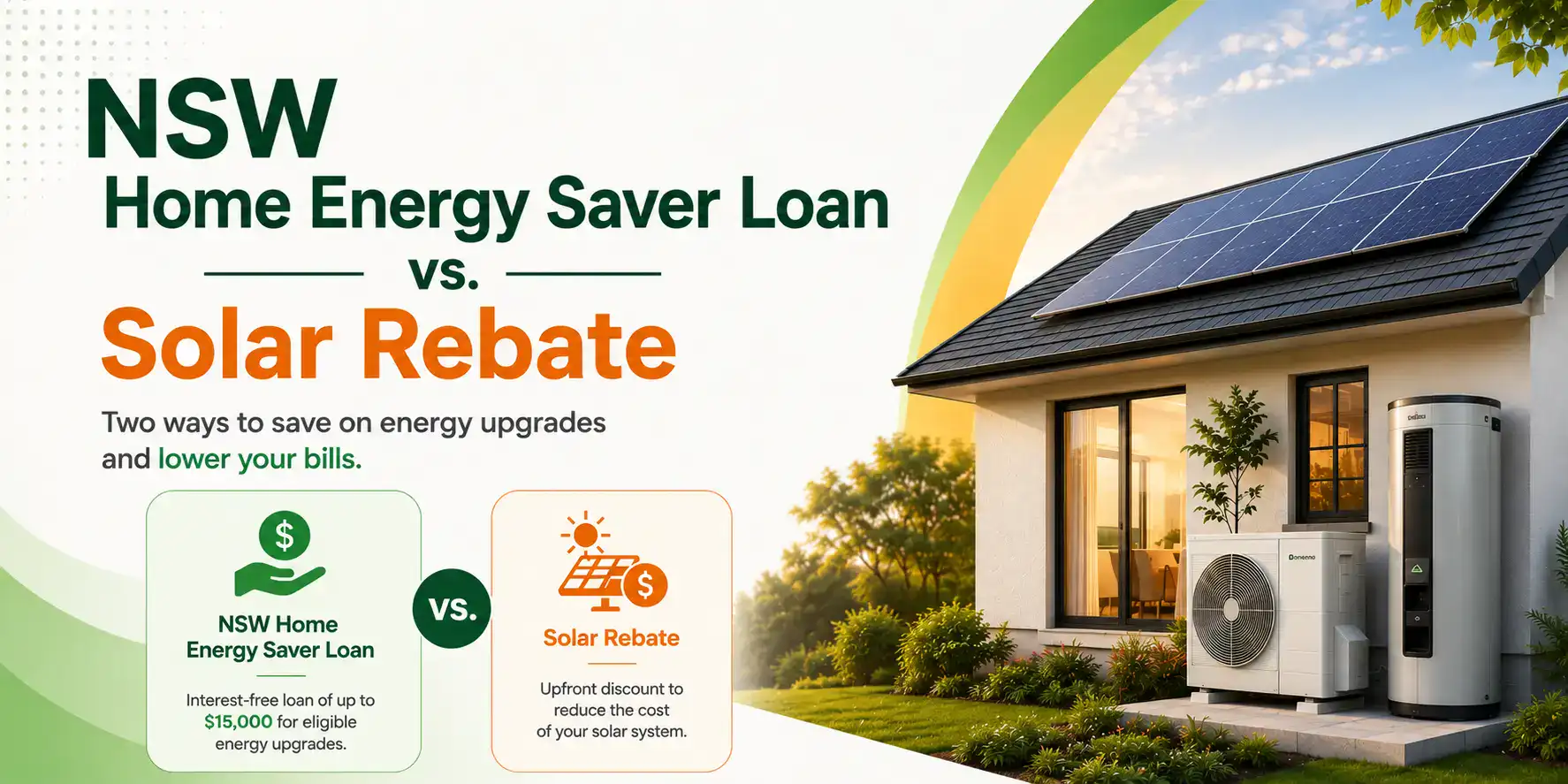
The main difference between the federal Small-scale Renewable Energy Scheme (SRES) and the NSW Home Energy Saver Loan is that the SRES provides an upfront discount through Small-scale Technology Certificates (STCs) to reduce the cost of eligible solar installations.
In contrast, the NSW Home Energy Saver program offers eligible households up to $4,000 off eligible energy upgrades and zero-interest loans of up to $15,000, repayable over up to 10 years. If eligible, you can combine the federal STC discount with both NSW incentives to lower your upfront costs and finance the remaining eligible expenses.
The NSW Home Energy Saver Loan is a NSW Government-funded finance program designed to reduce the upfront cost of eligible household energy upgrades. Eligible homeowners and landlords can apply for a zero-interest loan of up to $15,000, with repayments over a period of up to 10 years.
Loans are delivered through participating finance providers, currently Brighte and Plenti, which assess applications, manage repayments and confirm which products and suppliers they support. See the NSW Government’s loan eligibility and program guidelines.
Approved upgrades can include rooftop solar, home batteries, heat-pump hot water systems, solar water heaters, reverse-cycle air conditioning, induction cooktops, EV chargers, insulation, draught-proofing, window glazing and other eligible products. The exact products available depend on the program rules and the participating finance provider’s approved product and supplier network.
The loan is not a grant or a cash rebate. It must be repaid under the finance agreement, and you should not assume that every provider offers $0 setup fees, $0 account fees or a completely no-upfront-cost installation. Check the provider’s fees, required customer contribution and repayment terms before signing.
The core requirements include being an owner of the NSW property where the upgrade will be installed, being an Australian citizen or permanent resident, and meeting the combined taxable household income limit. From 10 November 2026, that income limit is $150,000 a year, reduced from $210,000.
Applications submitted before 10 November 2026 continue to be assessed against the previous $210,000 threshold, according to the NSW Government’s change announcement.
The finance provider also assesses the application and confirms product eligibility. Homeowners can receive one loan for their property, while landlords can receive one loan per property. Read the current NSW loan information and confirm the latest criteria with your chosen provider before applying.
What is often advertised as the “NSW solar rebate” is usually the Australian Government’s Small-scale Renewable Energy Scheme (SRES), which provides a financial benefit through tradable Small-scale Technology Certificates (STCs).
It is not a single fixed NSW cash rebate. For an eligible rooftop solar system, the installer or retailer will generally create and sell the STCs on your behalf, passing their value on as an upfront discount in your quote. The value depends on factors such as system size and location, and can change over time. See the Australian Government’s explanation of solar rebates and STCs.
To qualify, the system and installation must meet the SRES requirements, including applicable approved-product and installer accreditation rules. The federal STC incentive is not means-tested, but it is not automatically available for every system or installation. Ask your installer to show the STC discount separately in the quote.
| Feature | NSW Home Energy Saver Loan | Federal solar STC incentive |
| Financial type | Repayable zero-interest loan | Upfront discount from eligible STC value; not repaid |
| Maximum / value | Up to $15,000, subject to approval | Varies with system eligibility, size, location and certificate value |
| Repayment | Yes, over up to 10 years | No repayment of the STC discount |
| Coverage | Multiple approved home energy upgrades | Eligible small-scale renewable energy systems, including rooftop solar and eligible hot-water systems |
| Income limit | $150,000 combined taxable household income for applications from 10 November 2026 | No household income test for the federal STC scheme |
| Approval | Finance provider eligibility and credit assessment apply | System, product and installer must meet scheme requirements |
Yes. Eligible households can combine the NSW Home Energy Saver discount and zero-interest loan for the same project, provided they qualify for both.
The discount provides up to $4,000 off eligible energy-saving upgrades. If the project costs more than the discount covers, you can apply for a zero-interest loan of at least $2,000 and up to $15,000 to cover the remaining cost, subject to finance provider approval.
You must apply for the discount first through Creditex. Applying for the loan first means you cannot subsequently use the Home Energy Saver discount for the same purchase. For example, if you receive a $4,000 discount on a $10,000 upgrade, you can apply for a loan to help cover the remaining $6,000. However, you must make the required customer contribution.
The program also allows eligible Home Energy Saver products to be combined with other government incentives for additional savings. See the NSW Government’s Home Energy Saver guidelines for full eligibility and application requirements.
A separate federal incentive may also apply if you install an eligible home battery connected to new or existing solar PV. The Cheaper Home Batteries Program is delivered through battery STCs and is separate from both the NSW Home Energy Saver Loan and the solar PV STC calculation. Under the rules that took effect on 1 May 2026, eligible battery systems generally need to have 5–100 kWh nominal capacity, with STCs calculated on up to the first 50 kWh of usable capacity.
The discount is not a fixed amount for every battery and changes according to system capacity and installation date. Check the Australian Government’s current battery program eligibility rules before relying on an estimated discount.
They provide different types of financial benefit, so one does not automatically save more than the other. The STC incentive reduces the purchase price of an eligible solar system and does not need to be repaid. The Home Energy Saver Loan helps spread the remaining cost of approved upgrades over time without interest, but the principal still has to be repaid. If you add a battery, the separate federal battery incentive may reduce its upfront cost if the system qualifies.
Your actual savings will depend on the system price, incentives available, your electricity use, self-consumption, export rates, loan repayments and any applicable fees or customer contribution. Compare the full installed price and the net amount payable—not just the advertised rebate or monthly repayment.
The Home Energy Saver Loan may suit you if you own an eligible NSW property, meet the income and residency requirements, pass the finance provider’s assessment and want to spread the cost of approved upgrades. It can be useful for a broader home energy upgrade, such as solar with a battery, heat-pump hot water or reverse-cycle air conditioning, subject to the provider’s product list and loan limit.
The federal STC incentive applies to eligible solar installations regardless of household income. It can suit homeowners who have the funds available and want the certificate value deducted from the system price without taking out a loan. Unlike a finance application, STC eligibility is based on the system and installation requirements, not a household income or credit assessment.
You may not need to choose between the two. Eligible households can potentially use the federal solar STC discount to reduce the upfront price of an eligible solar system and use a NSW Home Energy Saver Loan to finance an approved remaining cost. Some households may also qualify for the separate NSW discount of up to $4,000, which must be applied for first when combining it with a loan for the same purchase. Eligibility, product approval, customer contributions and provider terms apply. Check the NSW Home Energy Saver program and the Australian Government’s solar incentive guidance before committing to an upgrade.
If you are a commercial property owner, facility manager or business operator in Australia, installing an energy-efficient commercial heat pump […]
Home batteries can help households store excess rooftop solar for use in the evening, reduce reliance on grid electricity and […]
Air conditioning rebates in New South Wales are often misunderstood. Many people assume they work like traditional government grants: apply, […]
Managing the heat in New South Wales can be a struggle, especially when power bills start to rise. Air conditioning […]
Our energy efficiency experts are here to answer all your questions and guide you through the products, rebates, and installation process.

Upgrade now and pay later with the Home Energy Saver Program!