
For Sydney homeowners wanting to replace an old electric or gas hot water system, a heat pump can provide a […]


Quick Answer
Reclaim is the better heat pump brand if you’re looking for premium performance, maximum energy efficiency, and excellent cold-weather operation. Its CO₂ refrigerant, advanced solar controls, and top-down heating technology make it an excellent choice for homeowners who want to maximise long-term energy savings.
Rinnai is the better choice if you’re looking for a more affordable heat pump without compromising on reliability. Its range combines strong performance, smart controls, quiet operation, and competitive pricing, making it an excellent all-round option for most Australian households.
| Feature | Rinnai Heat Pumps | Reclaim Heat Pumps |
| Best for | Everyday households seeking value | Premium homes and solar users |
| System type | Split and integrated models | Split systems |
| Tank sizes | 180L, 250L, 265L, 300L, 315L, 340L and 400L | 160L, 250L, 315L and 400L |
| Refrigerant | R32 and R290 | CO₂ (R744) and R290 (depending on the model) |
| Energy efficiency | Uses up to 75% less energy than a standard electric storage water heater | COP exceeding 5 under suitable operating conditions |
| Electric booster | Inbuilt electric boost element on selected models | No electric boost element required during normal operation |
| Noise level | From 45dB(A) | Around 37dB |
| Smart controls | Built in Wi-Fi with Rinnai Link App or SmartLife App (model dependent) | Smart Controller with optional Wi-Fi and Reclaim App |
| Cold weather | Operates in temperatures from -10°C to 45°C (model dependent) | Excellent cold-weather performance with built-in frost control |
| Warranty | 7 to 10-year cylinder, 5-year compressor | Up to 15-year tank and up to 10-year heat pump |
| Government rebates | Eligible for Federal STCs plus applicable VIC and NSW rebates | Federal and State programs – including STCs, VEECs, and ESCs |
NOTE: Warranty depends on the selected tank and system configuration.
Both Rinnai and Reclaim heat pumps are significantly more efficient than conventional electric storage water heaters, but they achieve their performance in different ways.
Rinnai states that its heat pump range can use up to 75% less electricity than a standard electric storage water heater.
Reclaim, on the other hand, claims its CO₂ heat pumps have a Coefficient of Performance (COP) exceeding 5, meaning they can produce more than five units of heat energy for every unit of electricity consumed under suitable operating conditions.
Combined with its top-down heating technology, this allows reclaim systems to deliver excellent efficiency while maintaining a consistent supply of hot water.
So, if maximum efficiency is your priority, Reclaim has the edge. However, Rinnai still offers substantial energy savings and represents excellent value for most households.
The refrigerant used inside a heat pump plays an important role in its efficiency, environmental impact, and cold-weather performance.
Rinnai offers heat pumps using both R32 and R290 refrigerants, depending on the model. R32 has been used in the Enviroflo S 5kW range, while newer models such as the Enviroflo S 7kW, AR Series, and GR Series use high-efficiency R290 refrigerant.
Reclaim’s flagship systems are best known for using natural CO₂ (R744) refrigerant, which delivers excellent cold-weather performance and high efficiency. However, the brand also offers selected models that use R290 refrigerant. Both CO₂ and R290 are natural refrigerants with very low global warming potential, making them environmentally friendly choices.
One of the biggest differences between the two brands is how they maintain hot water during periods of high demand.
Many Rinnai heat pumps include an inbuilt electric boost element. So, if household demand exceeds the heat pump’s recovery rate or weather conditions reduce heating performance, the electric element automatically assists to ensure hot water remains available. While this improves reliability, the system uses more electricity whenever the boost element operates.
Reclaim takes a different approach. Rather than relying on an electric immersion element during normal operation, it uses its high-efficiency CO₂ compressor and top-down heating design to recover hot water quickly.
The system also includes a One Shot Boost function through its controller, allowing homeowners to rapidly heat water on demand without depending on a conventional electric boost element.
That said, Reclaim offers a more efficient solution for households wanting to minimise direct electric heating. Rinnai, however, provides extra peace of mind for families with unpredictable hot water demand.
Both manufacturers offer durable storage tanks, but Reclaim provides greater flexibility.
Rinnai offers Australian-made vitreous enamel storage tanks across its range, with capacities from 180L to 400L depending on the model. Some models are available with standard or hard-water anodes to suit different water conditions and help extend tank life.
Reclaim offers a choice between glass-lined enamel and stainless steel tanks. Stainless steel tanks require less maintenance because they do not use sacrificial anodes and are suitable for most metropolitan water supplies.
Glass-lined tanks are better suited to areas with hard or high-mineral water and include a sacrificial anode for additional corrosion protection.
If you want more flexibility when choosing a storage tank, Reclaim offers more options. Rinnai, however, provides durable Australian-made tanks backed by strong warranty support.
Rinnai heat pumps are designed to operate in ambient temperatures ranging from -10°C to 45°C, with selected models featuring anti-frost protection to maintain reliable performance during colder weather. They perform well across most Australian climate zones and are suitable for the vast majority of households.
Reclaim has built its reputation on outstanding cold-weather performance. Its CO₂ refrigerant continues to extract heat efficiently even in very low temperatures, while built-in frost control helps maintain reliable operation throughout winter. Because of its efficient compressor and heating design, the system does not normally require an electric boost element during cold conditions.
If you’re a homeowner living in alpine regions or southern parts of Australia where winter temperatures regularly drop below freezing, Reclaim offers a clear advantage. For milder climates, both brands deliver dependable year-round performance.
If minimising noise is a priority, Reclaim is the better choice, although Rinnai also offers quiet operation suitable for most homes.
Rinnai heat pumps operate from approximately 45dB(A), depending on the model. This is comparable to the sound of a modern dishwasher or a quiet conversation and is suitable for most residential installations.
Reclaim operates at an average of 37dB, making it exceptionally quiet. The low operating noise makes it particularly well-suited to homes where the outdoor unit is installed close to bedrooms, outdoor entertaining areas, or neighbouring properties.
Both brands offer excellent smart controls, but Reclaim stands out with more advanced scheduling, energy management, and solar integration features.
Reclaim Heat Pump Smart Features
Rinnai Heat Pump Smart Features
Recovery rate determines how quickly a heat pump reheats water after heavy household use.
Rinnai’s recovery performance varies across its range depending on the model, tank size, and heating capacity. The larger 7.0kW models naturally recover faster than smaller units, making them suitable for households with higher hot water demand.
Reclaim uses a top-down heating system, where heated water is returned directly to the top of the storage tank instead of heating the entire tank from the bottom. This allows usable hot water to become available sooner after large water draws. The systems are capable of recovering approximately 110 litres of hot water per hour, helping to maintain a steady supply for larger households.
So, for families with high daily hot water usage, Reclaim generally offers faster recovery and improved availability between showers.
When comparing Rinnai and Reclaim warranties, the main differences are the length of coverage and the components included.
Rinnai
Reclaim
Both Rinnai and Reclaim heat pump hot water systems qualify for Australian government energy-efficiency incentives, helping to reduce the upfront installation cost.
Eligible systems from both brands can receive Federal Small-scale Technology Certificates (STCs) under the Renewable Energy Target.
Homeowners in Victoria may also qualify for Victorian Energy Efficiency Certificates (VEECs), while eligible installations in New South Wales can receive Energy Savings Certificates (ESCs) and Home Energy Saver interest-free loans.
The Available incentives vary depending on your location, the model installed, and the accredited installer.
The better brand depends on your budget, household needs, and long-term priorities.
Both Rinnai and Reclaim offer excellent heat pump hot water systems, but they cater to different types of homeowners.
Rinnai is the better choice if you want a reliable, energy-efficient heat pump that delivers excellent value for money. Its broad product range, competitive pricing, quiet operation, built-in Wi-Fi on many models, and eligibility for government rebates make it a practical option for most Australian households.
Reclaim is designed for homeowners who are willing to pay more for premium features. Its advanced refrigerant technology, outstanding cold-weather performance, faster hot water recovery, intelligent energy management, and longer warranty make it an excellent choice for those looking to maximise long-term efficiency and solar savings.
If you’re looking for the best balance of price, performance, and everyday practicality, Rinnai is the better buy. If you’re happy to invest more upfront for premium technology and the lowest possible long-term running costs, Reclaim is the better choice.
For Sydney homeowners wanting to replace an old electric or gas hot water system, a heat pump can provide a […]

If you own or rent a property in NSW, you can make eligible home energy upgrades without paying the full […]
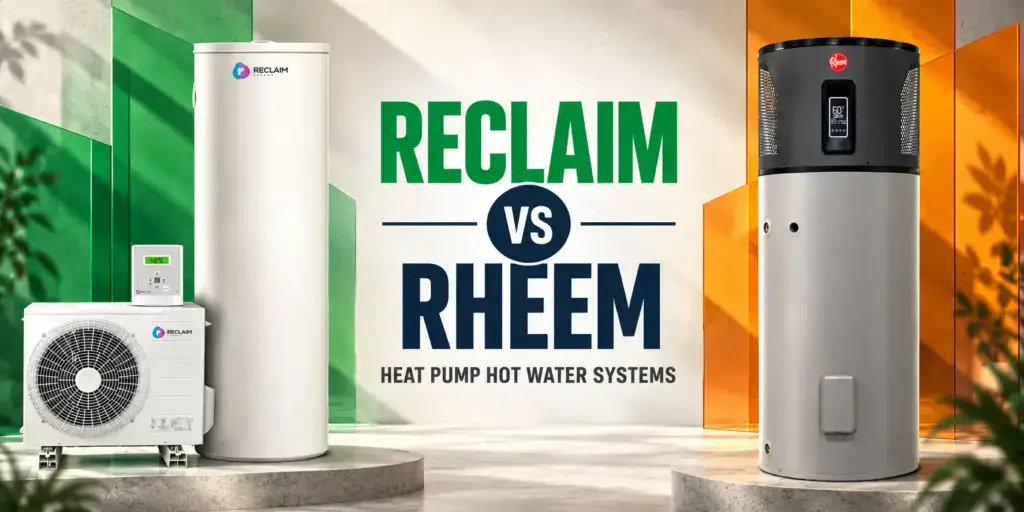
Quick Answer If you are choosing between Reclaim and Rheem, the better option depends on what matters most to you. […]
Quick Overview If you are a commercial property owner, facility manager, or business operator in Australia and plan to install […]



Our energy efficiency experts are here to answer all your questions and guide you through the products, rebates, and installation process.

Upgrade now and pay later with the Home Energy Saver Program!