

Sydney homeowners are seeking ways to reduce their power bills. With the sun beating down on New South Wales, the […]


Key takeaway:
For most Sydney homes, a split system heat pump hot water unit is the better long-term choice if noise, tight space, apartment living, or colder Western Sydney nights are a concern.
An all-in-one unit is usually cheaper and easier to install, making it a good option when you have plenty of outdoor space, a lower budget, and no nearby bedrooms or neighbours to worry about.
Sydney homeowners are often shocked when they see bills ranging from $3,000 to $6,000 for a new hot water system setup. Most people don’t even realise that there are two entirely different ways to build these systems. Making the wrong move here is a massive headache. It leads to noise complaints from the folks next door or huge installation fees you didn’t see coming.
The choice between a split system and an integrated unit really hits on three main points.
This guide sorts through that noise so you can talk to your plumber without feeling lost.
Most people looking for a heat pump just see a tank. They don’t realise the “engine” can be in different spots. That changes how it fits into your daily life.
In an integrated setup, the compressor and the storage tank live together in one tall cabinet. The mechanical heart sits right on top of the water tank. It looks like a slightly thicker version of those old electric heaters. Since everything is in one piece, it has a tidy footprint, but it is quite tall and heavy.
This design works well if you have plenty of height but not much floor space. Because it is a self-contained tower, you don’t have extra pipes running across your exterior walls. It is a simple solution that fits into most outdoor utility gaps without much fuss.
Keep in mind that if a small part breaks, the whole unit usually needs a look. Everything is packed so tightly that some technicians find them a bit more annoying to fix compared to separate parts. It is compact, but that comes with its own trade-offs.
A split system breaks things apart. You have a storage tank and a separate compressor unit that looks like a small air conditioning fan box. The tank can hide inside a laundry or garage, while the compressor sits outside where it can grab fresh air. They connect via pipes carrying refrigerant or water.
This separation is why people love them. You can mount the compressor on a wall bracket way up high or hide it behind the garden shed. Meanwhile, the water tank stays safe from the sun and rain, which often helps the tank stay in good shape for longer.
It is usually the top pick for modern renovations. You aren’t stuck with a giant white cylinder blocking your patio view. It lets you keep your outdoor area looking clean while the heavy lifting happens elsewhere.
To keep it simple: an integrated unit is like an iMac—it is all in one box. A split system is like an old-school desktop PC where the tower sits under the desk, and the monitor is on top. Both do the same job of pulling heat from the Sydney air to warm your water; they just take up space in different ways.
Let’s be real about the money. There is a big difference in the quote you get for these two types.
Integrated units are usually cheaper to buy. Since the factory builds everything into one frame, they use less piping and fewer valves. For a Sydney plumber, these are often a “drop-in” swap for an old electric tank. You pull the old one out, slide this one in, hook it up, and you’re eating dinner while it heats.
This lower price makes them very popular for rentals or if you’re watching every cent. If your pipes are already set for a vertical tank, the work is fast. Most crews can finish the job in a few hours without needing three different specialists on-site.
Just don’t forget that “cheaper” isn’t always the best long-term play. While you save money on day one, you want the system to last. Some budget all-in-one models have much shorter warranties than the high-end split systems.
Split systems cost more for a few reasons. The hardware is built tougher to handle being separated. Also, the install takes way more effort. A plumber has to mount the compressor, secure the tank, and run lines between them.
You might find that these need a more complex electrical plan, too. Because power has to reach the tank and the outdoor fan, your spark might spend more time running wires. This is a “hidden” cost you should ask about before you sign anything.
Even with the higher price, many find the investment is worth it. Being able to put the unit exactly where you want it often makes up for that extra thousand dollars. It gives you back your yard space.
This is the main reason Sydney homeowners end up hating their purchase. We live on top of each other. In places like Marrickville or Surry Hills, your neighbour’s window is right there.
With an integrated unit, the motor sits right on the tank. If that tank is bolted to the wall outside your bedroom, you’ll hear a hum. Modern units are quieter now, but the vibration stays in one spot.
If your house has thin walls, that shaking can actually travel through the frame. It isn’t just the wind from the fan; it’s a physical thrum. This is why where you put an all-in-one model is so vital.
Most people don’t care during the day. But at midnight, when the street is dead quiet, and the unit kicks on to use off-peak power, that hum feels like a jet engine.
The best part of a split system is moving the noise. You put the tank where it’s easy for the pipes, but you put the noisy fan around a corner or behind a brick wall.
This is a lifesaver if you have sensitive ears or neighbours who like to complain. You can point the fan away from the house. By the time the sound reaches a window, it has mostly faded away.
It’s also easier to quiet down a split unit. Since it is just a small box, you can use rubber pads or a small screen to kill the noise. You can’t really do that with a three-meter-tall integrated tower.
Brochures always talk about “cold climate” performance. Usually, they mean Canberra winters. But Sydney has its own weird weather pockets.
If you live in Manly, it stays pretty warm. An integrated unit will do fine. But if you are out in Penrith or Richmond, winter nights hit zero fast.
In those cold spots, a heat pump has to work twice as hard. Some systems struggle and start to freeze up. This makes the unit run a “defrost” mode, which uses more power and means your water takes longer to get hot.
If you’re in a frost-prone suburb, you have to check the temp range. You don’t want a lukewarm shower just because it was a cold Tuesday in the West.
Split systems often use better gas (like CO2) that works way better when the air is freezing. Integrated units can struggle, often switching to a backup electric heater. That is when your power bill goes through the roof.
A CO2 split system can keep working even at -10°C. That is overkill for Sydney, but it means on a 5°C night, the system is barely under pressure. It stays efficient to run while other units start using far more electricity.
Think of it as a safety net for your wallet. You pay more now, but you won’t get those massive winter bills that make you regret the whole thing.
Where is your heater right now? That answer usually picks the system for you.
If your tank is in a big garage, an integrated unit is a winner. There are heaps of air, and the walls soak up the noise. It is a clean, simple way to do it.
Just make sure the garage isn’t airtight. These things blow out cold air to make the water hot. If there’s no airflow, the garage becomes a freezer, and the heater stops working well.
If your garage is tiny, you might hate the cold breeze when you’re getting into the car. In that case, a split system with the fan outside is the smarter move.
Don’t ever put an all-in-one unit in a small cupboard without a vent. It will ruin the room. A split system is perfect here. The tank stays in the cupboard, and the fan goes on the outside wall.
This is very common in new Sydney townhouses. It keeps the big tank out of sight but gives the engine the air it needs. It’s the best way to keep your home looking good inside.
Plus, if the tank leaks, it’s usually in a laundry with a drain. If an integrated unit fails on a balcony without good drainage, it can be a total mess for the people downstairs.
Not every brand is both. If you like a certain name, your choice might be made for you.
Names like Rheem, Stiebel Eltron, and Dux own this space. They are the workhorses. You can find parts for them in almost every plumbing shop in Sydney.
These companies have been around forever. If something breaks in five years, you’ll find a guy who can fix it. That kind of backup is worth a lot when you’re standing in a cold shower.
A lot of these brands give you a longer warranty if you use their specific installers. Check that fine print to see what you’re actually getting for your money.
Sanden and Reclaim Energy are the kings here. They use high-end compressors from Japan that are super quiet. EVOHEAT also makes great split units that handle the salty Sydney air well.
These brands are for people who want the best of the best. They are built for the long haul. The quality is usually a big step up from the base models.
Since they focus on split tech, their systems are tuned perfectly. You get hot water back much faster after the kids have all had their showers.
The NSW Government wants you to ditch gas. They are giving out big rebates to help you switch.
Both types usually get you STCs (rebate certificates). But the exact cash amount depends on how efficient the model is.
Since split systems are often more efficient, they can sometimes grab a few extra hundred dollars. It won’t cover the whole price jump, but it takes the sting out. It’s like a bonus for buying the better machine.
Check the NSW Energy Savings Scheme too. Some installers can stack these rebates to make the price look much better. Always ask for the final price after all the government help is taken off.
Still stuck? Here is the cheat sheet:
Choosing between a split system and an all-in-one heat pump isn’t just a technical decision — it shapes how your home sounds, looks, and performs every single day for the next decade.
Get it right, and you’ll barely think about your hot water system again. Get it wrong, and you’ll live with avoidable noise, awkward placement, or higher running costs.
If you’re unsure, it’s worth getting a proper site check before committing. A quick inspection of space, airflow, and noise exposure can save you from a long-term regret that’s expensive to undo later.
Sydney homeowners are seeking ways to reduce their power bills. With the sun beating down on New South Wales, the […]
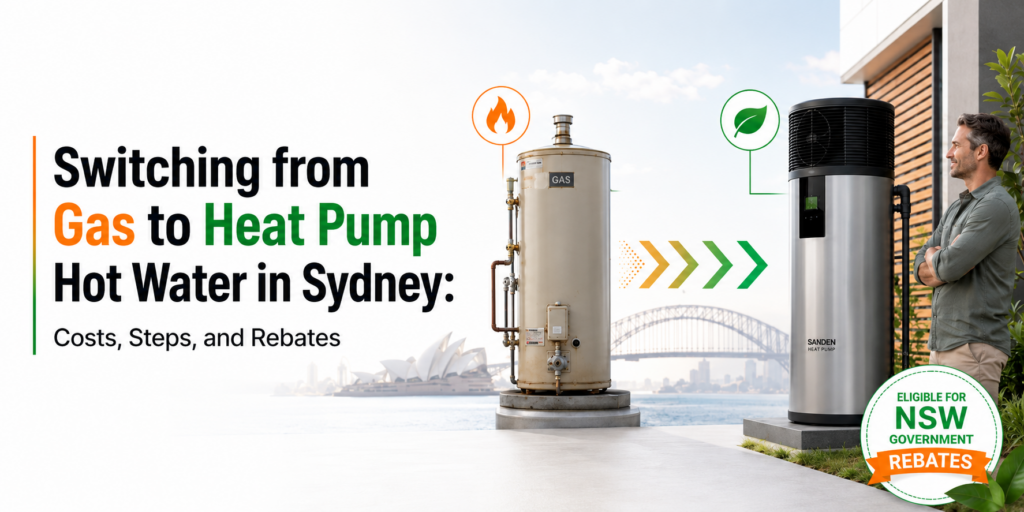
Swapping a gas hot water system to a heat pump is becoming a huge topic of conversation around Sydney dinner […]

Spending over $4,000 on a home appliance is a big deal. It is a commitment that makes most homeowners pause. […]

Let’s get straight to the point. You aren’t here for a lecture on thermodynamics or evaporation cycles. You’re here because […]








Our energy efficiency experts are here to answer all your questions and guide you through the products, rebates, and installation process.

Upgrade now and pay later with the Home Energy Saver Program!